

Patterns of brain activity predict people’s decisions up to 10 seconds before the people are aware of them, according to new research that casts fresh doubt on whether we have free will.
The ancient debate over free will centers on whether it’s an illusion to believe our thoughts and decisions are independent, since our brains really consist of atoms bouncing around according to their own rules. The new study suggests the questioning many be justified.
April 15, 2008
Courtesy Nature Journals
and World Science staff
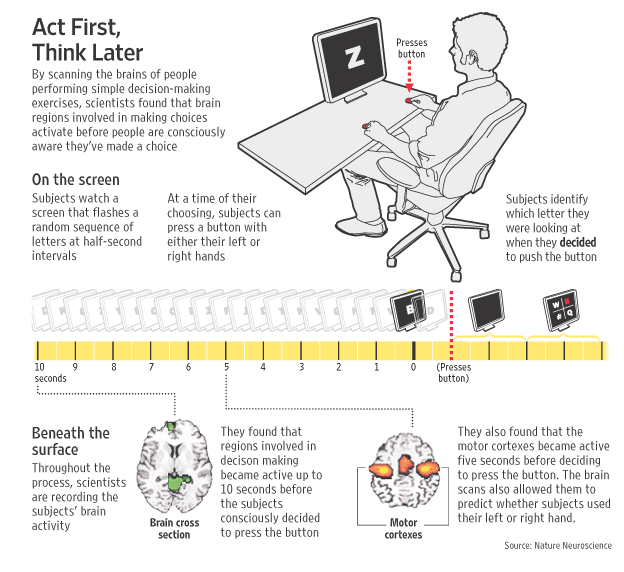
Infographic Source: http://www.nature.com/neuro/index.html
Researchers tracked brain activity while people viewed a stream of letters on screen, and then pressed a button. Each participant was asked to decide freely which of two buttons to press and when to press it.Scanning the brains with a technique called functional magnetic resonance imaging, the investigators used a statistical method known as pattern recognition to examine brain activity associated with each choice. Activity in two brain regions, called the prefrontal and parietal cortex, predicted which button the person would press, they found. These areas have previously been linked to self-reflection, selection amongst choices and executive control.This activity occurred up to 10 seconds before subjects were consciously aware of having made a decision, according to the researchers. The findings, they added, suggest high-level control areas start to prepare an upcoming decision long before it enters conscious awareness. The study, by John-Dylan Haynes of the Max Planck Institute for Human Cognitive and Brain Sciences in Leipzig, Germany and colleagues, is published online this week in the research journal Nature Neuroscience.