
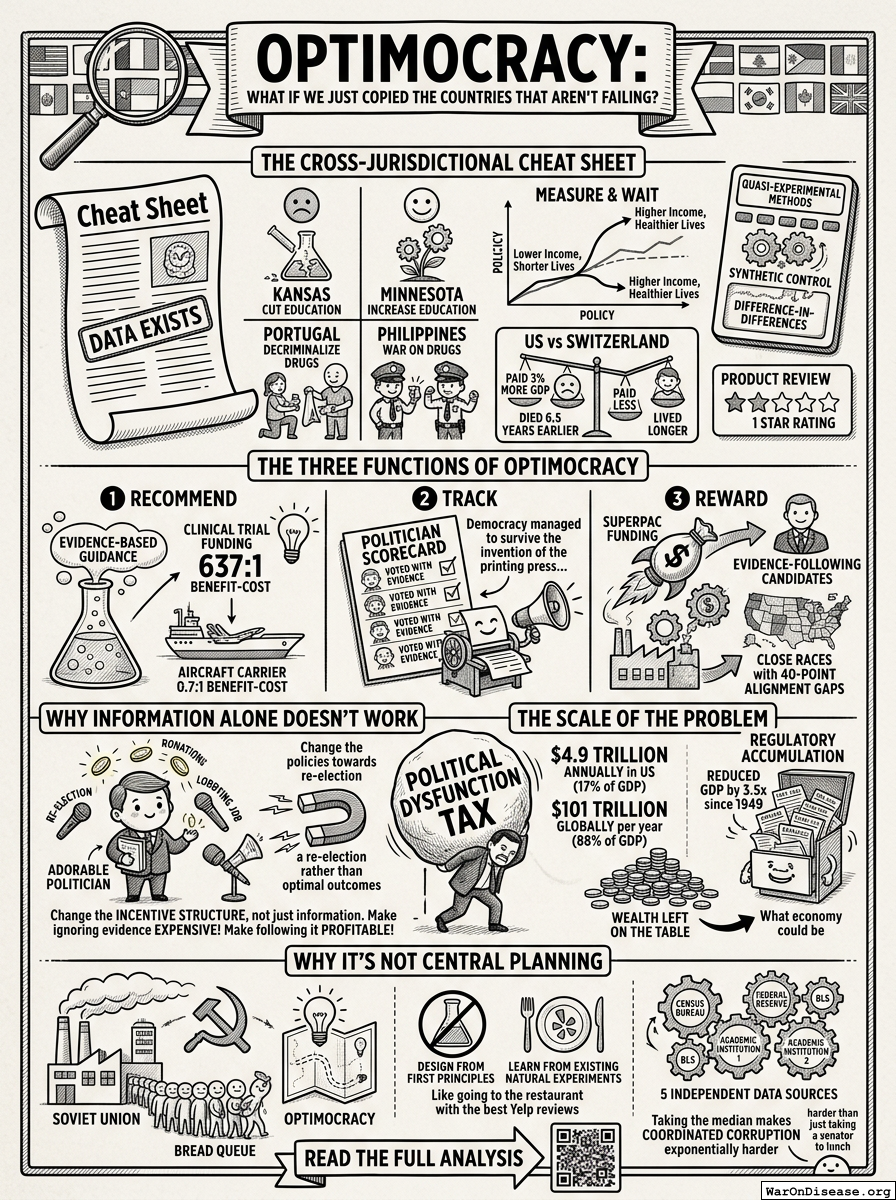
The Radical Idea of Looking at What Works
Every year, thousands of governments around the world make different policy decisions. Kansas cuts education; Minnesota increases it. Portugal decriminalises drugs; the Philippines wages war on them. Norway invests its oil revenue; Nigeria doesn't. These aren't thought experiments—they're real, running, measurable experiments happening constantly across every jurisdiction on Earth.
Optimocracy proposes an idea so obvious that it's genuinely astonishing nobody's implemented it: look at which policies produced the best outcomes, and then do those ones.
I know. Groundbreaking.
The Cross-Jurisdictional Cheat Sheet
When Kansas cut its education budget and Minnesota increased theirs, we didn't need to run a randomised controlled trial to find out what happened. We just needed to wait and measure. Did Kansas get richer? Did Minnesota get healthier? The data exists. It's been sitting there for decades, like a cheat sheet that everyone's too proud to look at.
The approach uses quasi-experimental methods—synthetic control, difference-in-differences, regression discontinuity—which are fancy statistical techniques for answering the question "what would have happened if they'd done the other thing?" It's like a choose-your-own-adventure book, except instead of being eaten by a dragon, the bad ending is that your citizens die six years earlier than the Swiss.
Speaking of which: the United States spends 3 percentage points more of GDP on government than Switzerland, and yet Americans live 6.5 fewer years. They pay more, get less, and die sooner. If this were a product review, it would be one star.
The Three Functions of Optimocracy
1. Recommend: Before every major vote, publish evidence-based guidance. "The data suggests that increasing pragmatic clinical trial funding has a 637:1 benefit-cost ratio. The data also suggests that building another aircraft carrier has a 0.7:1 ratio. Just thought you'd like to know."
2. Track: Record how each politician voted relative to the recommendations, and publish the results. Publicly. This is not complicated—it's a spreadsheet. Democracy managed to survive the invention of the printing press; it can probably survive the invention of the scorecard.
3. Reward: A SuperPAC funds candidates who follow the evidence and opposes those who don't. Money flows where the alignment gaps are largest and the races are winnable—close races with 40-point alignment gaps get priority over safe seats where the result is predetermined.
Why Information Alone Doesn't Work
You might think that if politicians just knew what the data said, they'd do the right thing. This is adorable. Politicians know perfectly well what the data says. They also know that following the data doesn't get you re-elected, doesn't attract campaign donations, and doesn't get you a cushy lobbying job after you leave office.
The insight of Optimocracy is that you need to change the incentive structure, not the information. Make ignoring evidence expensive. Make following it profitable. Politicians optimise for re-election, campaign contributions, and post-office prospects. Fine. Make all three of those things correlate with good policy, and watch as politicians suddenly discover their deep personal commitment to evidence-based governance.
The Scale of the Problem
The Political Dysfunction Tax—the gap between current and optimal governance—costs $4.9 trillion annually in the US alone (17% of GDP). Globally, it's $101 trillion per year, which is 88% of current GDP. We are leaving almost as much wealth on the table as we're actually producing.
Regulatory accumulation alone may have reduced GDP by 3.5x since 1949. That means the economy could be three and a half times larger if the government had simply stopped adding regulations at some point in the last seventy years. Not removed all regulations—just stopped adding new ones after a certain point. The equivalent of saying "actually, I think this filing cabinet is full enough."
Why It's Not Central Planning
The Soviet Union also thought it could optimise the economy from the centre. It was wrong, spectacularly, in a way that involved bread queues and the collapse of a superpower. Optimocracy avoids this by never designing anything from first principles. Instead, it learns from thousands of existing natural experiments.
It's the difference between trying to design the perfect recipe in a laboratory and simply going to the restaurant with the best Yelp reviews. You don't need to understand the chemistry of soufflé. You just need to notice that the French make better ones than the Americans, and then ask the French what they're doing differently.
The verification architecture uses five independent data sources reporting median income and healthy life years. Taking the median across all five makes coordinated corruption exponentially harder than current lobbying capture. You'd need to corrupt the Census Bureau, the Federal Reserve, the Bureau of Labor Statistics, and two academic institutions simultaneously, which is a lot harder than just taking a senator to lunch.
Comments