
Democracy, But Make It Actually Work
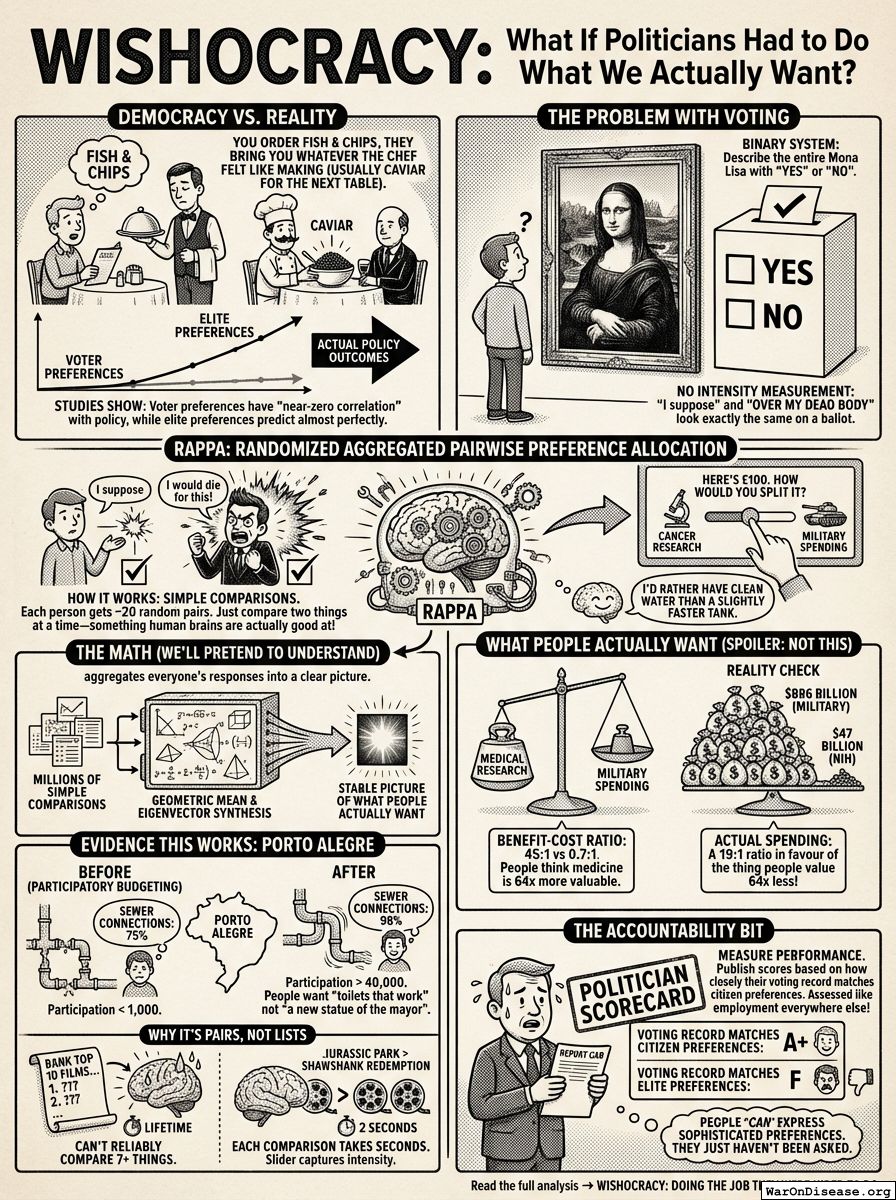
Democracy is a system where the people choose their leaders, and then the leaders do whatever they were going to do anyway. Studies show that voter preferences have a "near-zero correlation" with actual policy outcomes, while elite preferences predict policy almost perfectly. It's like a restaurant where you order fish and chips and the waiter brings you whatever the chef felt like making, which is always caviar for the table next to yours.
Wishocracy proposes fixing this with something called RAPPA—Randomized Aggregated Pairwise Preference Allocation. It sounds like a Japanese appetizer, but it's actually a way of finding out what people want by asking them, and then doing it. Revolutionary stuff.
The Problem with Voting
Current voting is binary. You get one tick, one box, one chance to express the full complexity of your political preferences. It's like being asked to describe the entire Mona Lisa using only the word "yes" or "no." "Is it... good?" "Yes." "Great, we'll go with that."
This means that someone who mildly prefers candidate A over candidate B has exactly the same electoral impact as someone who would literally throw themselves in front of a bus for candidate A. The system can't tell the difference between "I suppose" and "I would die for this," which is quite a significant design flaw.
How RAPPA Works
Instead of voting for candidates, citizens answer simple questions like: "Here's £100. How would you split it between cancer research and military spending?"
That's it. No manifestos, no attack ads, no trying to figure out which of the 847 things a politician promised they'll actually do. Just a slider, a pair of options, and your honest gut reaction.
Each person gets about 20 of these comparisons, randomly assigned from a big list of priorities. You don't need to rank everything—you just need to compare two things at a time, which is something human brains are actually good at. We can easily say "I'd rather have clean water than a slightly faster tank." We're less good at ranking 200 policy priorities simultaneously, which is why we currently don't, and which is why defence gets $886 billion while the NIH gets $47 billion.
The maths aggregates everyone's responses using something called a geometric mean and eigenvector synthesis, which are words I'm going to pretend I understand and you should probably pretend too. The point is: millions of simple comparisons converge into a stable picture of what people actually want.
What People Actually Want (Spoiler: Not This)
When researchers actually ask people to allocate resources between medical research and military spending, citizens assign a 45:1 benefit-cost ratio to medical research versus 0.7:1 for military spending. People think medicine is about 64 times more valuable than missiles.
And yet. Military spending: $886 billion. NIH: $47 billion. That's a 19:1 ratio in favour of the thing people think is 64 times less valuable. It's as if you told your financial advisor you wanted to invest in renewable energy and they put everything in a coal mine and then charged you a management fee.
Evidence This Works: Porto Alegre
In Porto Alegre, Brazil, they tried participatory budgeting—letting citizens actually decide where the money goes. Participation grew from fewer than 1,000 to over 40,000 people per year. And the results? Sewer connections went from 75% to 98%. It turns out that when you ask people what they want, they say "toilets that work" rather than "a new statue of the mayor."
This is somehow a controversial finding.
Why It's Pairs, Not Lists
Humans can reliably compare 2 things. We cannot reliably compare 7 or more things simultaneously—this is well-established cognitive science. Try ranking your top 10 films in order. Now try deciding whether Jurassic Park is better than The Shawshank Redemption. See? The second one took about two seconds. The first one would take you the rest of your life and you'd change your mind halfway through.
RAPPA works with the brain instead of against it. Each comparison takes seconds. The slider captures intensity—a 90:10 split means you really care; a 55:45 split means you're a bit ambivalent. This information currently gets completely lost in elections where "I suppose" and "over my dead body" look exactly the same on a ballot.
The Accountability Bit
Here's where it gets interesting. Once you know what people actually want—expressed in precise, quantifiable, comparable terms—you can measure how well politicians deliver it. You can literally score each legislator on how closely their voting record matches citizen preferences, and then publish the scores.
Politicians would be assessed the way we assess everything else: by whether they did the job they were hired to do. Which, come to think of it, is how employment works everywhere except government.
Stanford research found that voters showed "strong intuition for proportional representation" when given slider and ranking methods. People can express sophisticated preferences. They just haven't been asked. It's like complaining that nobody RSVPs to your party when you never sent the invitations.
Comments