
The War on Drugs is called a "war" because wars are traditionally things you can win. This one is different.
The Math Is Simple
Every minute someone is arrested for simple drug possession in the United States. In 2011, marijuana possession arrests totaled 663,032. That's 663,032 people arrested for possessing a plant. The annual cost of arresting and incarcerating hundreds of thousands of people for marijuana possession is $10 billion. These arrests are often for small quantities for personal use.
$10 billion is bigger than $0. This has been verified using a calculator.
The government extracts tens of thousands of dollars annually from working Americans to fund corporate welfare, foreign military occupations, and imprisoning people for possessing substances. This policy demonstrably increases human suffering while decreasing the amount of money available to organizations that demonstrably reduce it. It's a perfect inversion of stated goals.
If someone told you they were spending $10 billion per year to accomplish nothing, you'd suggest they stop. But that person has a badge and a gun, so here we are.
Statistical Trickery
The 2012 National Drug Control Strategy admits that "the War on Drugs is an utter failure." Then it requests more funding. This is called "failing upward" and it's how government budgets work.
Here's how the government spent money in 2012:
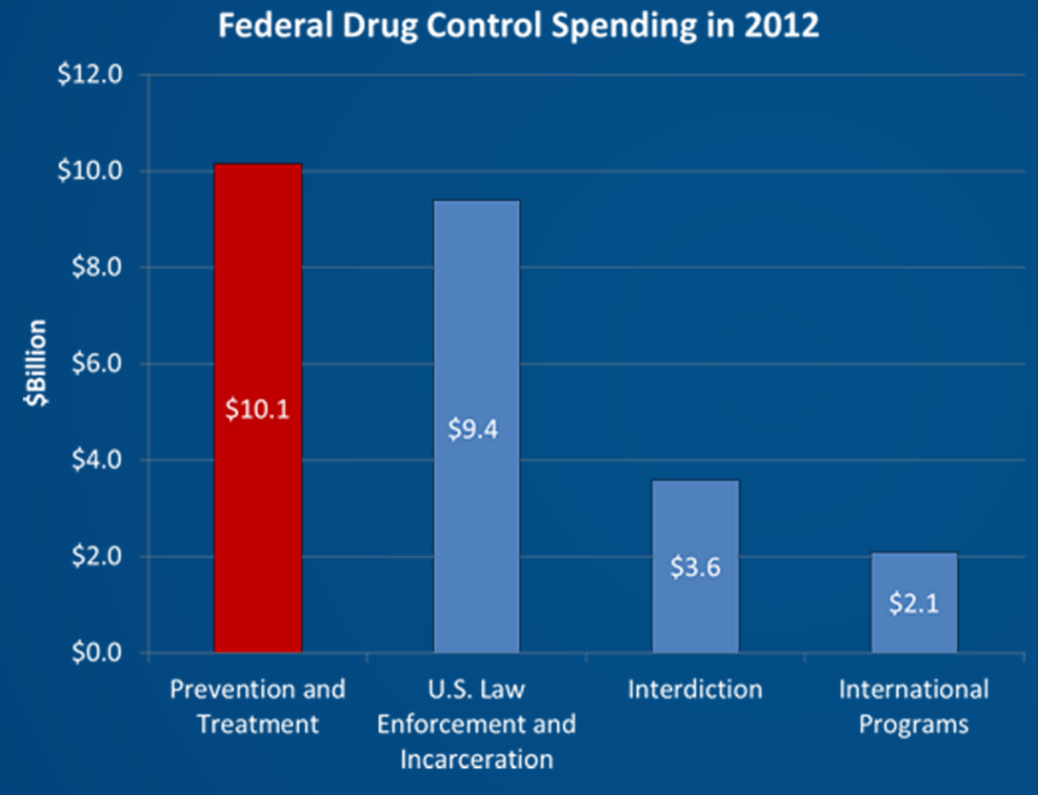
That graph suggests spending more on prevention and treatment than on law enforcement and incarceration. However, to produce this appearance, "Interdiction" and "International Programs" are separated from the "Law Enforcement and Incarceration" bar. This is called "creative accounting" and is illegal when regular people do it.
In reality, the government spends 50% more on law enforcement and incarceration than on prevention and treatment. Here's a less deceitful version:
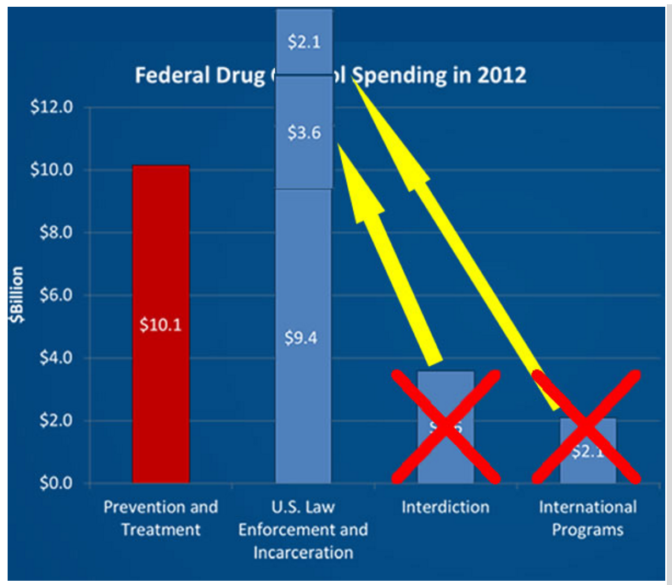
The difference between the two graphs is the difference between "what we say we're doing" and "what we're actually doing." Most organizations try to minimize this gap. The federal government maximizes it.
$1.5 Trillion for Zero Results
The money isn't even having any impact on illicit drug use levels. Addiction rates are at exactly the same level they were before $1.5 trillion was spent on "drug control measures."
$1.5 trillion dollars. Zero change in addiction rates. This requires third-grade arithmetic to understand, so the confusion is notable.

Addiction Rate and US Drug Control Spending
Source: http://www.mattgroff.com/questions-on-the-1315-project-chart/
If you spent $1.5 trillion on literally anything else—lottery tickets, Beanie Babies, a giant pile of cash that you set on fire—at least you'd have the satisfaction of watching it burn. This policy doesn't even provide that.
The line on the graph labeled "Drug Control Spending" goes up. The line labeled "Addiction Rate" stays flat. When one line going up doesn't make another line go down, that's called "not working." The government calls it "we need more funding."
The Constitutional Issue
The 10th Amendment states that powers not granted to the federal government by the Constitution, nor prohibited to the States, are reserved to the States or the people. This is sometimes called "the amendment everyone pretends doesn't exist."
Here are the powers granted to the federal government by Article 1, Section 8 of the Constitution:
- The Congress shall have Power To lay and collect Taxes, Duties, Imposts and Excises, to pay the Debts and provide for the common Defence and general Welfare of the United States; but all Duties, Imposts and Excises shall be uniform throughout the United States;
- To borrow Money on the credit of the United States;
- To regulate Commerce with foreign Nations, and among the several States, and with the Indian Tribes;
- To coin Money, regulate the Value thereof, and of foreign Coin, and fix the Standard of Weights and Measures;
- To provide for the Punishment of counterfeiting the Securities and current Coin of the United States;
- To establish Post Offices and post Roads;
- To promote the Progress of Science and useful Arts, by securing for limited Times to Authors and Inventors the exclusive Right to their respective Writings and Discoveries;
- To constitute Tribunals inferior to the supreme Court;
- To define and punish Piracies and Felonies committed on the high Seas, and Offences against the Law of Nations;
- To declare War, grant Letters of Marque and Reprisal, and make Rules concerning Captures on Land and Water;
- To raise and support Armies, but no Appropriation of Money to that Use shall be for a longer Term than two Years;
- To provide and maintain a Navy;
- To make Rules for the Government and Regulation of the land and naval Forces;
- To provide for calling forth the Militia to execute the Laws of the Union, suppress Insurrections and repel Invasions;
- To provide for organizing, arming, and disciplining, the Militia, and for governing such Part of them as may be employed in the Service of the United States, reserving to the States respectively, the Appointment of the Officers, and the Authority of training the Militia according to the discipline prescribed by Congress;
- To exercise exclusive Legislation in all Cases whatsoever, over such District (not exceeding ten Miles square) as may, by Cession of Particular States, and the Acceptance of Congress, become the Seat of the Government of the United States, and to exercise like Authority over all Places purchased by the Consent of the Legislature of the State in which the Same shall be, for the Erection of Forts, Magazines, Arsenals, dock-Yards and other needful Buildings
- To make all Laws which shall be necessary and proper for carrying into Execution the foregoing Powers and all other Powers vested by this Constitution in the Government of the United States, or in any Department or Officer thereof.
The ability to restrict what substances individuals put in their bodies is not on that list. The commerce clause (regulating commerce among states) is sometimes cited to justify these actions. However, a person growing a plant in their backyard and consuming it themselves is not engaging in interstate commerce. They are sitting in their backyard.
The federal government continues to imprison people who are not engaging in interstate commerce and merely possess restricted substances. This is called "creative interpretation" of the Constitution, which is different from "reading" the Constitution.
Even if the Constitution somehow permitted this (it doesn't), this graph shows that prohibitionist policies are not achieving their stated aims. When a policy is both unconstitutional AND ineffective, continuing it is a bold choice.

The Real Cause of Drug Use
People with mental illness self-medicating is the primary cause of problematic drug use. In Dreams From My Father, Obama admitted this was the reason he turned to drugs when he stated, "Pot had helped, and booze; maybe a little blow when you could afford it."
The former President of the United States used illegal drugs to cope with mental health issues. He was not arrested. He later became President. This is what's called "luck" or "being the right demographic."
The mental health system's failure to take a rigorous, data-centric approach to diagnosis and treatment is why mental illness—and by extension problematic drug use—remains pervasive. Treating mental illness as a moral failure instead of a medical condition makes as much sense as arresting people for having diabetes.
With 0.1% of the $10 billion spent on law enforcement and incarceration, a data-driven mental health application could prevent more problematic drug use than the entire $10 billion currently accomplishes. But that would require admitting the current approach doesn't work, which would require reading the graph showing it doesn't work, which would require acknowledging that graphs exist.
What the Public Actually Wants
55% of Americans support ending marijuana prohibition, as illustrated by this infographic:

When a majority of citizens support ending a policy, and that policy costs $10 billion annually, and that policy demonstrably doesn't work, continuing the policy is called "representative democracy."
The Solution No One Wants to Hear
Here's what would actually work:
- Request $0 for federal incarceration of nonviolent drug offenders
- Request $0 for interdiction and "international programs" (which is bureaucrat-speak for "the expensive parts")
- Redirect those funds toward evidence-based mental health treatment
- Stop arresting 663,032 people per year for marijuana possession
- End federal marijuana prohibition, which 55% of Americans already support
This would save $10 billion per year, free hundreds of thousands of people from prison, and actually address the root causes of problematic drug use. It will never happen because it makes too much sense.
The War on Drugs has cost $1.5 trillion and accomplished nothing except the incarceration of millions of Americans, the enrichment of drug cartels, and the militarization of police forces. When something doesn't work, the rational response is to stop doing it. The government response is to do more of it.
If insanity is doing the same thing over and over and expecting different results, then the War on Drugs is clinically insane. The irony is that the people imprisoned for drug possession are called the crazy ones.
Comments