
Legal Bribery: A User's Guide
There is a popular belief that you can't put a price on human life. Economists disagree. They put a price on everything. Your life, statistically speaking, is worth about $13.7 million according to the Department of Transportation, which arrived at this number in the process of deciding how much to spend on road safety. It's oddly comforting to know that a government department has carefully calculated your exact worth, in the same way that it's comforting when the butcher weighs your steak.
Incentive Alignment Bonds—or IABs—start from a refreshingly honest premise: politicians don't do the right thing because it's right. They do things because it's profitable. So what if we made the right thing profitable?
The Three-Layer Architecture of Legal Corruption
IABs work in three elegant stages, like a heist film where the thing being stolen is better governance.
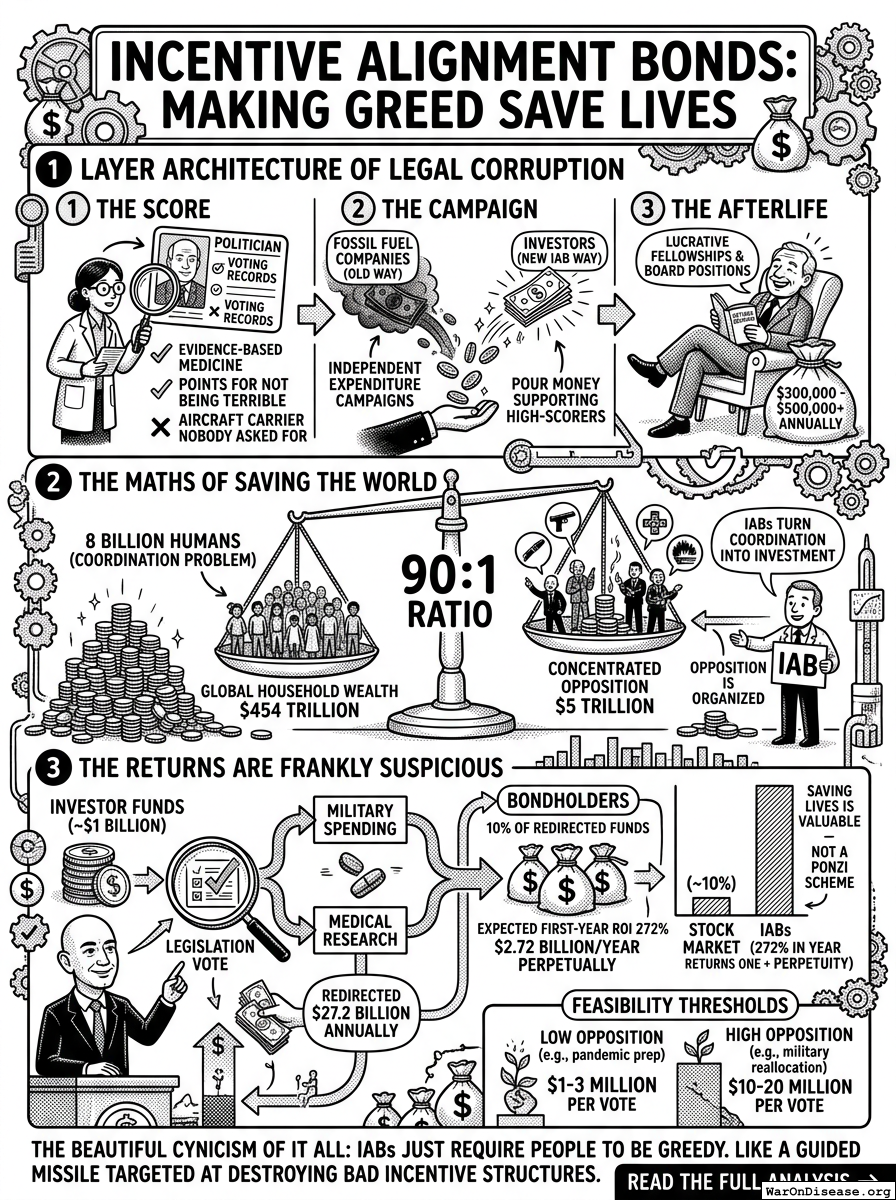
Layer 1 — The Score: Politicians receive "Public Good Scores" based on their voting records. Vote for evidence-based medicine? Points. Vote for another aircraft carrier nobody asked for? No points. It's like a loyalty card for not being terrible.
Layer 2 — The Campaign: Independent expenditure campaigns (basically Super PACs) pour money into supporting high-scoring politicians and opposing low-scorers. This is already legal. It happens now. The only difference is that instead of the money coming from fossil fuel companies who want to burn the planet, it comes from investors who want to save it.
Layer 3 — The Afterlife: High-scoring politicians, upon leaving office, gain access to lucrative fellowships and board positions paying $300,000-$500,000+ annually. Because it turns out that the promise of a cushy retirement is worth more to a politician than the promise of a better world, and we might as well work with that rather than against it.
The Maths of Saving the World
Here's where it gets indecent. Global household wealth is approximately $454 trillion. The concentrated opposition—weapons manufacturers, pharmaceutical monopolists, fossil fuel companies, all the usual suspects—controls about $5 trillion. That's a 90:1 ratio in favour of the people who would benefit from better governance.
The reason the $5 trillion side keeps winning isn't because they have more money. It's because they're organized. A weapons manufacturer will spend $50 million lobbying for one contract. Eight billion humans who would benefit from peace won't spend anything, because no individual's contribution makes a difference, and also because they're busy trying to pay rent.
IABs solve this coordination problem by turning it into an investment. You don't donate to save the world—you invest to save the world, and you get paid back. With interest.
The Returns Are Frankly Suspicious
The expected first-year return on investment is 272% from a hypothetical global health treaty. The mechanism: invest about $1 billion in passing a treaty that redirects $27.2 billion annually from military to medical research. Bondholders get 10% of the redirected funds—$2.72 billion per year, in perpetuity.
For context, the stock market returns about 10% per year on a good day. IABs return 272% in year one and then keep paying forever. If this were a Ponzi scheme, it would be the most obvious one in history. But it's not a Ponzi scheme. It's just that saving human lives is really, really, really valuable, and we've been pricing it at zero.
Why This Hasn't Happened Yet
The same reason you haven't reorganized your kitchen even though you know exactly where everything should go: nobody wants to be the one to start, and everyone assumes someone else will do it. In economics, this is called a "collective action problem." In everyday life, it's called "being human."
The feasibility threshold is about $5-20 million per pivotal legislator vote, depending on how much the opposition cares. Low-opposition domains like pandemic preparedness cost $1-3 million per vote. High-opposition domains like military reallocation cost $10-20 million per vote. These are remarkably small numbers when you consider that the alternative is several million people dying per year.
If Jeff Bezos donated 0.1% of his net worth, he could buy enough legislative votes to redirect $27.2 billion per year into medical research, saving roughly 10.7 billion lives over the long term, and getting a 272% return on his investment. The fact that nobody has done this yet is either evidence of irrationality, ignorance, or the possibility that Jeff Bezos hasn't read this article. Someone should send it to him.
The Beautiful Cynicism of It All
The genius of IABs is that they don't require anyone to be good. They don't require voters to be informed, politicians to be virtuous, or corporations to be altruistic. They just require people to be greedy, which is the one thing we can absolutely count on.
It's capitalism, but pointed at a useful target for once. Like a guided missile, except instead of destroying a building it destroys the incentive structure that prevents your government from curing cancer.
Comments