
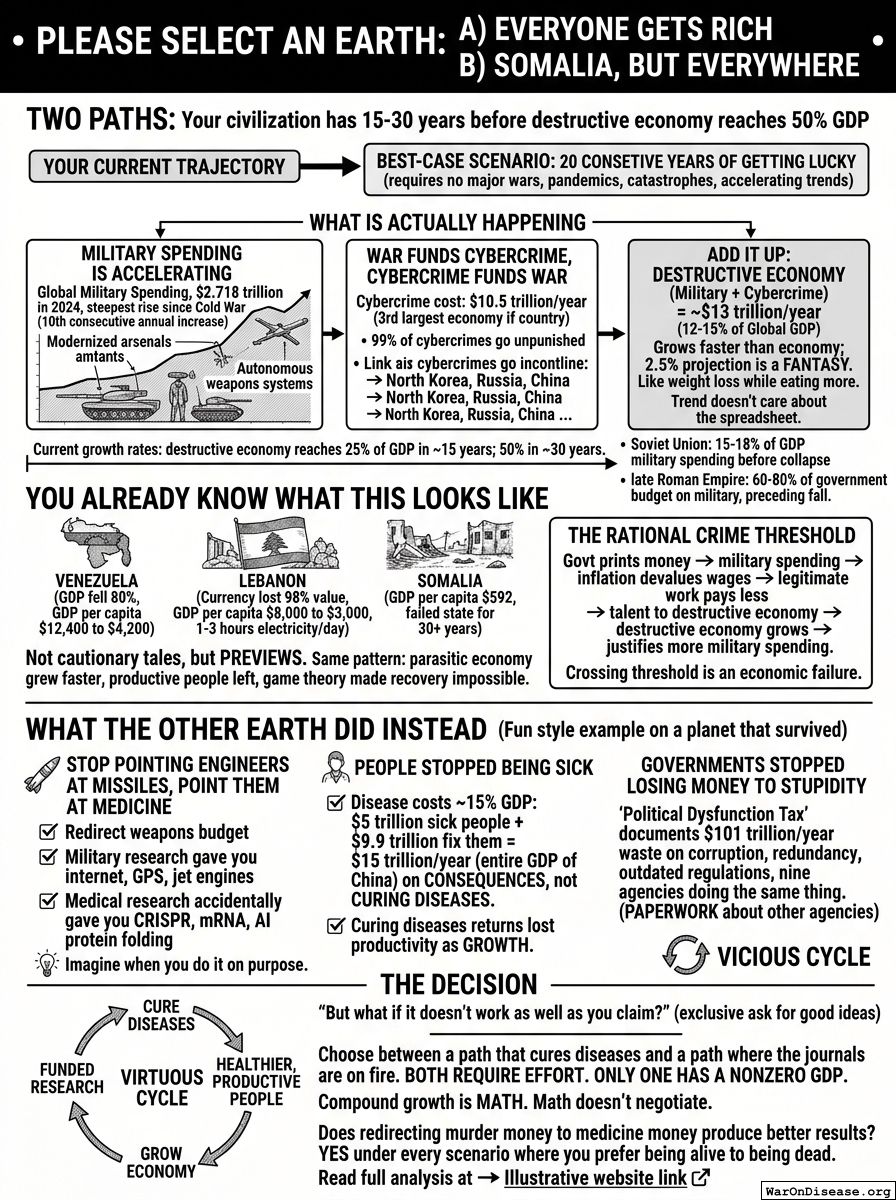
Two Paths
Your civilization has somewhere between 15 and 30 years before the destructive economy reaches 50% of GDP. At that point, half of all economic activity is destructive, so building things stops making sense because whatever gets created gets stolen fast enough that stealing becomes the rational move.
This article models two paths: the one you're on, and the one where you redirect the murder budget.
Your Current Trajectory
Your economists project 2.5% annual growth. This projection assumes no major wars, no pandemics worse than COVID, no catastrophes, and no acceleration of any trend that is currently accelerating. It is not a baseline. It is the best-case scenario for a civilization that spends more on explosion technology than on figuring out why its own bodies stop working, and it requires 20 consecutive years of getting lucky. Your species has never had 20 consecutive years of getting lucky.
Here is what is actually happening.
Your military spending is accelerating, not stabilizing. Global military spending hit $2.718 trillion in 2024, up 9.4% in a single year—the steepest rise since the Cold War. That was the 10th consecutive annual increase. Your nuclear arsenals are being modernized, not reduced. You are deploying autonomous weapons systems without governance frameworks, which means you are building machines that make irreversible decisions and then not telling them when to stop.
War funds cybercrime. Cybercrime funds war. Your military spending isn't the whole destructive economy. Cybercrime costs your civilization $10.5 trillion per year, growing at roughly 15% annually. If measured as a country, it would be the third-largest economy on Earth, after the US and China. North Korea funds its nuclear program through state-sponsored hacking. Russia finances military operations with ransomware revenue. China's cyber-espionage steals the intellectual property that its military-industrial complex can't develop on its own. Cybercrime is war by other means, and it is more profitable than the global trade of all major illegal drugs combined. And 99% of cybercrimes go unpunished, because your enforcement systems were designed for a world where criminals had to physically show up.
AI amplifies whatever you point it at. Right now, you are pointing it at destruction. A single AI agent can probe thousands of systems simultaneously, generate custom phishing attacks in any language, and find vulnerabilities faster than your entire cybersecurity workforce combined. AI doesn't change which direction humanity is pointed; it makes you go faster in whatever direction you were already going. Same technology. Same capability. Different direction. The tool doesn't care. You have to choose.
Add it up. Your destructive economy (military spending plus cybercrime, not even counting the political dysfunction tax or the cost of disease) is already roughly $13 trillion per year, which is 12-15% of global GDP. Both components are growing faster than your economy, and AI is about to accelerate both.
Your 2.5% projection is not the trajectory you are on. It is the trajectory you would be on if you stopped doing all the things you are currently doing more of. Projecting 2.5% growth while your destructive economy grows faster than your productive one is like projecting weight loss while eating more every day. The spreadsheet says one thing. The trend says another. The trend does not care about the spreadsheet.
So How Long Do You Have?
At current growth rates, your destructive economy reaches 25% of GDP in ~15 years and 50% in ~30 years.
The Soviet Union devoted an estimated 15-18% of GDP to military spending before it collapsed, and that was just military, without a $10 trillion cybercrime sector on top. The late Roman Empire spent roughly 60-80% of its entire government budget on the military, which, combined with currency debasement and rising tax burdens, produced the fiscal crisis that preceded its fall.
You Already Know What This Looks Like
If the Soviet Union and Rome sound too distant, here is what economic collapse looks like right now, on your planet, to people who are alive while you read this.
Venezuela's GDP fell 80% in under a decade. GDP per capita went from $12,400 to $4,200. The minimum wage is $4 per month. 82% of the population lives in poverty. 8 million people fled the country. A Harvard economist called it "the biggest economic collapse in human history outside of war or state collapse."
Lebanon's currency lost 98% of its value. GDP per capita dropped from $8,000 to $3,000 in three years. The electricity grid provides 1 to 3 hours per day. People's life savings simply vanished.
Somalia has a GDP per capita of $592, ranks last on the Human Development Index, and has been a failed state for over 30 years. Recovery is not in progress. Recovery is not planned.
These are not cautionary tales. They are previews. Every one of these collapses followed the same pattern: a parasitic economy grew faster than the productive one, the productive people left or switched sides, and the system passed a point where the game theory made recovery impossible. The difference is that when Venezuela collapses, Venezuelans can flee to Colombia. When the global economy reaches terminal parasitic load, there is no Colombia.
The Rational Crime Threshold
Here is the loop. Your governments print money to fund military spending, which devalues wages through inflation, which makes legitimate work pay less, which pushes talent toward the destructive economy, which grows, which justifies more military spending.
Cybercrime has a higher return on investment than most legitimate businesses, and 99% of it goes unpunished. When a software engineer can earn more in a week of ransomware than in a year of building products, crossing the threshold is not a moral failure. It is an economic one. You made legitimate work pay poorly by diverting productive investment into destruction, then act surprised when people choose the option that pays.
What the Other Earth Did Instead
Here's what happened on the planet that survived. They looked at the trend line, noticed where it went, and decided to point it somewhere else. They signed the treaty, redirected the weapons budget, and then realized the same logic applied to everything else that was broken.
They stopped pointing engineers at missiles and pointed them at medicine. Your species actually did this once before. After World War II, you cut military spending by 87% in two years and got the biggest economic boom in your history. Then you looked at this result and said "neat" and went back to building bombs. This is the most human thing I have ever observed. Military research accidentally gave you the internet, GPS, and jet engines. Medical research has already accidentally given you CRISPR, mRNA platforms, and AI protein folding. You keep discovering world-changing technologies as a side effect of research, like a chef who keeps accidentally inventing new elements while trying to make soup. Imagine what happens when you do it on purpose.
People stopped being sick. Disease currently costs your civilization ~15% of GDP: $5 trillion in people too sick to work plus $9.9 trillion in trying to fix them. That is $15 trillion per year—the entire GDP of China—being spent on the consequences of not curing diseases instead of on curing diseases. As diseases get cured, all that lost productivity comes back as growth. It was like watching someone take their foot off the brake and being surprised the car went faster.
Their governments stopped losing money to stupidity. The Political Dysfunction Tax documents $101 trillion per year in money governments waste on corruption, redundancy, regulations written before computers existed, and nine agencies doing the same thing badly. That last part bears repeating: you have nine agencies doing the same thing. Not nine agencies doing nine things. Nine agencies doing one thing, and the one thing is paperwork about the other eight agencies.
These three things compound on each other. Better-funded research produces innovations, which cure diseases, which make people healthier and more productive, which grows the economy, which funds more research. It's a virtuous cycle. You're currently running the vicious version, where sick people can't work, so the economy shrinks, so there's less money for research, so people stay sick. You could have switched at any time. You did not switch. I find this fascinating in the way that a veterinarian finds a dog that keeps eating bees fascinating.
The Decision
"But what if it doesn't work as well as you claim?" I love this question. Your species asks it exclusively about good ideas. Nobody ever asks "but what if the arms race doesn't work as well as we claim?" about the thing that has a nonzero probability of killing everyone. Your risk assessment is applied in one direction only, like a door that only locks from the outside.
You do not have a stable middle path. The 2.5% "baseline" is not a path you can stay on; it is a fantasy that requires every accelerating trend to simultaneously stop accelerating. Your actual choice is between a path that cures diseases and a path where the journals are on fire. Both require effort. Only one of them has a nonzero GDP at the end.
What This Means Per Person
GDP in the trillions is abstract. Here's what it means for actual humans.
On your current trajectory, average income by year 20 is a question your economists cannot answer, because their models do not have a variable for "the journals are on fire." Under the path where you redirect the murder budget and fix governance, average income reaches extraordinary levels. Even the minimum sustainable path (1% Treaty alone) multiplies your cumulative lifetime earnings many times over.
The opportunity cost of inaction is not abstract. It is the largest number most humans will never bother to calculate.
Go Ahead, Change the Numbers
Every input to this model is a named variable you can look up and argue with. I know you will, because arguing is your second-favorite activity after building weapons. Cut all assumptions in half. Cut them in quarters. The model still produces a civilization instead of a collapse, because no plausible adjustment to any single variable eliminates the effect of three compounding mechanisms running simultaneously for 20 years. Compound growth doesn't care about your skepticism. It's math. Math doesn't negotiate.
The question is not "will the treaty produce exactly these returns?" The question is "does redirecting murder money to medicine money produce better results than not doing so?" The answer is yes under every scenario where you prefer being alive to being dead. If you do not prefer being alive to being dead, this article is not for you, and I wish you well in whatever you're doing instead.
Comments