
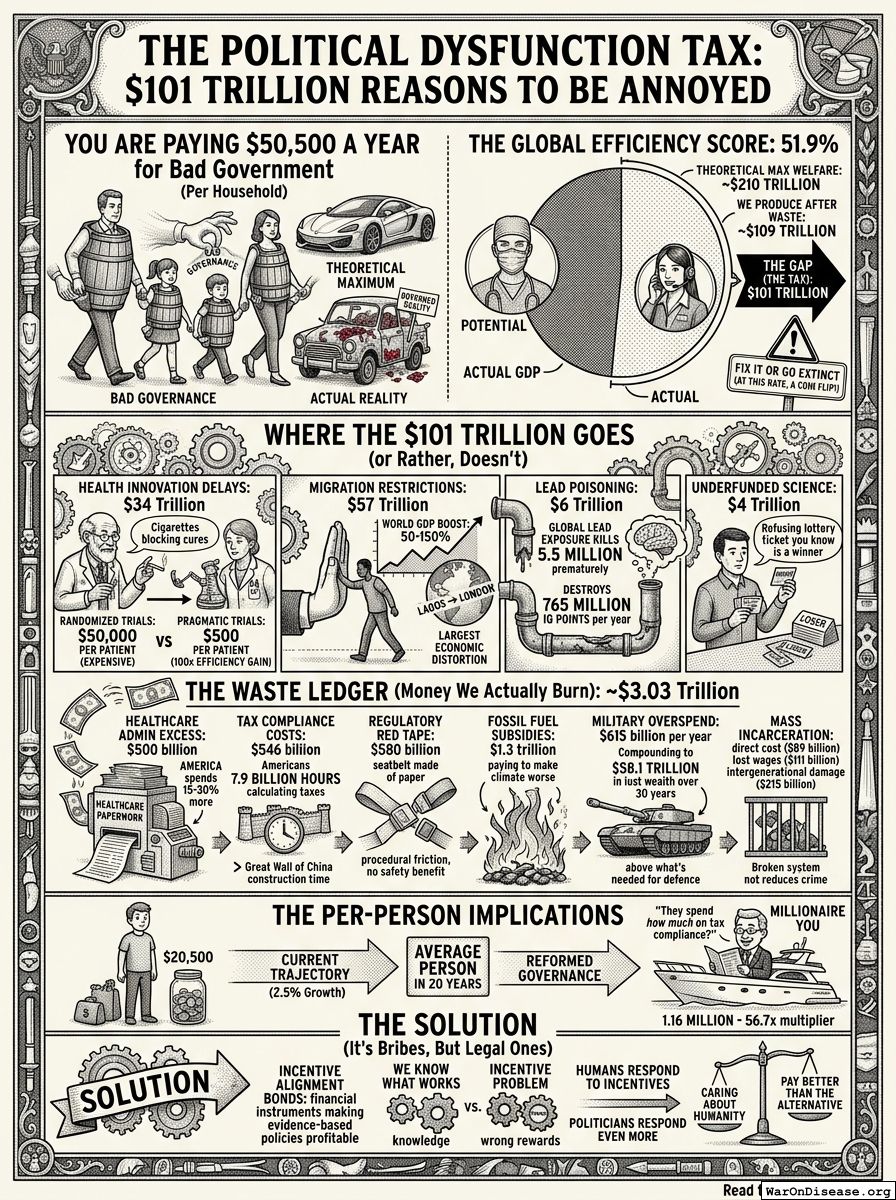
You Are Paying $50,500 a Year for Bad Government (Per Household)
There is an invisible tax that nobody voted for, nobody collects, and nobody benefits from. It's not on your pay slip, it's not in the budget, and no politician has ever run on a platform of increasing it. And yet it costs every four-person household approximately $50,500 per year.
This is the Political Dysfunction Tax—the gap between what civilization could produce if governance was halfway competent, and what it actually produces given that it isn't. It's the difference between the car we're driving and the car we could be driving if someone hadn't filled the engine with jam.
The Global Efficiency Score
After totalling up all the waste, missed opportunities, and bureaucratic entropy, the analysis arrives at a Global Governance Efficiency Score of 51.9%. Humanity is operating at roughly half its potential. We are, in economic terms, a student who could have been a surgeon but somehow ended up working in a call centre because nobody told them about the exam.
The theoretical maximum welfare—what we could produce—is about $210 trillion. We produce about $109 trillion after waste. The difference is $101 trillion per year, every year, forever, until we either fix it or go extinct, which at this rate might be a coin flip.
Where the $101 Trillion Goes (or Rather, Doesn't)
Health Innovation Delays: $34 Trillion
We're sitting on cures worth approximately $34 trillion per year and not developing them because the regulatory system was designed during an era when doctors still recommended cigarettes. The shift from expensive randomized controlled trials ($50,000 per patient) to pragmatic trials ($500 per patient) represents a 100x efficiency gain that nobody is implementing, presumably because it would work.
Migration Restrictions: $57 Trillion
Economist Michael Clemens calculated that removing barriers to labour mobility would increase global GDP by 50-150%. Currently, $57 trillion in economic output disappears every year because someone born in Lagos isn't allowed to work in London. It's the largest single distortion in the global economy, and it persists because the people making the rules aren't the ones stuck behind the border.
Lead Poisoning: $6 Trillion
Global lead exposure kills 5.5 million people prematurely and destroys 765 million IQ points per year. Seven hundred and sixty-five million IQ points. That's enough collective brainpower to solve most of the other problems on this list, except it's been dissolved by lead pipes that we know how to replace but somehow haven't gotten around to.
Underfunded Science: $4 Trillion
We are leaving approximately $4 trillion on the table by not funding research that would pay for itself many times over. It's like refusing to buy a lottery ticket that you already know is a winner because you're too busy buying lottery tickets that definitely aren't.
The Waste Ledger (Money We Actually Burn)
On top of the missed opportunities, there's about $3.03 trillion in money that's actively being wasted:
- Healthcare admin excess: $500 billion—America spends 15-30% more on healthcare paperwork than efficient systems
- Tax compliance costs: $546 billion—Americans spend 7.9 billion hours per year calculating their taxes, which is more time than it took to build the Great Wall of China, and roughly as useful
- Regulatory red tape: $580 billion in procedural friction with no safety benefit, like a seatbelt made of paper
- Fossil fuel subsidies: $1.3 trillion globally—we are literally paying to make the climate worse
- Military overspend: $615 billion per year above what's needed for actual defence, compounding to $58.1 trillion in lost wealth over 30 years
- Mass incarceration: $89 billion in direct costs plus $111 billion in lost wages plus $215 billion in intergenerational earnings damage, for a system that doesn't actually reduce crime
The Per-Person Implications
Under the current trajectory of 2.5% growth, the average person will earn about $20,500 in twenty years. Under reformed governance, that same person would earn $1.16 million—a 56.7x multiplier.
This means that somewhere in a parallel universe where humans are slightly less daft, you are a millionaire. The version of you that lives in well-governed reality is presumably reading this on a yacht and shaking their head at how the rest of us live. "They spend how much on tax compliance?" they'd say, sipping champagne that costs less than a TurboTax subscription.
The Solution (It's Bribes, But Legal Ones)
The paper proposes Incentive Alignment Bonds—financial instruments that make it profitable for private investors to push politicians toward evidence-based policies. Because the one thing we know about humans is that they respond to incentives, and the one thing we know about politicians is that they respond to incentives even more.
The fundamental insight is depressingly simple: we don't have a knowledge problem. We know what works. We have a incentive problem. The people who could fix things are rewarded for not fixing them. The solution isn't to make them care about humanity. The solution is to make caring about humanity pay better than the alternative.
Comments