
An Audit of the World's Largest Economy (It's Not Great)
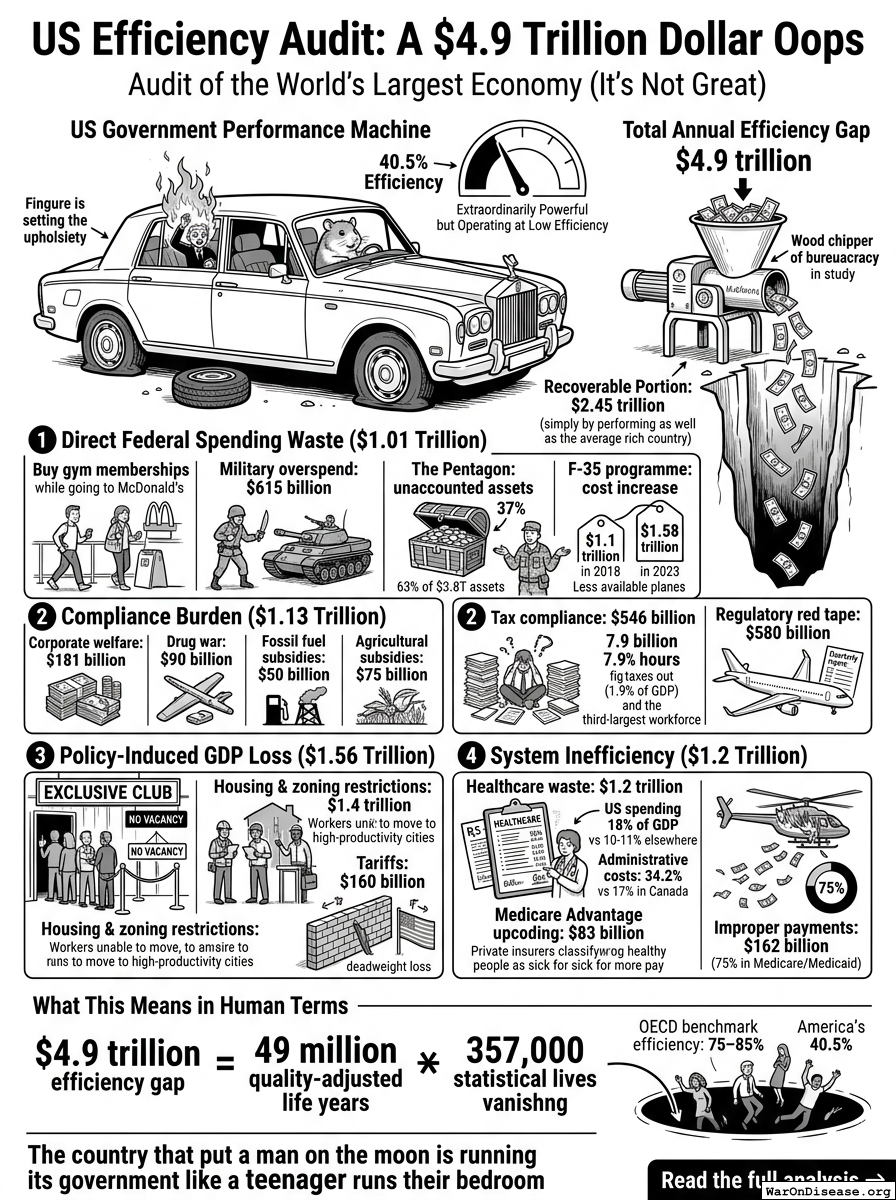
If the United States government were a car, it would be a Rolls-Royce with three flat tyres, a hamster running the engine, and someone in the back seat setting fire to the upholstery. It's an extraordinarily powerful machine operating at approximately 40.5% efficiency, which is the kind of performance that would get any private company laughed off the stock exchange and into a documentary.
The total annual efficiency gap is $4.9 trillion (95% CI: $3.62T–$6.5T). That's 17% of American GDP being fed into a wood chipper made of bureaucracy. About $2.45 trillion of that is recoverable if the US simply performed as well as the average rich country, which is a bit like saying you could double your salary by showing up to work sober.
Category 1: Direct Federal Spending Waste ($1.01 Trillion)
This is money the government actively spends on things that don't work, like a person who keeps buying gym memberships but goes to McDonald's instead.
Military overspend: $615 billion above what's needed for actual deterrence. The US spends more on its military than the next ten countries combined, which is like bringing a tank to a knife fight and then complaining that the tank was too expensive.
The Pentagon owns $3.8 trillion in assets but cannot account for $2.5 trillion of them. That's 63%. The Pentagon has lost track of more money than most countries have ever had. If you lost 63% of your possessions, you'd call the police. The Pentagon just calls it Tuesday.
The F-35 programme's lifetime sustainment cost increased from $1.1 trillion in 2018 to $1.58 trillion in 2023, despite the planes becoming less available. So they cost more and work less. It's like a plumber who charges extra every time your pipes burst, which is also every time.
Corporate welfare: $181 billion. The drug war: $90 billion. Fossil fuel subsidies: $50 billion. Agricultural subsidies: $75 billion. Each one an investment in making things worse, which is quite an achievement when you think about it.
Category 2: Compliance Burden ($1.13 Trillion)
This is money the private sector spends because the government told it to, and for no discernible benefit.
Tax compliance: $546 billion. Americans spend 7.9 billion hours per year figuring out their taxes. That's 1.9% of GDP—nearly one in fifty dollars earned goes toward calculating how many dollars you've earned. It is the bureaucratic equivalent of having to fill out a form to find out which form you need to fill out.
If those hours were a workforce, it would be the third-largest employer in the country, behind only Walmart and Amazon. Except those companies produce things people want. Tax compliance produces migraines and a vague sense of existential dread.
Regulatory red tape: $580 billion in compliance costs that provide no safety benefit. This is not the regulation that stops your airplane from falling apart. This is the regulation that requires your airplane to file a quarterly report about its feelings.
Category 3: Policy-Induced GDP Loss ($1.56 Trillion)
These are the things that would happen if the government simply got out of the way.
Housing and zoning restrictions: $1.4 trillion. American cities have zoned themselves into a housing crisis by making it illegal to build homes where people want to live. Workers can't move to high-productivity cities because they can't afford the rent, because the cities won't allow enough buildings, because the people who already live there don't want more buildings. It's like a club that gets worse the more exclusive it becomes.
Tariffs: $160 billion in deadweight loss. Tariffs are a tax on your own citizens for the crime of wanting to buy things from foreigners, which is a strange punishment given that the entire premise of trade is that everyone benefits.
Category 4: System Inefficiency ($1.2 Trillion)
This is the deep structural stuff that requires redesigning entire systems.
Healthcare waste: $1.2 trillion. The US spends 18% of GDP on healthcare compared to 10-11% in countries with similar or better outcomes. Administrative costs eat up 34.2% of health spending versus 17% in Canada. That means one-third of American healthcare spending goes to deciding who pays for the healthcare, rather than doing any healthcare.
Medicare Advantage upcoding: $83 billion per year in overpayment, projected to hit $1.2 trillion cumulative over 10 years. This is the programme where private insurers get paid more for sicker patients, and so—in a twist that will shock absolutely no one who has ever met a financial incentive—they classify everyone as very, very sick.
Improper payments: $162 billion government-wide, with 75% concentrated in Medicare and Medicaid. These are payments that shouldn't have been made, to people who shouldn't have received them, for services that may or may not have been performed. It's like throwing money out of a helicopter, except the helicopter is also on fire, and someone is charging you for the helicopter.
What This Means in Human Terms
The $4.9 trillion efficiency gap is equivalent to 49 million quality-adjusted life years lost annually. Using the Department of Transportation's value of a statistical life ($13.7 million), that's 357,000 people—roughly the population of a mid-sized city—vanishing every year into the gap between what is and what could be.
The OECD benchmark efficiency is 75-85%. America is at 40.5%. The country that put a man on the moon is running its government like a teenager runs their bedroom.
Comments