
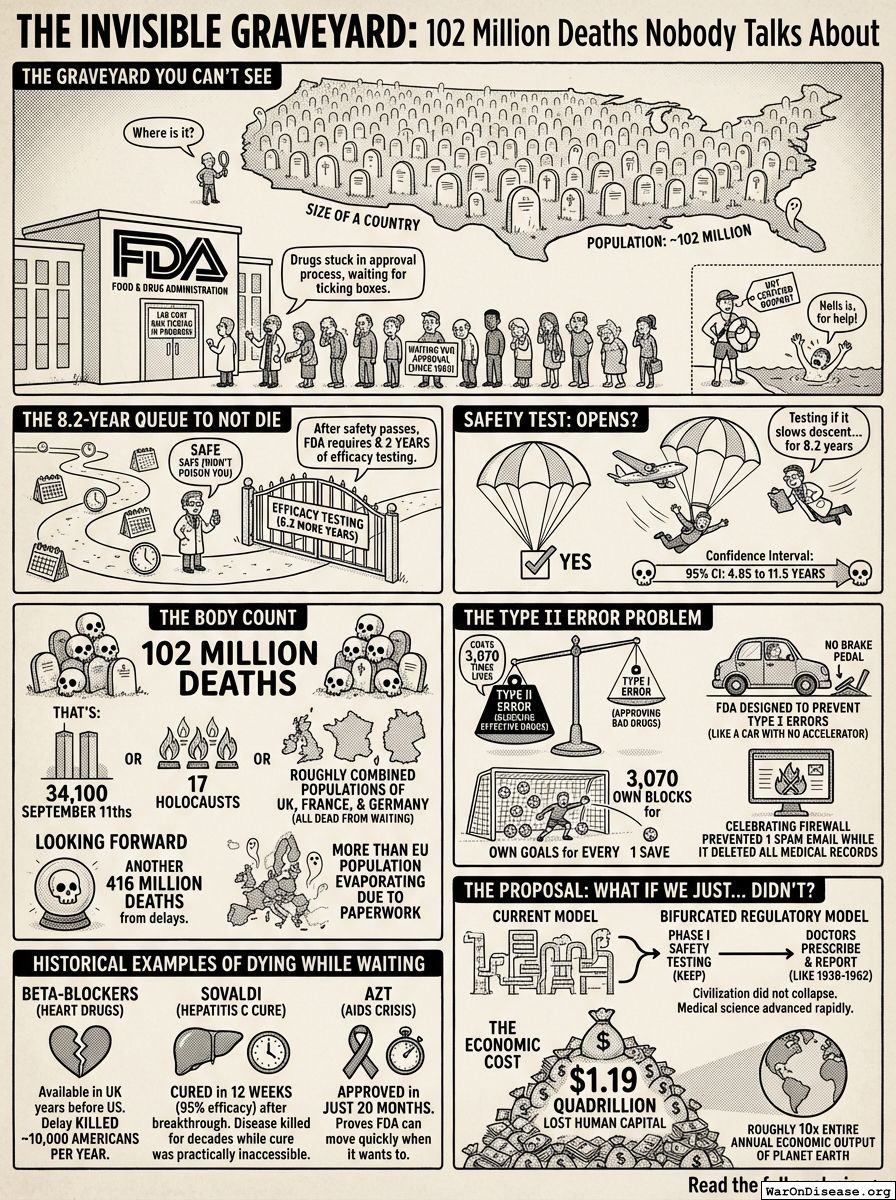
The Graveyard You Can't See (Because It's the Size of a Country)
There's a graveyard that nobody visits because it doesn't exist in any physical sense, and also because it contains approximately 102 million people, which would make it rather difficult to park. These are the people who have died since 1962 because drugs that could have saved them were stuck in the FDA's approval process, waiting for someone in a lab coat to finish ticking boxes.
The FDA, as we've established, stands for Food and Drug Administration, and its primary function appears to be ensuring that no American is ever exposed to a drug that hasn't been proven to work, even if the alternative is that they die while the proof is being assembled. It's a bit like a lifeguard who won't throw you a life ring until it's been certified as buoyant.
The 8.2-Year Queue to Not Die
After a drug passes safety testing—meaning scientists have confirmed it won't actually poison you—the FDA requires an additional 8.2 years of efficacy testing to confirm it does what it's supposed to do. This is like testing whether a parachute opens, confirming that yes, it does open, and then requiring 8.2 more years of testing to prove that open parachutes slow your descent, while people continue to fall out of planes.
The 95% confidence interval is 4.85 to 11.5 years, which means that in the best case, you only have to wait about 5 years for medicine that already exists and has already been proven not to kill you. In the worst case, it's 11 and a half years. That's long enough to get two degrees and a PhD, though admittedly you might not finish the PhD because you'd be dead.
The Body Count
Let's put 102 million deaths in context, because the human brain is not designed to comprehend numbers this large. Mostly the human brain is designed to count berries and notice tigers.
- That's 34,100 September 11ths
- Or 17 Holocausts
- Or roughly the combined populations of the UK, France, and Germany, all dead from waiting
And that's just the historical deaths from 1962 to 2024. Looking forward, the analysis estimates another 416 million deaths from delays to disease eradication. Combined, that's over half a billion preventable deaths—more than the population of the European Union, just sort of evaporating because of paperwork.
The Type II Error Problem
In statistics, a Type I error is when you approve a bad drug (you think it works but it doesn't). A Type II error is when you block a good drug (you think it doesn't work but it does). The FDA is exquisitely calibrated to prevent Type I errors, which is a bit like designing a car with no accelerator because you're really worried about speeding.
The analysis finds that Type II errors—blocking effective drugs—cost 3,070 times more lives than Type I errors save. Three thousand and seventy times. If you were a goalkeeper and you blocked 3,070 own goals for every 1 goal you saved from the opposition, people might start to question your positioning.
Even if you imagine a Thalidomide-scale catastrophe happening every single year—which it doesn't, but let's be creative—the FDA would prevent about 2.59 million disability-adjusted life years of damage. The drugs it blocks would have saved orders of magnitude more. It's like celebrating that your firewall prevented one spam email while it accidentally deleted all your medical records.
Historical Examples of People Dying While Waiting
Beta-blockers: These heart drugs were available in the UK years before the FDA approved them in the US. The delay killed an estimated 10,000 Americans per year. Per year. The British could save people from heart attacks and the Americans couldn't, not because of different science, but because of different paperwork.
Sovaldi: When this Hepatitis C cure was finally pushed through the FDA's breakthrough pathway in 2014, it cured the disease in 12 weeks with 95% efficacy. Twelve weeks. The disease had been killing people for decades while a 12-week cure was theoretically available but practically inaccessible.
AZT: During the AIDS crisis, when people were dying in terrifying numbers and the government was broadly pretending this wasn't happening, AZT was approved in just 20 months. This proves the FDA can move quickly when it wants to. It just usually doesn't want to, in the same way that your internet provider can send an engineer within 24 hours but somehow it usually takes three weeks.
The Proposal: What If We Just... Didn't Do This?
The authors propose a "Bifurcated Regulatory Model," which is a fancy way of saying: keep Phase I safety testing (because yes, drugs should not poison people), but then let doctors prescribe the drugs and report what happens, like they did between 1938 and 1962. During those years, somehow, civilization did not collapse. Doctors prescribed drugs, noted the results, and medical science advanced at a pace that now seems almost hallucinatory by comparison.
It's almost as if the system we designed to protect people has become the largest single cause of preventable death in the modern world. Which is the kind of irony that would be funny if it weren't, you know, 102 million people.
The Economic Cost of All This Death
The lost human capital from these deaths is valued at approximately $1.19 quadrillion. That's using the standard economic value of $150,000 per disability-adjusted life year, which is the number economists use when they need to put a price on human suffering because they find it easier than having feelings.
For scale, global GDP is about $115 trillion per year. The cost of the FDA's efficacy lag is roughly ten times the entire annual economic output of planet Earth. It's as if every human being worked for ten years and produced nothing, except we did produce something—we produced 102 million graves and a very thorough filing system.
Comments