
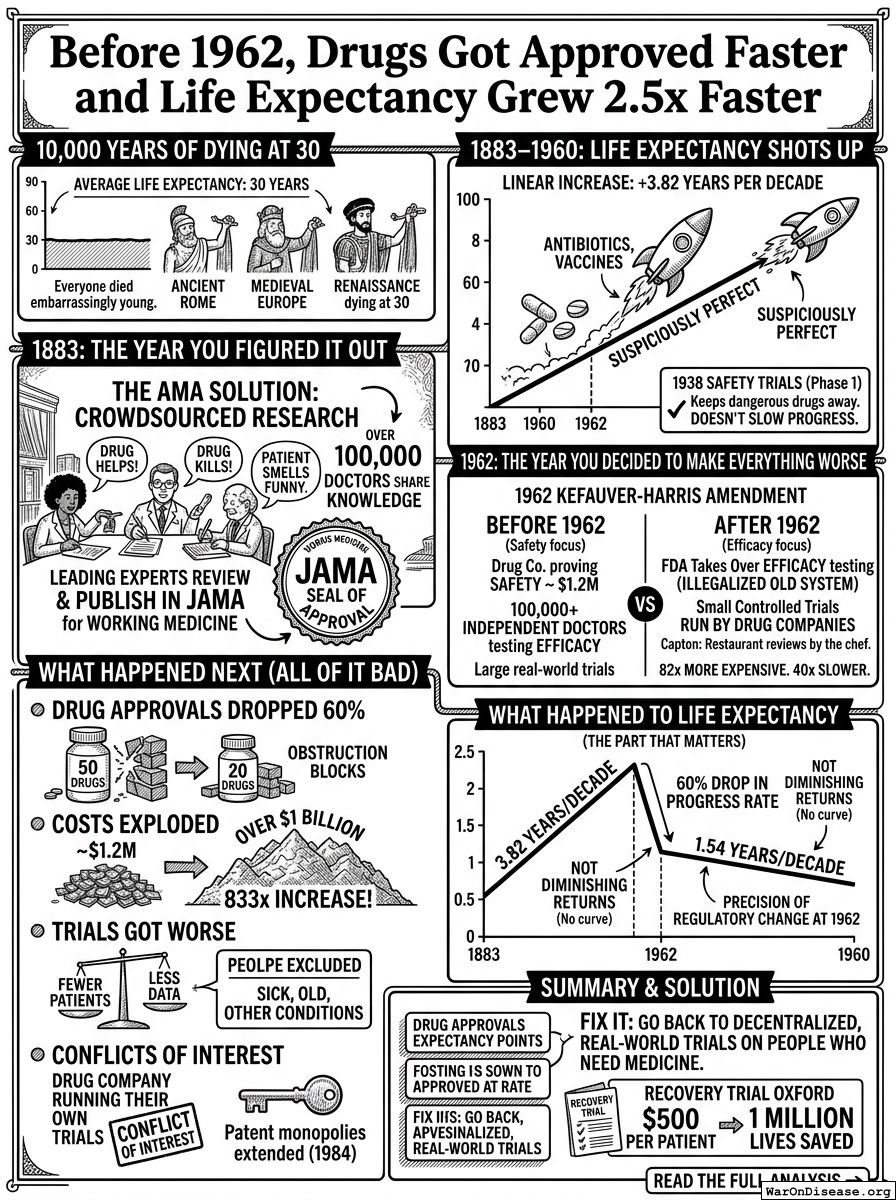
10,000 Years of Dying at 30
For over 99% of human history, average life expectancy was 30 years.
Ancient Rome: 30 years. Medieval Europe: 30 years. Renaissance: Still 30 years.
Kings, peasants, philosophers, farmers—everyone died embarrassingly young. For ten thousand years, the human species was collectively unable to figure out how to not die at the age most people today are still arguing about whether they're a "morning person."
10,000 years. Zero progress.
1883: The Year You Figured It Out
Then something changed. In 1883, doctors founded the Journal of the American Medical Association (JAMA). They did something novel: they shared information. After 10,000 years someone thought "what if we told each other what works?"
Over 100,000 doctors across America tried treatments on real patients. They wrote down what happened. "This drug helped." "This drug killed the patient." "This drug did nothing but made the patient smell funny."
Leading experts reviewed these case reports. They compiled them into studies and published results. If a medicine worked and didn't kill people, JAMA gave it a seal of approval.
Crowdsourced, observational, objective, peer-reviewed clinical research. And it worked.
The Result
After 10,000 years of zero progress, life expectancy suddenly shot up. It increased by 3.82 years every decade. For 80 years straight. The most linear relationship in medical history. Suspiciously perfect. It lasted from 1883 to 1960.
1938: Safety Trials (The Part That Actually Worked)
Elixir sulfanilamide killed over 100 people in 1937. Congress required all new drugs to include safety testing. This evolved into the Phase 1 Safety Trial. This was reasonable. Test if a compound kills people before giving it to patients. Makes sense.
The 3.82 years per decade gain stayed the same. It held steady before and after the new safety regulations. Safety testing worked without slowing medical progress. Not positive impact. Not negative impact. Just: "stop the drugs that poison people." Done. Moving on.
Thalidomide: When Safety Regulations Actually Worked
Thalidomide hit European markets in 1957 for morning sickness. It caused thousands of horrific birth defects. Existing FDA safety regulations prevented any birth defects in the US. Zero American babies harmed. The 1938 safety framework worked exactly as intended.
The safety regulations succeeded. But the emotional reaction to Thalidomide created public outcry for more regulation. Not more safety regulation (that had already worked). More efficacy regulation. This is the legislative equivalent of your house surviving a fire and then, in response, tearing out the roof.
1962: The Year You Decided to Make Everything Worse
Effective safety regulations already existed. They worked. America had zero Thalidomide deaths. So naturally, the government responded to this success by adding massive efficacy regulations. The 1962 Kefauver-Harris Amendment changed everything.
They took efficacy testing away from 100,000+ independent doctors and gave it to drug companies. It got 82 times more expensive. It got 40 times slower.
Before 1962:
- Drug companies spent ~$1.2 million (inflation-adjusted) to prove safety
- Once approved as safe, 100,000+ independent doctors tested efficacy on real patients
- The AMA compiled results and published findings
After 1962:
- The FDA took over efficacy testing
- They made the old system illegal
- They required small, controlled trials run by... the drug companies themselves
The irony: Regulations meant to ensure drugs work did this by banning large real-world trials, requiring small artificial trials, and letting drug companies run their own tests. We replaced the people who use the product with the people who sell it. This is like getting restaurant reviews exclusively from the chef.
What Happened Next (All of It Bad)
Drug Approvals Dropped 60%
The new regulations immediately reduced new drug approvals by 60%. Not gradually. Immediately. One year you approve 50 drugs. The next year you approve 20. The diseases didn't become 60% less urgent. The regulations just became 60% more obstructive.
Costs Exploded
Since 1962, the cost of bringing a new treatment to market went from ~$1.2 million to over $1 billion (inflation-adjusted). That's roughly an 833x increase. For worse results.
Trials Got Worse in Every Way
- Trials got smaller: Fewer patients, less data.
- Patients got less representative: They excluded sick people, old people, and people with other conditions. You know—the people who actually need medicine.
- Conflicts of interest exploded: Drug companies ran their own trials. Independent doctors lost control. It's like letting students grade their own exams and then being surprised when everyone gets an A.
Patent Monopolies Extended
The regulations created massive delays. Congress "fixed" this by extending drug patent monopolies in 1984. Kefauver's amendments aimed to make drugs safer and cheaper. Instead they made them more dangerous (smaller trials, less real-world data), more expensive (monopolies extended), and less available (60% fewer approvals).
What Happened to Life Expectancy (The Part That Matters)
Remember that suspiciously linear 3.82-year increase every decade from 1883 to 1960?
In 1962, it dropped by 60%. To 1.54 years per decade.
From 1880 to 1960: 3.82 years per decade. From 1962 onward: 1.54 years per decade.
The break is so clean you can see the exact year Congress decided to "help." It's not a gradual curve suggesting diminishing returns. It's a sharp break in a straight line at exactly the year the regulations changed. Coincidences are supposed to be less precise than this.
The "Diminishing Returns" Excuse
Some claim "diminishing returns explain the slowdown." Diminishing returns produce a smooth curve. It flattens over time. What happened was a straight line that instantly changed slope in 1962. Diminishing returns don't produce sudden linear breaks. Regulatory changes do.
The "Correlation Is Not Causation" Excuse
True. Correlation alone proves nothing. But correlation + mechanism + temporal precision is how science works:
- Temporal correlation: Life expectancy growth dropped by half right after 1962
- Mechanism: Regulations reduced new treatments by 60%, increased costs 833x, and banned real-world efficacy trials
- Precision: The break happens at exactly 1962, not "sometime in the mid-20th century"
If you don't trust this method, you can't trust any clinical research. Or science generally.
More Treatments = More Survivors (The Obvious Thing That Needs Proving)
A three-way fixed-effects analysis studied 66 diseases in 27 countries. Without new drugs launched after 1981, people would have lost 2.16 times more years of life. The cost? $2,837 per life-year saved.
There's a strong correlation between new cancer treatments and cancer survival over 30 years. More treatments invented, more people survive. Turns out medical research works. Who knew.
The Summary
- 10,000 years: Zero progress
- 1880-1960: Decentralized real-world trials, 3.82 years/decade progress
- 1962: Kefauver-Harris passes. Progress drops 60% to 1.54 years/decade
- Today: Still stuck with the broken system
Humanity solved medical progress in 1883. Congress broke it in 1962. The fix is not complicated: go back to testing drugs on the people who need them, in the hospitals they're already in, using the data that already exists. The RECOVERY trial proved this works. Oxford spent $500 per patient and saved a million lives. The Americans are still filling out forms.
Comments