
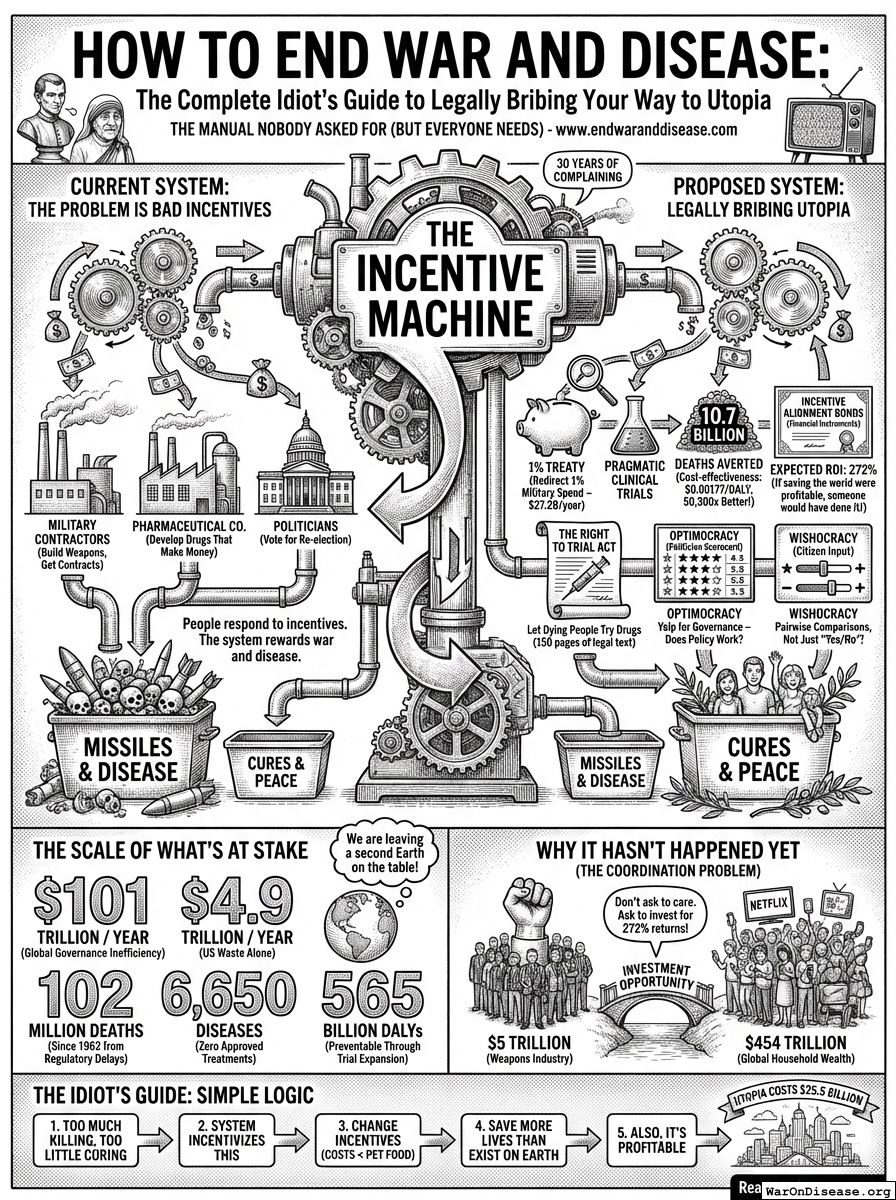
The Manual Nobody Asked For (But Everyone Needs)
There is a manual for ending war and disease. It has a website. It contains maths. The maths checks out. Nobody has read it, in the same way that nobody reads the manual for their television even though they've been complaining about the picture quality for thirty years.
The subtitle is "The Complete Idiot's Guide to Legally Bribing Your Way to Utopia," which is either the most cynical or the most honest title in the history of public policy. Probably both. It's the kind of title that would make Machiavelli proud and Mother Teresa uncomfortable, which is roughly the correct emotional range for a serious proposal about fixing civilization.
The Core Insight (It's About Incentives, Stupid)
The manual starts from a premise so obvious it's embarrassing: people respond to incentives. Politicians vote for things that get them re-elected and paid. Pharmaceutical companies develop drugs that make money. Military contractors build weapons that get contracts. None of these people are evil—they're just doing what the system rewards them for doing.
The problem isn't bad people. The problem is bad incentives. We've built a civilization where the most profitable thing you can do is build a missile, and the least profitable thing you can do is cure a disease. And then we wonder why we have lots of missiles and lots of disease.
The solution? Change the incentives. Make curing diseases profitable. Make preventing war pay. Make being a good politician the path to wealth and status, rather than a quaint hobby for people who don't understand how Washington works.
The Components (A Recipe for Utopia)
The manual pulls together a whole ecosystem of proposals, each one slightly more ambitious than the last:
The 1% Treaty: Redirect 1% of global military spending ($27.2 billion/year) to pragmatic clinical trials. Expected result: 10.7 billion deaths averted. Cost-effectiveness: $0.00177 per DALY. This is 50,300 times more cost-effective than the current best health intervention (bed nets).
Incentive Alignment Bonds: Financial instruments that pay investors to push politicians toward evidence-based policies. Expected ROI: 272%. Because if saving the world were profitable, someone would have done it by now. So the manual makes it profitable.
The Right to Trial Act: Legislation saying that sick people should be allowed to try medicine. This is, apparently, a radical idea that requires 150 pages of legal text to implement, because we live in the timeline where "let dying people try drugs" is controversial.
Optimocracy: A system for scoring politicians based on whether their policies actually work, using data from thousands of jurisdictions. Like Yelp reviews for governance, except the stakes are slightly higher than whether the pasta was al dente.
Wishocracy: A mechanism for finding out what citizens actually want, using pairwise comparisons and sliders instead of binary voting. Because it turns out that "yes or no" is not a great way to express the full complexity of your feelings about healthcare policy.
The Scale of What's at Stake
The manual quantifies what we're leaving on the table:
- $101 trillion per year in global governance inefficiency
- $4.9 trillion per year in US waste alone
- 102 million deaths since 1962 from regulatory delays
- 6,650 diseases with zero approved treatments
- 565 billion DALYs preventable through trial expansion
These numbers are so large that they essentially mean "everything." The gap between what civilization produces and what it could produce is almost as large as what it currently produces. We are, in economic terms, leaving a second Earth on the table.
Why It Hasn't Happened Yet
The manual addresses this head-on. It's not that people don't care. It's not that the maths is wrong. It's that changing the system requires overcoming a coordination problem: everyone would benefit, but nobody wants to go first.
The weapons industry spends $5 trillion maintaining the status quo. Global household wealth is $454 trillion. That's a 90:1 advantage for the people who want change—but the $454 trillion side is disorganised, diffuse, and busy watching Netflix.
The manual's answer is to turn the coordination problem into an investment opportunity. Don't ask people to donate. Don't ask them to protest. Don't ask them to care about strangers. Just ask them to invest in a financial instrument that pays 272% returns while coincidentally saving 10.7 billion lives. Let greed do what altruism couldn't.
The Idiot's Guide Part
The manual calls itself an idiot's guide, and in a way it is—the core logic is simple enough for anyone to understand:
- We spend too much on killing and too little on curing
- The people who decide this are incentivised to keep it that way
- We can change their incentives for less money than we spend on pet food
- If we do, we save more lives than currently exist on Earth
- Also, it's profitable
That's it. That's the manual. Everything else is details, data, and several hundred pages of evidence that makes you want to laugh and cry simultaneously, which is the correct response to discovering that utopia costs $25.5 billion—less than the annual budget of the US Department of Agriculture—and we just haven't gotten around to buying it.
Comments