
84 Cents: The Price of One Year of Not Suffering
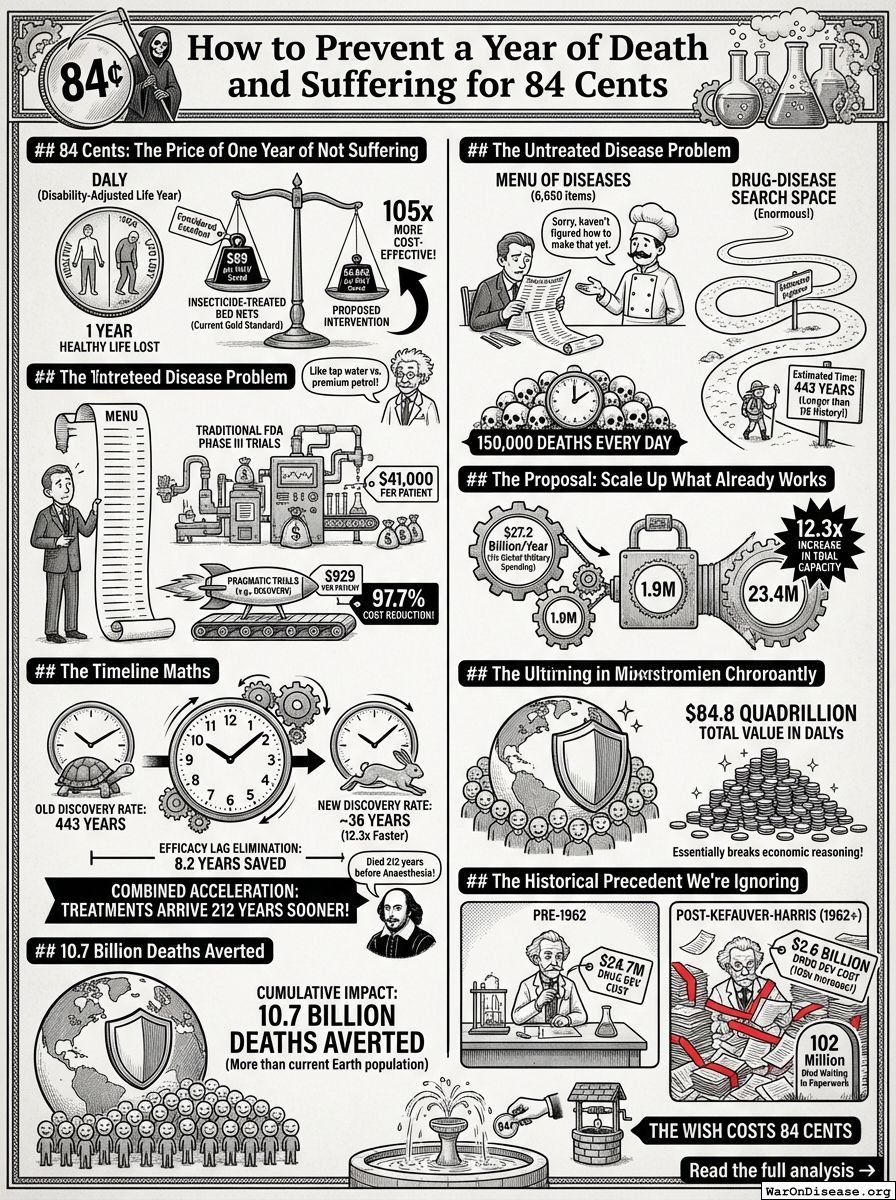
A DALY is a "disability-adjusted life year," which is a year of healthy life lost to either disease or premature death. Economists invented it because they needed a way to compare the misery of different conditions, like a universal currency of suffering. "How bad is malaria versus depression?" "About 1.3 DALYs versus 0.8 DALYs." It's morbid, but useful.
The current gold standard for cost-effective health interventions is insecticide-treated bed nets, which save a DALY for about $89. This is considered excellent. Entire organisations exist to promote bed nets as the most efficient way to reduce human suffering.
This analysis claims you can prevent a DALY for $0.842. Eighty-four cents. That's not a typo. That's 105 times more cost-effective than the current best-in-class intervention. It's like discovering that the most efficient car in the world actually runs on tap water, and everyone's been buying premium petrol.
The Untreated Disease Problem
There are currently 6,650 diseases with zero FDA-approved treatments. Six thousand, six hundred and fifty conditions for which modern medicine offers nothing except sympathy and a large bill. If diseases were a restaurant menu, two-thirds of it would say "sorry, we haven't figured out how to make that yet." You'd send it back.
About 150,000 people die every day from diseases. Some of those diseases are treatable—we just haven't gotten around to testing the treatments. The drug-disease search space is enormous, and at current trial rates, it would take approximately 443 years to explore it fully. That's longer than the United States has existed. It's longer than most civilisations have lasted.
The Proposal: Scale Up What Already Works
The intervention is embarrassingly simple: fund more pragmatic clinical trials.
Traditional FDA Phase III trials cost $41,000 per patient. Pragmatic trials—where you test drugs on regular patients in regular hospitals, like the RECOVERY trial that saved a million COVID lives—cost about $929 per patient. That's a 97.7% cost reduction.
With $27.2 billion per year (1% of global military spending), you could expand from 1.9 million annual trial participants to 23.4 million—a 12.3x increase in trial capacity. This doesn't just accelerate progress; it compresses centuries of medical advancement into decades.
The Timeline Maths
Two acceleration effects combine:
Discovery acceleration: Scaling trial capacity 12.3x means exploring the drug-disease search space 12.3 times faster. What would have taken 443 years now takes about 36. That's a 204-year acceleration in when treatments are discovered.
Efficacy lag elimination: Currently, after a drug passes safety testing, the FDA requires an additional 8.2 years of efficacy testing. Removing this lag saves another 8 years.
Combined: treatments arrive 212 years sooner on average. Two hundred and twelve years. Shakespeare died 212 years before anaesthesia was discovered. Imagine all the diseases we could have cured in that time, and then imagine not curing them because we spent the money on aircraft carriers instead.
10.7 Billion Deaths Averted
With 150,000 daily disease deaths and a 212-year average acceleration, the cumulative impact is approximately 10.7 billion deaths averted. That's more than the current population of Earth. This is a one-time benefit—once the acceleration happens, it's done—but it's a one-time benefit equivalent to saving every human being currently alive.
The total value in DALYs is 565 billion, which at the standard economic valuation of $150,000 per DALY comes to $84.8 quadrillion. This is such a large number that it essentially breaks economic reasoning. It's like asking "how much would you pay to have the sun keep shining?" The answer is "everything," which is not a useful number for budgeting purposes, but it does suggest that maybe we should at least try.
The Historical Precedent We're Ignoring
Before 1962, drug development cost about $24.7 million in today's dollars. After the Kefauver-Harris Amendment—which required proof of efficacy on top of safety—costs exploded to $2.6 billion. A 105x increase.
The drugs didn't get 105 times better. The diseases didn't get 105 times harder. The paperwork got 105 times longer. And somewhere in that paperwork, buried under a mountain of forms and forms about forms, are approximately 102 million people who died waiting.
Eighty-four cents. That's what it would cost to prevent one year of that suffering. Less than a chocolate bar. Less than a bus fare. Less than the coin you'd throw in a fountain while wishing for exactly this kind of thing.
The wish costs 84 cents. The fountain is right there. For some reason, we're all just walking past it.
Comments