
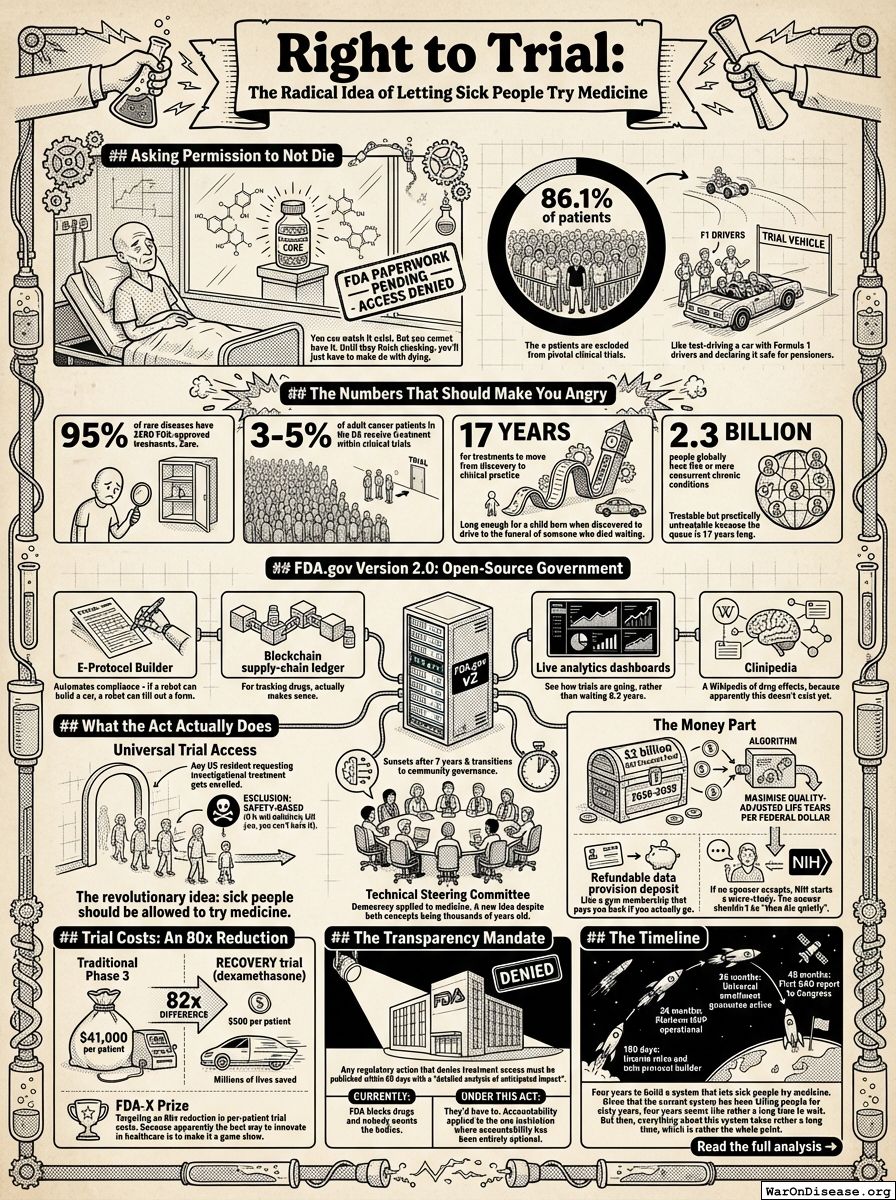
Asking Permission to Not Die
Currently, if you have a disease and there's a drug that might cure it, but the drug hasn't finished its paperwork, you are not allowed to try it. You can watch it exist. You can read about it in journals. You can look at the chemical structure and think "that would look lovely inside my bloodstream." But you cannot have it, because someone at the FDA hasn't finished checking whether it works, and until they have, you'll just have to make do with dying.
86.1% of patients are excluded from pivotal clinical trials. Eighty-six percent. That means the drugs are being tested on a small, carefully selected group of people who may or may not resemble you in any meaningful way, and then the results are applied to everyone. It's like test-driving a car using only Formula 1 drivers and then declaring it safe for pensioners.
The Numbers That Should Make You Angry
- 95% of rare diseases have zero FDA-approved treatments. Zero. If you have a rare disease, there is a 95% chance that nobody has ever been allowed to officially try to cure you.
- Only 3-5% of adult cancer patients in the US receive treatment within clinical trials
- It takes 17 years for treatments to move from discovery to clinical practice—long enough for a child born when the drug was discovered to be old enough to drive to the funeral of someone who died waiting for it
- 2.3 billion people globally have five or more concurrent chronic conditions, each of which is theoretically treatable but practically untreatable because the queue is 17 years long
FDA.gov Version 2.0: Open-Source Government
The Right to Trial Act proposes building FDA.gov v2—an open-source platform that does for drug testing what Wikipedia did for encyclopaedias, except with better sourcing and fewer arguments about whether a hot dog is a sandwich.
The platform would include:
- An E-Protocol Builder that automates compliance—because if a robot can build a car, a robot can fill out a form
- Blockchain supply-chain ledger for tracking drugs, which is the first time anyone has proposed using blockchain for something that actually makes sense
- Live analytics dashboards so everyone can see how trials are going, rather than waiting 8.2 years for the FDA to tell you what happened
- "Clinipedia"—a Wikipedia of drug effects, because apparently this doesn't exist yet, which is concerning
The whole thing would be governed by a nine-member Technical Steering Committee with AI-assisted code review. Low-risk code changes auto-merge within 72 hours. The committee's authority sunsets after 7 years and transitions to community governance. It's democracy applied to medicine, which is apparently a new idea despite both concepts being thousands of years old.
What the Act Actually Does
Universal Trial Access (24 months after passage): Any US resident requesting an investigational treatment gets enrolled in at least one pragmatic trial. The only exclusions are safety-based—if the drug will definitely kill you, you can't have it. Otherwise, you're in.
This is, to be clear, the revolutionary idea: sick people should be allowed to try medicine. The fact that this requires an act of Congress tells you everything you need to know about the current system.
The Money Part: A $2 billion NIH Discount Fund (2026-2030) subsidises trial costs using an algorithm that maximises quality-adjusted life years per federal dollar. Patients pay a net cost after the discount. There's also a refundable data provision deposit, which incentivises patients to complete the protocol by refunding their deposit when they do—like a gym membership that pays you back if you actually go.
The Fallback: If no sponsor accepts a patient within 60 days, the NIH starts a micro-study for them. Because the answer to "nobody wants to test this drug on you" shouldn't be "then die quietly."
Trial Costs: An 80x Reduction
Traditional Phase 3 trials cost $41,000 per patient. The RECOVERY trial—the one that discovered dexamethasone saved COVID patients—cost about $500 per patient. That's an 82x difference for a trial that literally saved millions of lives.
The Act includes an FDA-X Prize competition targeting an 80x reduction in per-patient trial costs. Because apparently the best way to innovate in healthcare is to make it a game show. Honestly, at this point, whatever works.
The Transparency Mandate
Here's my favourite bit: under the Act, any regulatory action that denies treatment access must be published within 60 days with a "detailed analysis of anticipated impact on patient populations" including quantitative health-economic modelling.
In other words: if the FDA blocks a drug, they have to publicly explain how many people will die as a result. Currently, the FDA blocks drugs and nobody counts the bodies. Under this Act, they'd have to. It's accountability applied to the one institution where accountability has been, until now, entirely optional.
The Timeline
- 180 days: Interim rules and beta protocol builder
- 24 months: Platform MVP operational
- 36 months: Universal enrollment guarantee active
- 48 months: First GAO report to Congress
Four years to build a system that lets sick people try medicine. Given that the current system has been killing people for sixty years, four years seems like rather a long time to wait. But then, everything about this system takes rather a long time, which is rather the whole point.
Comments