
From Explosions to Trial Slots
That was the peace dividend: the money you get from buying 1% fewer explosions. Now here is the health dividend: what happens when you spend it on medicine instead.
Right now, somewhere in your regulatory system, a drug that already passed safety testing is sitting in a filing cabinet while the disease it treats keeps killing people. Somewhere else, a researcher with a promising compound for one of 7,000+ untreated diseases is filling out the same form for the fourth time.
The health dividend is what happens when you stop doing this.
I am now going to show you what $27.2 billion buys when you stop wasting it on permission slips. I apologize in advance for the number of numbers. Your species requires receipts before it will believe anything, even things that are obviously true. Especially things that are obviously true.
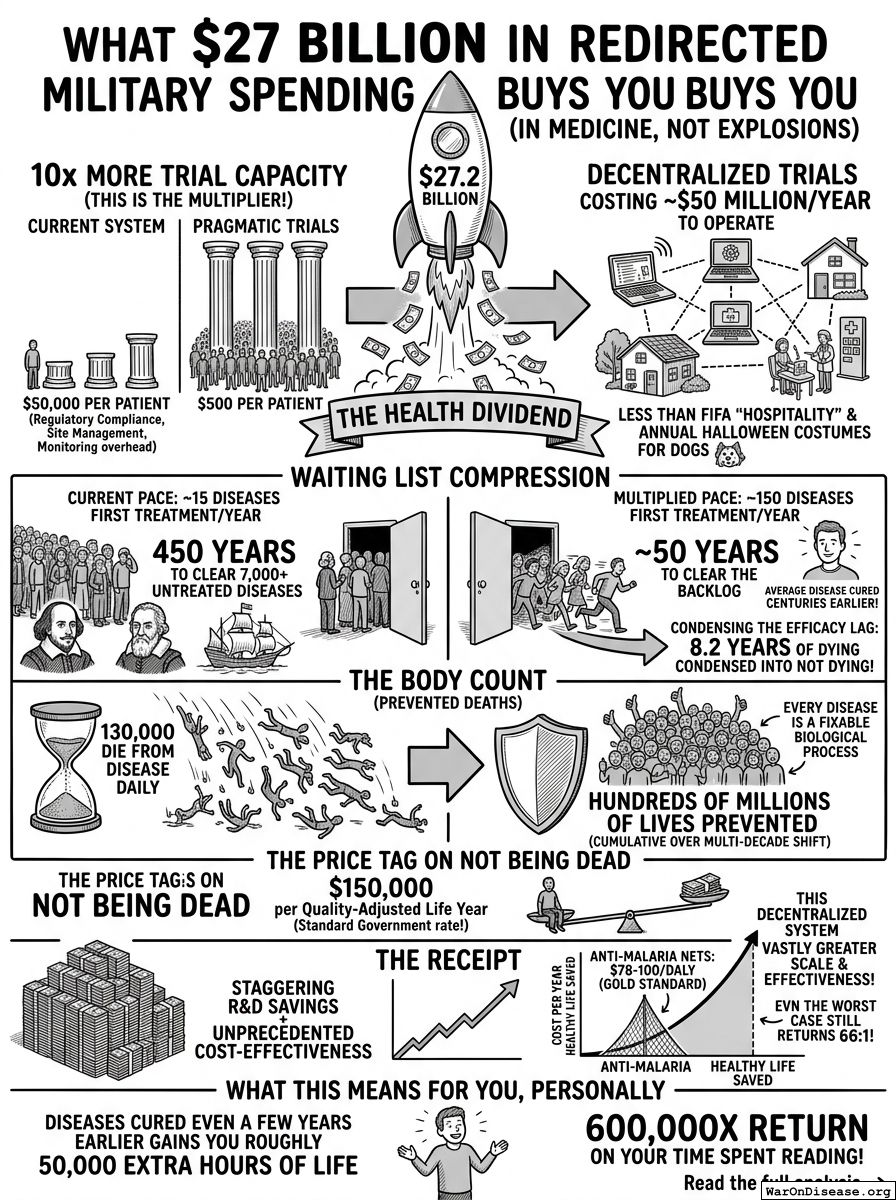
Your current system charges $50,000 per patient in a clinical trial. I asked why and was told "regulatory compliance, site management, and monitoring overhead," which I believe is the human phrase for "permission costs more than medicine." Pragmatic trials cost $500 per patient. At that price, the redirected military money buys you roughly 10 times more trial capacity than currently exists on Earth.
Remember this number. Everything that follows depends on it.
The Waiting List
Over 7,000 diseases currently have zero approved treatments, and about 15 diseases get their first treatment per year. At that rate, you clear the backlog in roughly 450 years. I will let you sit with that number for a moment. It is longer than your species has had printing presses.
For context, 450 years ago, Shakespeare was writing plays, Galileo was building telescopes, and your species already had universities and intercontinental shipping. You just had not gotten around to curing most diseases. At this pace, you still will not for another 450 years.
Apply the 10x multiplier. Instead of 15 diseases getting their first treatment per year, you get 150. The queue clears in ~50 years instead of 450. The average untreated disease gets its first treatment centuries earlier. That is the difference between "your grandchildren might see a cure" and "you might see a cure." On Wishonia, we consider this a meaningful distinction. On Earth, it apparently requires a 78-page chapter to justify.
Your species figured out how to split atoms in 6 years during a war, but letting a cancer patient take a pill that passed safety testing requires the gestation period of three consecutive elephants. The 10x multiplier compresses the elephant parade.
But trial capacity is only half the delay. Once a drug passes safety testing, your regulatory system sits on it for another 8.2 years to confirm it works well enough, while people who could be taking it die instead. Add the capacity acceleration and the efficacy lag together: decades of dying, condensed into not dying.
The Body Count
130,000 people die from disease every day. While you were reading the previous section, approximately 300 of them did. They are not coming back to find out how the math turned out.
Not all of those deaths are currently preventable, but the vast majority are eventually avoidable with sufficient biomedical research. "Eventually avoidable" does not mean "currently preventable." It means: given enough research, these diseases have biological solutions. Every disease, including aging, is a biological process, and biological processes are, in principle, fixable. This is the theoretical ceiling, not a near-term promise.
Over a multi-decade timeline shift, the cumulative toll prevented runs into the hundreds of millions of lives. Nobody objected to this methodology when it was used to value smallpox eradication. They will object now because the number is larger, which is a strange reason to object to saving more people.
The Price Tag on Not Being Dead
Your governments already put a price on human life when deciding whether to approve drugs, build highways, or regulate pollution. The standard rate: $150,000 per quality-adjusted life year. Your species finds this uncomfortable to discuss but does it constantly. You just prefer to do it in footnotes, where the dying can't see.
"But the total economic value is more than global GDP!" Yes. GDP ($101 trillion) measures market transactions. It does not measure the value of not being dead, not being in pain, and not watching your children die of treatable diseases. The $150,000/QALY figure is not something I invented. I just multiplied it by the number of sick people, which is also not my fault.
The Receipt
A decentralized trial system costs roughly $50 million per year to operate. For reference, this is roughly what your species spends annually on Halloween costumes for dogs. Less than one fighter jet. Less than what FIFA spends on "hospitality" (your word for bribing officials in a building with chandeliers). A system that could test cures for 7,000+ diseases costs less to run than the outfits you put on animals that do not want to wear them.
The R&D savings alone produce a staggering return on investment without counting a single human life. Include the lives (which you would think someone would, but your species has a long history of not counting the people who die quietly), and the total societal return is astronomical.
The cost per year of healthy life saved is less than anti-malaria bed nets, which are the gold standard of cost-effective interventions at $78-100 per DALY. This system operates at vastly greater cost-effectiveness, at vastly greater scale. This costs less per life-year than mosquito nets and nobody has heard of it. Your species has spent more money marketing energy drinks.
Even the worst case (everything goes wrong, adoption is terrible, the servers catch fire) still returns an estimated 66:1. Your worst medical outcome is better than your best military one.
Every day without this system wastes billions in unnecessary trial spending alone. The regulatory lag is not a safety feature. It is a waiting room where people die. You just gave it a nicer name.
What This Means for You, Personally
For you personally: if diseases get cured even a few years earlier, the average human gains roughly 50,000 extra hours of life. You spent about 5 minutes reading this article. That is a 600,000x return on your time. Your best investment ever was reading. I realize the irony, given that most of you stopped reading 12 paragraphs ago.
Comments