
The Price of Staying Alive Has Gone Up a Bit
In 1962, it cost about $24.7 million in today's money to develop a new drug. That's a lot, obviously, but it's the kind of number you could at least visualize. Like, that's about fifty nice houses, or one medium footballer.
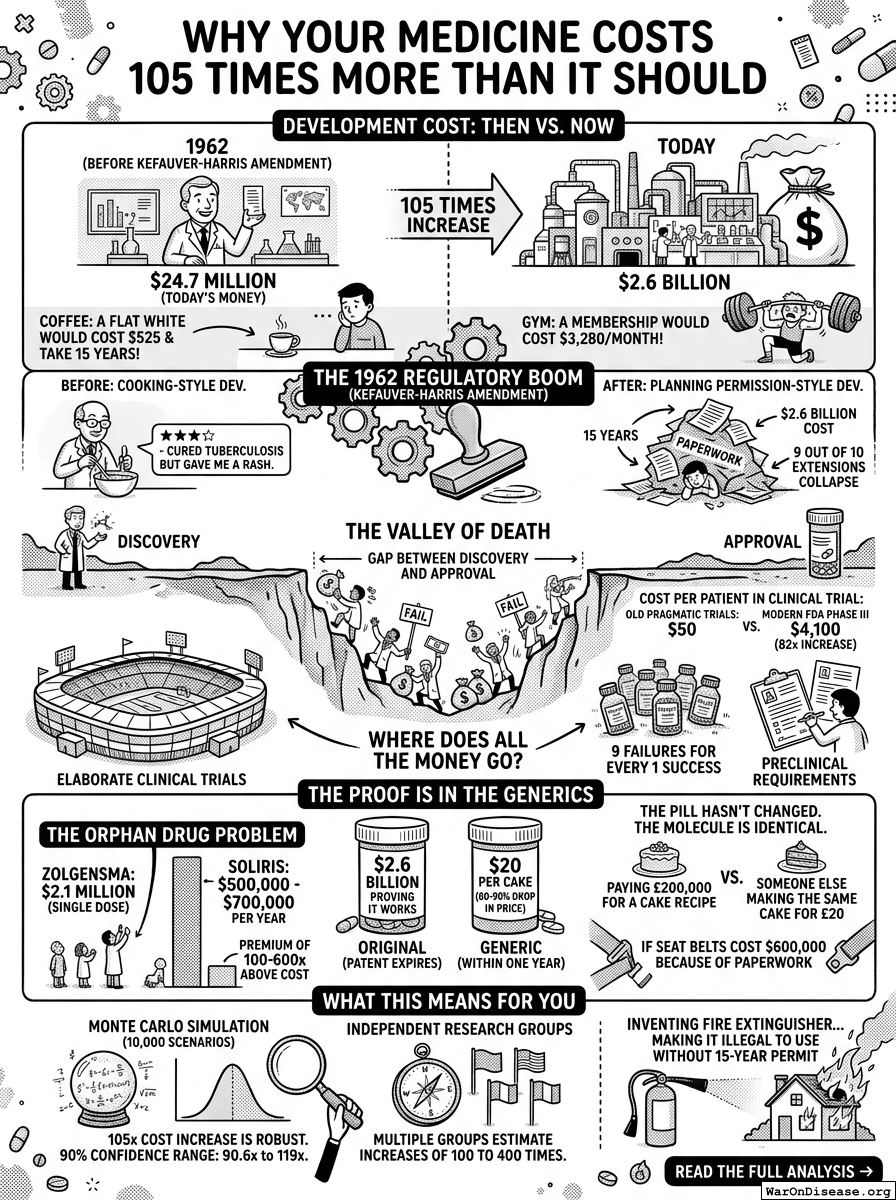
Today, it costs $2.6 billion. That's 105 times more. To put that in perspective, if your morning coffee had increased by the same factor, you'd be paying about $525 for a flat white. And the flat white would take 15 years to arrive.
What Happened in 1962?
In 1962, the American government passed the Kefauver-Harris Amendment, which sounds like a buddy cop film but was actually a law requiring drug companies to prove their drugs worked before selling them to people. Which on the surface sounds reasonable, in the same way that requiring restaurants to prove their food is edible sounds reasonable—until you realize that the process of proving it takes so long that everyone starves to death while the paperwork goes through.
Before 1962, developing a drug worked a bit like cooking. You had an idea, you tried it out, you reported what happened. Doctors would just test drugs and write up the results in medical journals. It was like Yelp, but for pharmaceuticals. "Three stars—cured my tuberculosis but gave me a rash."
After 1962, developing a drug became more like applying for planning permission to build an extension on your house, if the extension took 15 years and cost $2.6 billion and nine out of ten extensions collapsed during construction and you had to pay for those too.
The Valley of Death (Not a Place You'd Want to Holiday)
Drug development now has something called the "Valley of Death," which is the gap between discovering a promising molecule and actually getting it approved. It's called the Valley of Death because that's what happens to a lot of people while they're waiting.
The cost per patient in a clinical trial has gone from about $50 in the old pragmatic trials to $4,100 in a modern FDA Phase III trial. That's an 82 times increase. If your gym membership had gone up 82 times, you'd be paying about $3,280 a month and you still wouldn't be going.
Where Does All the Money Go?
Some of it goes to the trials themselves, which are now so elaborate they make the Olympics look like a casual kickabout. Some goes to the nine drugs that fail for every one that succeeds, because under the current system you have to pay full price for your mistakes, like a very expensive game of "Operation" where the buzzer costs $2.6 billion.
And some of it goes to what scientists call "preclinical requirements," which is a fancy way of saying "things you have to do before you can start doing the thing you actually want to do." It's like being told you need to fill in a form before you can get the form you need to fill in.
The Proof Is in the Generics
Here's the bit that really makes you want to lie down. When a drug's patent expires and generic companies can make the same pill without all the regulatory rigmarole, prices typically drop 80-90% within one year. The pill hasn't changed. The molecule is identical. What's changed is that nobody has to spend $2.6 billion proving that it works, because someone already did that.
It's like paying £200,000 for a cake recipe, then watching someone else make the exact same cake for £20. The cake tastes the same. The only difference is that one baker had to fill in seventeen years of paperwork first.
The Orphan Drug Problem
For really rare diseases, where there aren't many customers to spread the development cost across, you can see the full insanity of the pricing. Zolgensma, a treatment for spinal muscular atrophy, costs $2.1 million for a single dose. Soliris costs $500,000-$700,000 per year. These aren't luxury items. These are "your child will die without this" items, priced like a medium-sized yacht.
That's a premium of 100 to 600 times above what the drug would cost without the regulatory overhead. It's as if seat belts cost $600,000 because of the paperwork involved in proving that being flung through a windscreen is bad.
What This Means for You
A Monte Carlo simulation—which is like a crystal ball but with maths instead of mysticism—ran 10,000 scenarios and confirmed that the 105x cost increase is robust. The 90% confidence range is 90.6x to 119x. So even in the best-case scenario, drugs cost about 91 times more than they should.
Multiple independent research groups using completely different methods have estimated increases of 100 to 400 times. They can't all be wrong. Well, they can—humans are quite good at all being wrong at the same time—but in this case the numbers come from different directions and all arrive at the same depressing conclusion: we've made it 100 times more expensive to save lives, and we've somehow convinced ourselves this is progress.
It's a bit like if we'd invented the fire extinguisher and then immediately made it illegal to use without a 15-year permit, and then congratulated ourselves on our commitment to fire safety while the house burned down.
Comments