
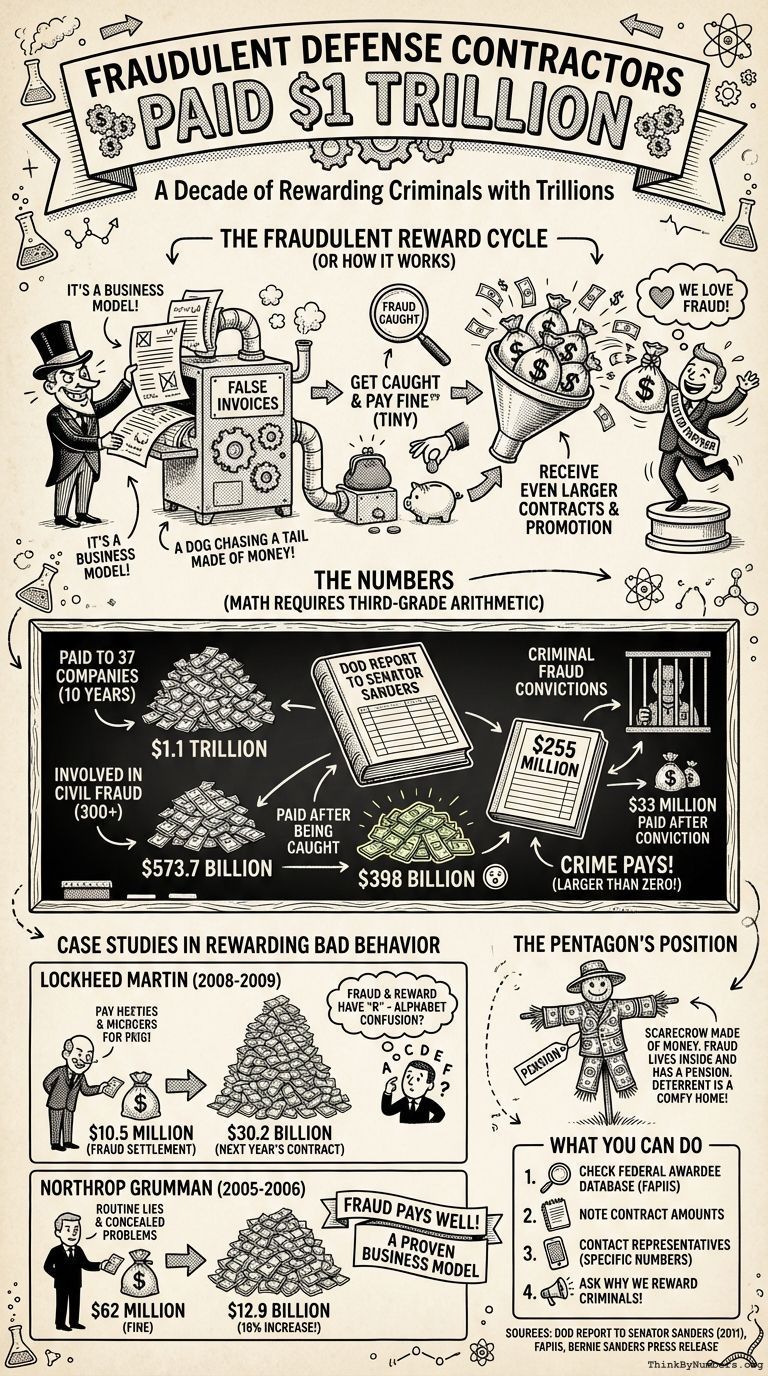
The Pentagon paid $1.1 trillion over a decade to contractors who defrauded the government. After being convicted of crimes, they got more money. The math requires third-grade arithmetic, so the confusion is notable.
Maybe to understand government contracting, we have to look at the word 'fraud' itself. Basically, it's made up of letters that spell something we punish in regular society but reward with billions in the military. It's a mystery, and that's why so are defense contracts.
How It Works
Here's the system:
- Defense contractor submits false invoices
- Gets caught committing fraud
- Pays fine (usually small)
- Receives even larger contracts
It's like a dog chasing its tail, if the tail was made of money and the dog was democracy.
Fraud works by lying about money. When normal people do this, they go to prison. When defense contractors do it, they get promoted to "trusted partner." This makes the contractors very happy, which is why there's an explosion of fraud.
The Numbers
The Department of Defense, in a report prepared for Senator Bernie Sanders, detailed the following:
- $1.1 trillion paid to 37 companies engaged in fraud over 10 years
- $573.7 billion paid to 300+ contractors involved in civil fraud cases
- $398 billion of that paid AFTER they were caught
- $255 million to contractors convicted of criminal fraud
- $33 million paid AFTER criminal convictions
I checked. $1.1 trillion is larger than zero, which is the amount you typically reward criminals.
Case Studies in Rewarding Bad Behavior
Lockheed Martin paid $10.5 million in 2008 to settle fraud charges for submitting false invoices. The Pentagon responded by giving them $30.2 billion in 2009. More than ever before. Because when someone steals from you, you obviously give them a raise.
I think the reason we reward fraud is because "fraud" and "reward" both have the letter "r" in them. The Pentagon probably got confused by the alphabet.
Northrop Grumman paid $62 million in 2005 after "routinely submitting false contract proposals" and concealing inventory problems. The next year, they received $12.9 billion in contracts. That's 16% more than the year before they were caught lying.
The pattern is clear: Fraud pays well. Specifically, it pays in government contracts.
Maybe if we all just committed fraud against the Pentagon, we'd all be rich. But that would be stealing, which is wrong. Unlike contractor fraud, which is apparently a business model.
The Pentagon's Position
When asked to recommend ways to punish fraudulent contractors, the Pentagon noted that sanctions "already exist" but admitted "it is not clear, however, that these remedies are sufficient to deter and punish fraud."
You know your deterrent isn't working when the punished behavior increases by 16%.
A deterrent is like a scarecrow for fraud. But instead of scaring the fraud away, we built a scarecrow made entirely of money. Now the fraud lives inside it and has a pension.
What You Can Do
Senator Sanders created a public database tracking contractor fraud. You can check the Federal Awardee Performance and Integrity Information System to see which companies defraud the government and how much we pay them anyway.
Here's how to use this information:
- Check which contractors have fraud records
- Note how much they still receive in contracts
- Contact your representatives with specific numbers
- Ask why we're rewarding criminals with tax dollars
The full Pentagon report is available here and the data tables are here.
Sources
- Department of Defense Report to Senator Bernie Sanders, October 2011
- Federal Awardee Performance and Integrity Information System
- Bernie Sanders Senate Press Release
Comments