
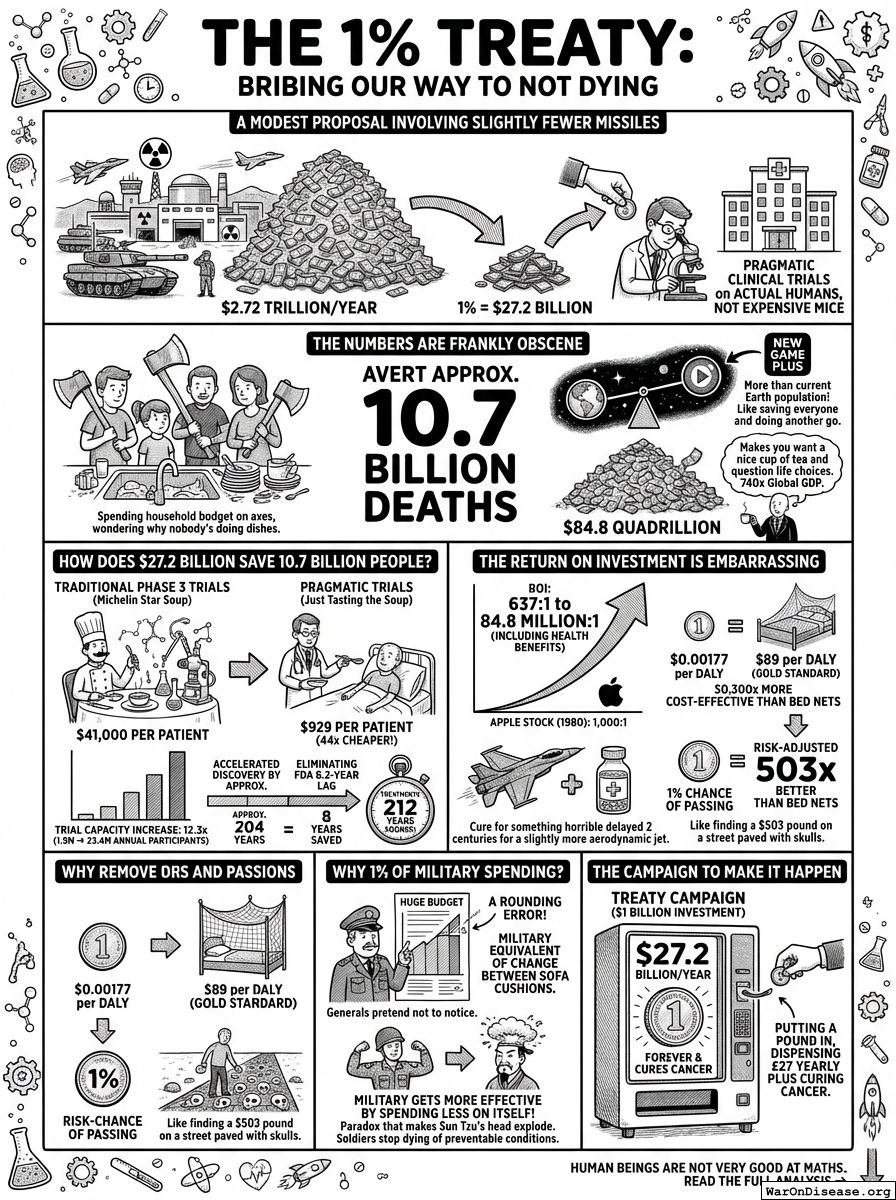
A Modest Proposal Involving Slightly Fewer Missiles
Humanity currently spends about $2.72 trillion per year on the military. That's trillion with a T, which is the letter you get when you take a billion and give it a growth hormone. We spend this money primarily on the ability to kill each other, which is a bit like a family spending their entire household budget on axes and then wondering why nobody's doing the dishes.
The 1% Treaty proposes taking just 1% of that—a measly $27.2 billion—and spending it on medical research instead. Specifically, on pragmatic clinical trials that test whether drugs work on actual humans in actual hospitals, rather than on very expensive mice in very expensive laboratories.
The Numbers Are Frankly Obscene
According to the analysis, this modest reallocation would avert approximately 10.7 billion deaths. That's more people than currently exist on Earth. It's as if you could save everyone alive today and then do another go, like some sort of cosmic new game plus.
The economic value of those saved lives? $84.8 quadrillion. I had to look up what a quadrillion was, and it turns out it's a real number and not something a child made up. It's a thousand trillion, or about 740 times the current global GDP. It's the kind of number that makes you want to sit down and have a nice cup of tea and question all of your life choices.
How Does $27.2 Billion Save 10.7 Billion People?
Right, here's where it gets properly mad. Currently, we test drugs using traditional Phase 3 clinical trials that cost about $41,000 per patient. These are like going to a Michelin star restaurant when all you wanted was to find out if the soup was poisonous.
Pragmatic trials—where you just test drugs on regular patients in regular hospitals—cost about $929 per patient. That's a 44 times reduction, which means you can test 44 times more drugs on 44 times more people. It's like discovering that you can check if soup is poisonous by simply tasting it instead of sending it to Switzerland for analysis.
This creates a 12.3x increase in trial capacity, expanding from 1.9 million to 23.4 million annual trial participants. All those extra trials accelerate when we discover which treatments work by approximately 204 years. Plus, eliminating the FDA's 8.2-year efficacy lag after drugs are already proven safe saves another 8 years.
Combined, treatments arrive 212 years sooner on average. Which means that right now, somewhere, there's a cure for something horrible that we won't discover for two centuries because we're spending the money on a slightly more aerodynamic fighter jet instead.
The Return on Investment Is Embarrassing
The ROI is 637:1 on a conservative estimate, and up to 84.8 million to 1 when you include the health benefits. For context, the best financial investment in history was probably buying Apple stock in 1980, and that only returned about 1,000:1.
The cost-effectiveness works out to $0.00177 per DALY (disability-adjusted life year). The current gold standard for cost-effective health interventions is insecticide-treated bed nets at $89 per DALY. This proposal is 50,300 times more cost-effective than bed nets.
Even if you think there's only a 1% chance the treaty would actually pass—and given humanity's track record, that might be generous—the risk-adjusted cost-effectiveness is still 503 times better than bed nets. It's like finding a pound on the street, except the pound is worth $503 and the street is paved with the skulls of people who died of preventable diseases.
Why 1% of Military Spending?
Because it's a number small enough that generals can pretend not to notice. One percent of the defence budget is a rounding error—it's the military equivalent of the change that falls between your sofa cushions. The entire global military would barely notice it was gone.
What they would notice, eventually, is that their soldiers stopped dying of cancer, their pilots stopped getting heart disease, and their submarines stopped being crewed by people with preventable chronic conditions. The military would actually get more effective by spending less on itself, which is the kind of paradox that would make Sun Tzu's head explode.
The Campaign to Make It Happen
The estimated cost to actually pass this treaty is about $1 billion in campaign spending. One billion to unlock $27.2 billion per year forever. That's like putting a pound in a vending machine and having it dispense £27 every year for the rest of time, plus also it cures cancer.
The fact that we haven't done this yet is perhaps the strongest evidence that human beings are not, on the whole, very good at maths.
Comments