
What 1% Less Murder Money Buys You
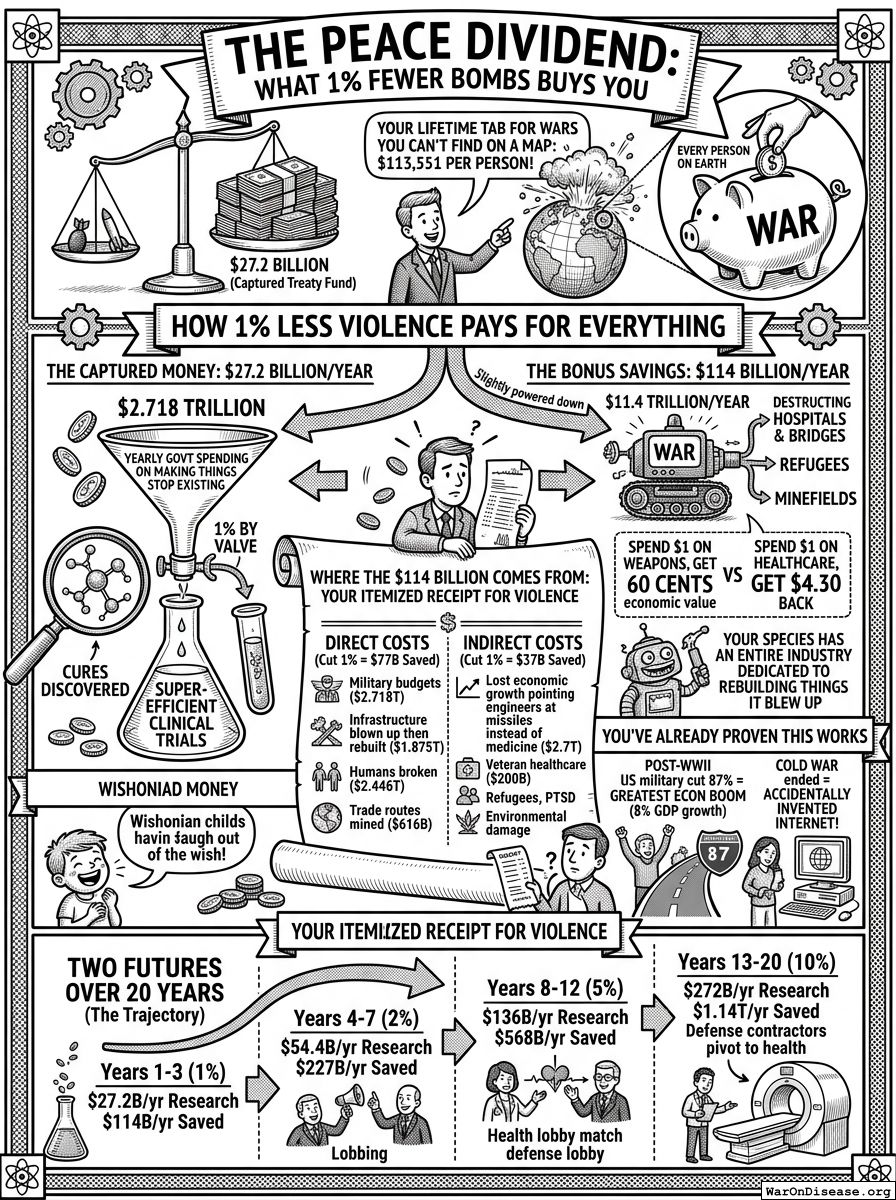
Here's what 1% less murder money buys you. A 1% Treaty Fund gets $27.2 billion to subsidize hyper-efficient clinical trials. The world saves $114 billion it would have spent rebuilding bombed hospitals, treating shrapnel wounds, and housing refugees. Your lifetime tab for wars in countries you can't find on a map: $113,551 per person over 80 years. That's per person. Every person on Earth. Including you. You personally have been billed $113,551 for explosions on the other side of the planet, and nobody sent you an invoice because they knew you'd cancel.
How 1% Less Violence Pays For Everything
Pragmatic clinical trials can be 100x more efficient than the current system. Two ways you profit from building 1% fewer bombs:
The Captured Money: $27.2 Billion/Year
Your governments spend $2.718 trillion yearly on things whose sole purpose is making other things stop existing. Redirect 1%:
$2,718B × 0.01 = $27.2 billion
The rounding error on your murder budget.
The Bonus Savings: $114 Billion/Year
Wars cost $11.4 trillion/year. Build 1% fewer bombs, fight 1% fewer wars, save $114 billion.
$11,400B × 0.01 = $114 billion
Money no longer spent on un-blowing-up hospitals and bridges, removing shrapnel from people you put shrapnel into, housing refugees whose homes you converted into craters, and routing shipping containers around minefields. Your species has an entire industry dedicated to rebuilding things it blew up. You employ people to fill holes that you employed other people to make. On Wishonia, this is used as a children's fable about inefficiency. The children laugh. Then they ask if it's real. Then they stop laughing.
Where the $114 Billion Comes From
Your itemized receipt for violence:
Direct costs: $7.7 trillion per year. Military budgets ($2.718T), infrastructure you blow up and then pay to rebuild ($1.875T), humans you break ($2.446T), and trade routes you keep putting mines in ($616B). Cut 1%: $77 billion saved.
Indirect costs: $3.7 trillion per year. The part your accountants pretend doesn't exist. Lost economic growth from pointing engineers at missiles instead of medicine ($2.7T). Veteran healthcare, because the humans you send to war come back needing hospitals ($200B). Refugees, PTSD, environmental damage, lost human capital. Cut 1%: $37 billion saved.
Total: $11.4 trillion per year on war. 1% less war saves $114 billion.
On your planet, this is called "a good deal." On mine, it's called "so obvious that failing to do it constitutes evidence of a cognitive disability."
Plus cancer gets cured as a bonus. Almost forgot about that part.
The GDP Multiplier (Or: Why Bombs Are a Terrible Investment)
Spend a dollar on weapons, get 60 cents of economic value. Spend a dollar on healthcare, get $4.30 back. Your species chose weapons. Every time. For centuries. On Wishonia, this would be considered evidence. On Earth, it is considered an anecdote, which is what humans call evidence when they don't want to act on it.
The Elasticity Question
The elasticity parameter asks the only interesting question here: if you cut military spending 1%, do war costs actually drop 1% too? Or do humans, being humans, find a way to keep killing each other at full price?
At e = 0.25 (the "humans are barely trainable" scenario), only a quarter of cuts reduce violence. At e = 1.0 (full match, probably generous given your track record), every dollar cut is a dollar of war cost saved.
It doesn't matter. Even at e = 0.25, the $27.2 billion is treaty-mandated. That money moves regardless of whether you manage to be less violent. It's a bank transfer, not a prayer.
Here's why the elasticity is probably better than 1.0: military spending doesn't just respond to threats; it generates them. Robert Pape at the University of Chicago found that 95% of suicide terrorist attacks from 1980 to 2003 were responses to foreign military occupation, not ideology. Half the attackers had no religious motivation at all (the leading group was atheist Marxists). Your $8 trillion War on Terror took terrorist attacks from about 1,000 per year to nearly 17,000 by 2014. Bases provoke resistance, resistance justifies bigger budgets, bigger budgets fund more bases. It's a feedback loop. Cut 1% of the bases, you remove 1% of the provocation, which removes more than 1% of the terrorism. It's like discovering that your umbrella was causing the rain.
You've Already Proven This Works
After World War II, America cut military spending 87% (from $878 billion to $114 billion in today's money) and got the greatest economic boom in human history. 8% GDP growth for a decade, home ownership doubled, the interstate highway system. The Cold War ended, spending dropped by half, and you accidentally invented the internet. Every time your species stops buying explosions, prosperity shows up uninvited. You're asking for 1%. You've proven you can handle 87%.
The Part Where the Math Gets Embarrassing
The guaranteed floor is $27.2 billion/year. Direct budget transfer. No elasticity, no assumptions, no hoping humans behave. Just math. The best case is $114 billion/year in total societal benefit; the range is wide because, again, your species.
Even the pessimistic scenarios stay above roughly $50B annually, which means your "worst case" is still the largest increase in medical research funding in human history. For context, the Captured Dividend alone would boost global medical research funding by roughly 40% over the current $68 billion baseline. You've been spending more on camouflage paint than on curing Alzheimer's. Camouflage paint. To make things invisible. While Alzheimer's makes people invisible and you can't even be bothered to match the budget.
The Trajectory, Not the Snapshot
Skeptics ask whether 1% fewer bombs means exactly 1% fewer wars. This is the wrong question. It's like asking whether the first seed planted produced exactly one tree's worth of shade. The question is what happens when the seeds keep growing.
The treaty doesn't stay at 1%. Incentive Alignment Bonds are tradable securities held by rich and powerful people whose income scales directly with treaty expansion. At 1%, bondholder payouts start. At 2%, they double. At 10%, they collect ten times as much. These aren't activists you can ignore at a dinner party. They're investors with Bloomberg terminals, lobbyists, and the same tools your weapons manufacturers currently use to expand military budgets, except pointed at curing diseases.
Two Futures Over 20 Years
| Years | Treaty % | Research Funding | War Costs Saved | What Happens |
|---|---|---|---|---|
| 1-3 | 1% | $27.2B/yr | $114B/yr | Treaty passes. Bondholders start lobbying for 2%. |
| 4-7 | 2% | $54.4B/yr | $227B/yr | Politicians discover voters like living. |
| 8-12 | 5% | $136B/yr | $568B/yr | Health lobby rivals defense lobby. |
| 13-20 | 10% | $272B/yr | $1.14T/yr | Defense contractors pivot to health. |
The difference between the civilization that survived and the one that didn't wasn't intelligence, resources, or goodwill. It was whether the richest people on the planet made more money from expanding the treaty or from letting it die.
The 1% Treaty isn't the peace dividend. It's the down payment on a future so nice that your brain is literally incapable of even imagining it currently.
Comments