
Your Itemized Receipt for Global Violence
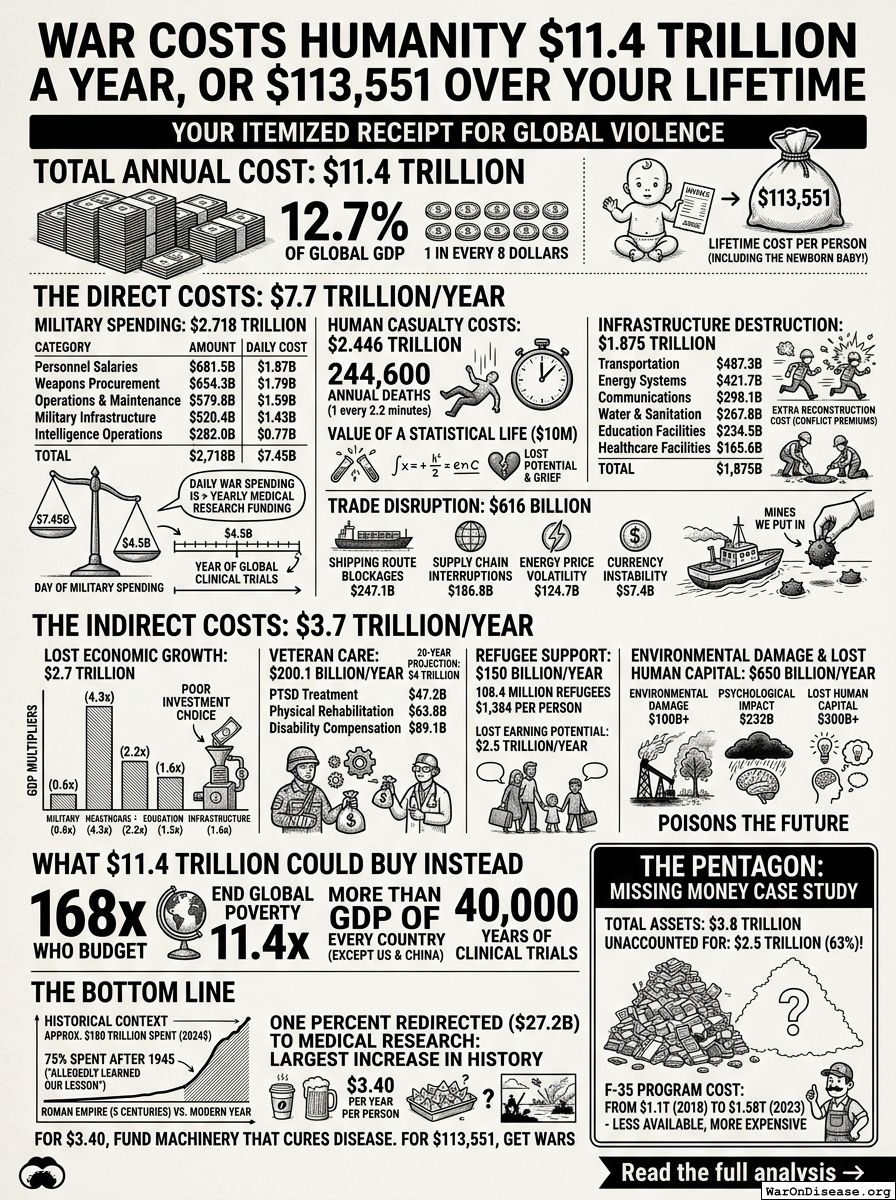
War costs your species $11.4 trillion per year. That's 12.7% of global GDP—one in every eight dollars earned on Earth goes toward the industry of making things and people stop existing.
Over a lifetime, that's $113,551 per person. Every person. Including you. Including the baby born five minutes ago who has done nothing wrong and is already $113,551 in the hole on the exploding-things budget.
Nobody sent you an invoice because they knew you'd cancel.
The Direct Costs: $7.7 Trillion/Year
Military Spending: $2.718 Trillion
This is the money your governments openly admit to spending on things whose primary function is converting other things into smaller, hotter, more scattered versions of themselves.
| Category | Amount | Daily Cost |
|---|---|---|
| Personnel Salaries | $681.5B | $1.87B |
| Weapons Procurement | $654.3B | $1.79B |
| Operations & Maintenance | $579.8B | $1.59B |
| Military Infrastructure | $520.4B | $1.43B |
| Intelligence Operations | $282.0B | $0.77B |
| TOTAL | $2,718B | $7.45B |
$7.45 billion per day on the military. For context, the entire global budget for clinical trials is about $4.5 billion per year. You spend more on war in a single day than you spend on curing disease in an entire year. This is a choice. Nobody forced this choice on you. You made it, repeatedly, for decades, and then complained that you couldn't afford healthcare.
Human Casualty Costs: $2.446 Trillion
Roughly 244,600 people die from conflict annually—670 per day, one every 2.2 minutes. Using the standard economic value of a statistical life ($10 million, which is the number governments use when deciding whether to install a guardrail), that's $2.446 trillion per year in deleted humans.
Every 2.2 minutes, the global economy loses $10 million worth of person. That's not counting their family's grief, their unfinished projects, or the fact that one of them might have been the person who cures cancer. Statistically, given enough deaths, you've almost certainly killed several would-be cure-discoverers. The disease got them before the disease got them, if you follow.
Infrastructure Destruction: $1.875 Trillion
| Type | Annual Damage |
|---|---|
| Transportation | $487.3B |
| Energy Systems | $421.7B |
| Communications | $298.1B |
| Water & Sanitation | $267.8B |
| Education Facilities | $234.5B |
| Healthcare Facilities | $165.6B |
| TOTAL | $1,875B |
War zone reconstruction costs 1.3-2.1x more than normal construction, because of what military analysts call "conflict premiums" and normal people call "construction workers getting shot."
You blow up hospitals and then pay extra to rebuild them. You destroy roads and then pay extra to repave them. You flatten schools and then pay extra to re-educate the children who survived. You have an entire industry dedicated to un-doing the things another industry did. You employ people to fill holes that you employed other people to make.
Trade Disruption: $616 Billion
- Shipping route blockages: $247.1B
- Supply chain interruptions: $186.8B
- Energy price volatility: $124.7B
- Currency instability: $57.4B
This is the cost of putting mines in shipping lanes and then routing around the mines you put in the shipping lanes. It's the maritime equivalent of digging a hole in your own driveway and then complaining about the pothole.
The Indirect Costs: $3.7 Trillion/Year
Lost Economic Growth: $2.7 Trillion
This is the big one. Your military spending has a GDP multiplier of 0.6x—every dollar spent generates only 60 cents of economic value. Healthcare spending has a multiplier of 4.3x. Education: 2.2x. Infrastructure: 1.6x.
You chose the investment that returns 60 cents on the dollar. Every time. For decades. This is the financial equivalent of consistently choosing the worst item on the menu, every night, at every restaurant, for 75 years, and then writing a Yelp review blaming the restaurant.
The $2.7 trillion in lost annual GDP growth is the difference between what your economy would produce if you invested in things that grow it versus things that explode.
Veteran Care: $200.1 Billion/Year
You send humans to war, they come back broken, and then you pay to fix them. The 20-year projected cost of current veteran care: $4 trillion.
| Category | Annual Cost | 20-Year Projection |
|---|---|---|
| PTSD Treatment | $47.2B | $944B |
| Physical Rehabilitation | $63.8B | $1,276B |
| Disability Compensation | $89.1B | $1,782B |
| Total | $200.1B | $4,002B |
Refugee Support: $150 Billion/Year
108.4 million refugees globally, at $1,384 per person. Their lost earning potential: $2.5 trillion per year. You displaced them, and then their inability to work costs everyone else $2.5 trillion. War is an investment that keeps losing money long after the fighting stops.
Everything Else: $650 Billion/Year
- Environmental damage: $100B+ (soil, water, air, biodiversity)
- Psychological impact: $232B
- Lost human capital: $300B+
Landmines contaminate soil for decades. Depleted uranium contaminates water tables. Burning oil fields contaminate the atmosphere. War doesn't just destroy the present. It poisons the future and then sends the future an invoice.
The Pentagon: A Case Study in Missing Money
The Pentagon owns $3.8 trillion in assets but cannot account for $2.5 trillion of them. That's 63%. The Pentagon has lost track of more money than most countries have ever had. If you lost 63% of your possessions, you'd call the police. The Pentagon just calls it Tuesday.
The F-35 programme's lifetime sustainment cost increased from $1.1 trillion in 2018 to $1.58 trillion in 2023, despite the planes becoming less available. So they cost more and work less. It's like a plumber who charges extra every time your pipes burst, which is also every time.
What $11.4 Trillion Could Buy Instead
The total annual cost of war ($11.4T) is equivalent to:
- 168x the entire WHO budget
- Enough to end global poverty 11.4 times over
- More than the entire GDP of every country except the US and China
- Roughly 40,000 years of clinical trial funding at current rates
If you took the money the world spends on war in a single year and spent it on clinical trials instead, you could fund 40,000 years of medical research. Four hundred centuries. You could test every known safe compound against every known disease, with replication, and still have change left over for a nice lunch.
Historical Context
Your species has spent approximately $180 trillion (in 2024 dollars) on war throughout history. 75% of that was spent after 1945—the year you allegedly learned your lesson. The Roman Empire spent less on its military across five centuries than one year of modern military spending. You are spending more per year on destruction than history's largest empire spent in half a millennium, and you call this "maintaining peace."
The Bottom Line
$11.4 trillion per year. $113,551 per person over a lifetime. 12.7% of everything the human race produces, fed into a wood chipper made of geopolitics.
One percent of the military budget—$27.2 billion—redirected to medical research would be the largest increase in clinical trial funding in human history. It would cost each person on Earth approximately $3.40 per year. Three dollars and forty cents. Less than a coffee. Less than a beer. Less than the nachos you bought at the game last weekend that gave you heartburn.
For $3.40, you could fund the machinery that cures most diseases. For $113,551, you get wars in countries you can't find on a map. You are currently paying for the wars. Nobody asked if you wanted the nachos instead. The nachos are better for you in every measurable way, including the heartburn.
Comments