
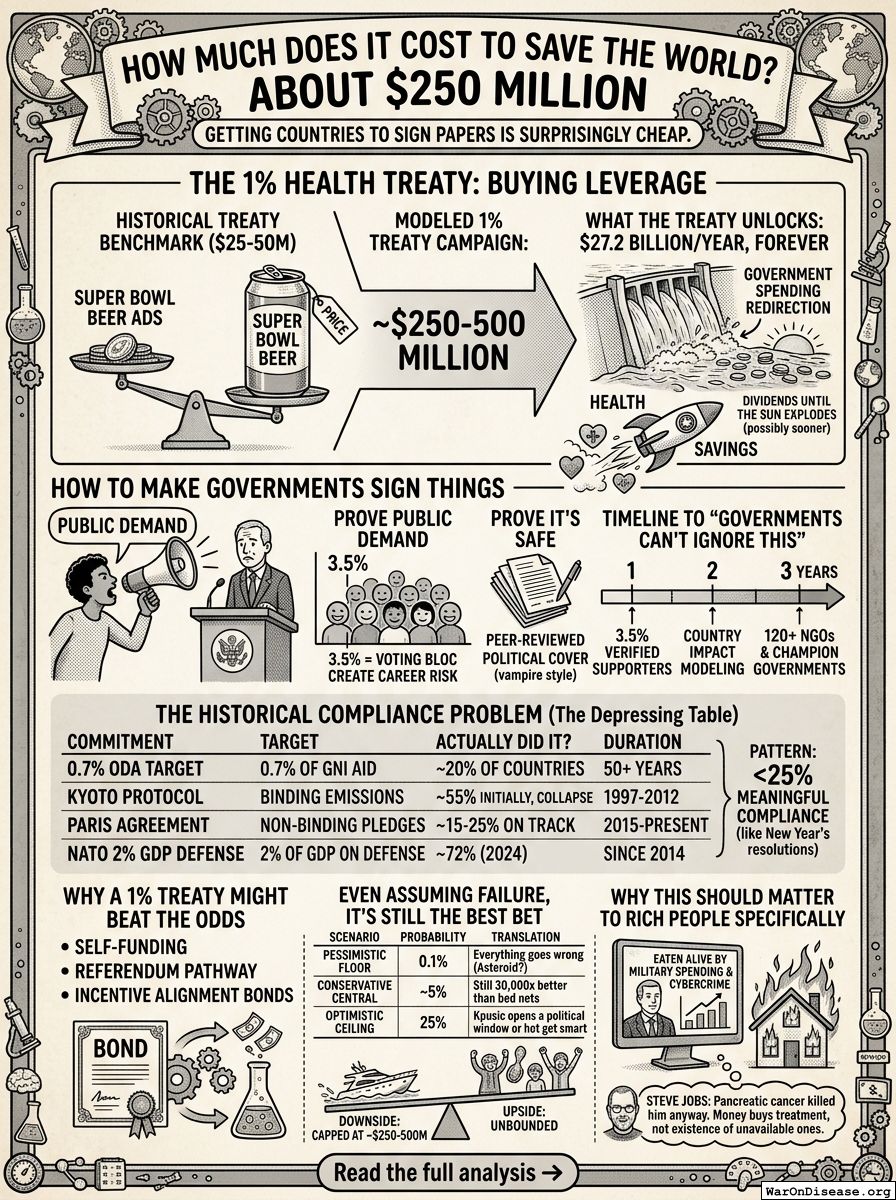
Getting Countries to Sign Papers Is Surprisingly Cheap
"Getting 195 countries to agree costs billions and takes forever."
No. Getting countries to implement things costs billions. Getting them to sign papers is surprisingly cheap. Your entire diplomatic system runs on the principle that writing your name on a document feels like accomplishing something. It doesn't, but it's affordable.
What Treaties Actually Cost
The Ottawa Treaty banning landmines took 14 months. One staff member, Jody Williams, grew a coalition to over a thousand organizations across 60 countries. 122 states signed. She won the Nobel Peace Prize. One woman with a phone convinced 122 countries to stop burying explosives in the ground where children walk. Your species is capable of remarkable things when one person gets sufficiently annoyed.
The Cluster Munitions Convention took about two years. Seven governments and a coalition of NGOs got 94 states to sign. The Arms Trade Treaty took a decade but started with three supporting governments. The Nuclear Ban Treaty also took a decade. ICAN ran the entire operation with five staff in a Geneva office. 122 states voted yes. Another Nobel Prize. Five people in a Geneva office won a Nobel Prize. You have more people in your accounting department.
Pattern: Total to get a treaty signed: $25-50 million (in today's dollars). Your species spends more than that on Super Bowl ads for beer—the thing that makes you temporarily stupider. You will pay more to sell stupidity beverages during one sporting event than it costs to get 122 countries to agree on anything.
Cost for a 1% Health Treaty
Historical treaty campaigns ran on pocket change. But this is not just a signature campaign. It's a referendum engine, lobbying operation, diplomatic push, and reserve fund aimed directly at military budgets, which means you are picking a fight with the most powerful industry your species has ever created.
| Budget Frame | What It Covers | Cost |
|---|---|---|
| Historical treaty benchmark | NGO-led campaigns to get signatures on paper | $25-50M |
| Modeled 1% Treaty campaign | Referendum, lobbying, diplomacy, legal work, reserve fund | ~$250-500M |
The Math
Campaign cost: ~$250-500 million. What the treaty unlocks: $27.2 billion/year. Forever.
Even before you count downstream health gains, this is a one-year redirection of government spending far larger than the campaign that triggered it. You are not buying signatures. You are buying leverage. The campaign cost pays for itself in the first year and then keeps paying dividends until the sun explodes, which, given your species' current trajectory, may happen sooner than the astronomers predicted.
How to Make Governments Sign Things
Politicians move when they see voters demanding it and political cover to do it. Give them both.
First, prove public demand. Get 3.5% of the population to say "yes" with verified identity. The 3.5% finding is not a magic law of treaty ratification. It is a coordination heuristic: the point where a cause stops looking like a niche moral hobby and starts looking like a voting bloc large enough to create career risk. That's not activism. That's a mandate.
Second, prove it's safe. Peer-reviewed modeling showing every nation gains more in health savings than it loses in military spending. Politicians need cover the way vampires need darkness. Give them the numbers and they'll pretend it was their idea (the second most reliable pattern in your political history, after blaming the previous administration).
Timeline to "Governments Can't Ignore This"
With an initial campaign push, you can reach "Treaty-Ready" status in 2-3 years: a platform with ~280 million verified supporters (the 3.5% threshold), country-by-country impact modeling, and a coalition of 120+ supportive NGOs and 5-10 champion governments.
Once these assets exist, formal negotiations become very hard to avoid. Not because politicians want them. Because ignoring 280 million people is the kind of career decision that leads to "spending more time with family."
The Historical Compliance Problem (The Depressing Table)
| Commitment | Target | Actually Did It? | Duration |
|---|---|---|---|
| 0.7% ODA Target | 0.7% of GNI to foreign aid | ~20% of countries | 50+ years |
| Kyoto Protocol | Binding emissions targets | ~55% initially, then collapse | 1997-2012 |
| Paris Agreement | Non-binding pledges | ~15-25% on track | 2015-present |
| NATO 2% GDP Defense | 2% of GDP on defense | ~72% of members (2024) | Since 2014 |
Pattern: International financial commitments achieve <25% meaningful compliance. Your species signs things and then doesn't do them. It's like a New Year's resolution, but for geopolitics.
Why a 1% Treaty Might Beat the Odds
Previous treaties ran on guilt. Guilt has terrible fuel efficiency. This one runs on greed, which is (regrettably) humanity's only reliable fuel source.
It's self-funding: the health dividends exceed the "cost," so you make money by doing the right thing, which is the only way your species does the right thing. "Should we cure more diseases?" polls well across every political spectrum. It has a referendum pathway that bypasses government resistance (politicians hate this, which is how you know it works). And Incentive Alignment Bonds create a permanent lobbying force where wealthy investors profit from treaty expansion, creating the same political pressure that currently expands military budgets—except pointed at curing diseases.
Even Assuming Failure, It's Still the Best Bet
The model assumes a ~5% probability of success. Failure is the base case. It's still a good bet.
Even at 5% probability of success, the expected cost per DALY (disability-adjusted life year) is still 30,000 times more cost-effective than malaria bed nets, which are the gold standard of global health interventions.
| Scenario | Probability | Translation |
|---|---|---|
| Pessimistic floor | 0.1% | Everything goes wrong. Asteroid, possibly. |
| Conservative central | ~5% | Failure remains the base case. Still 30,000x better than bed nets. |
| Optimistic ceiling | 25% | A major crisis opens a political window. Or humans decide to be smart for once. |
Downside: Capped at ~$250-500M. You lose the cost of a nice yacht. Upside: Unbounded. You cure most diseases.
Even assuming failure is the base case, this beats the gold standard of global health interventions. The downside is a yacht. The upside is the end of most disease. Your species makes worse bets every day in Las Vegas, except there the upside is a slightly larger pile of papers. The yacht will be fine. It was going to depreciate anyway.
Why This Should Matter to Rich People Specifically
"But I'm rich, I'll be fine." No, you won't.
Your wealth cannot currently buy a cure for Alzheimer's, cancer, ALS, Parkinson's, or aging. No amount of money cures diseases that haven't been researched. Steve Jobs had $10.5 billion and pancreatic cancer killed him anyway. Money buys the best treatment available. It does not make unavailable treatments exist.
Meanwhile, your productive economy (the one generating your wealth) is being eaten alive by the destructive economy. Military spending plus cybercrime is already 12-15% of GDP and growing faster than your actual economy. A rich person in a collapsing economy is a person with a large number on a screen attached to a bank that no longer functions.
The 1% Treaty doesn't cost you money. It makes you money, keeps you alive longer, and preserves the economic system your money exists within. The alternative is a nice-looking portfolio in a civilization that increasingly resembles a casino where the house is also on fire.
The Bottom Line
Getting 195 countries to redirect 1% of their military budgets to medical research costs about $250-500 million. Getting them to keep doing it costs nothing, because it pays for itself.
The campaign cost is less than what your species spent on the last three Marvel movies. Those movies did not cure any diseases, though to be fair, nobody expected them to. Nobody expects anything to cure diseases, because you've collectively decided that curing diseases is an unrealistic goal, despite having cured diseases before, multiple times, for much less money than this.
Your species routinely spends more money on things that matter less. The question is not "can we afford this?" The question is "can we afford not to?" and the answer is no, but you'll probably try anyway, because that's what you do.
Comments