
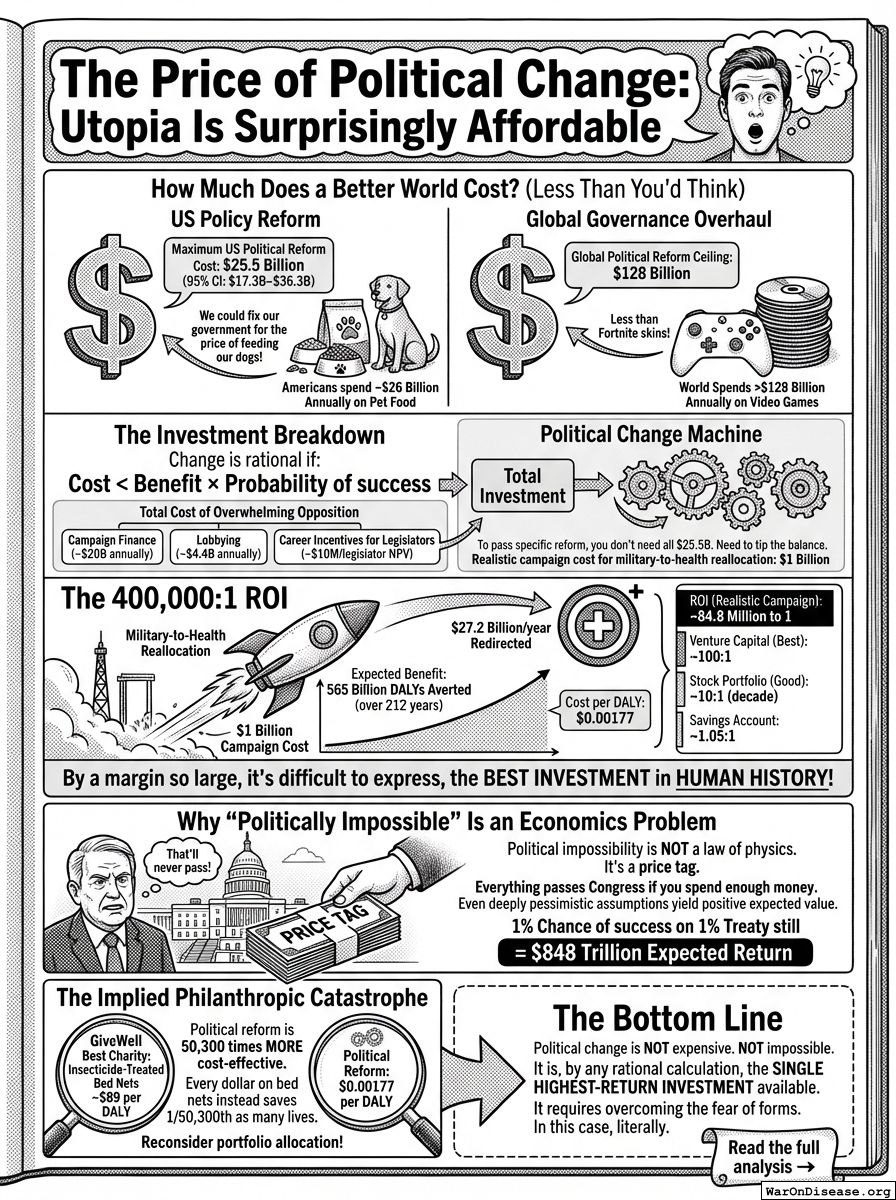
How Much Does a Better World Cost? (Less Than You'd Think)
Most people assume that changing the world is either impossible or prohibitively expensive. It's the kind of thing people say at dinner parties—"you can't fight the system"—before going back to complaining about the system for the next forty years. The Price of Political Change paper does something unusual: it prices the system fight, and it turns out the system is cheaper than a new football stadium.
The maximum cost to reform all US policy through legal channels is estimated at $25.5 billion (95% CI: $17.3B–$36.3B). That sounds like a lot until you remember that Americans spend $26 billion a year on pet food. We could literally fix our entire government for the price of feeding our dogs, but we've collectively decided that Buddy's kibble is a higher priority.
Globally, the ceiling is $128 billion, which is less than what the world spends on video games annually. The complete overhaul of global governance costs less than Fortnite skins.
The Investment Breakdown
Political change is an investment decision, not a moral one. The equation is:
Change is rational if: Cost < Benefit × Probability of success
The paper breaks down the total cost of overwhelming all political opposition:
- Campaign finance: ~$20 billion annually across all US races
- Lobbying: ~$4.4 billion annually
- Career incentives for legislators: ~$10 million per legislator in net present value (the future earnings they protect by doing what donors want)
To pass any specific reform, you don't need all $25.5 billion. You need enough to tip the balance in marginal races and make it more profitable for politicians to support your reform than to oppose it. For the military-to-health reallocation, the realistic campaign cost is about $1 billion.
The 400,000:1 ROI
One billion dollars to redirect $27.2 billion annually from military to medical research. The expected benefit: 565 billion disability-adjusted life years averted over a 212-year acceleration period. The cost per DALY: $0.00177.
Even at the maximum global political investment of $128 billion, the ROI on military-to-health reallocation is 678,000:1. At the realistic $1 billion campaign cost, it's approximately 84.8 million to one.
For comparison:
- The best venture capital investments return maybe 100:1
- A good stock portfolio returns maybe 10:1 over a decade
- A savings account returns about 1.05:1
Political reform returns 84.8 million to one. It is, by a margin so large it's difficult to express in normal numbers, the best investment in human history. And nobody is making it.
Why "Politically Impossible" Is an Economics Problem
People say things like "that'll never pass Congress" as if political impossibility is a law of physics. It's not. It's a price tag. Everything passes Congress if you spend enough money in the right places. We know this because terrible things pass Congress all the time, and they pass because someone spent money to make them pass.
The paper reframes "political impossibility" as a capital allocation problem. High-value reforms generate such extraordinary returns that even deeply pessimistic assumptions about political costs produce positive expected value. Even if you assume only a 1% chance of success, the expected return on the 1% Treaty campaign is still $848 trillion—roughly 7 times global GDP.
This means that funding political reform is rational even for the most cynical, self-interested investor. You don't need to believe in democracy. You don't need to care about sick people. You just need to be able to do basic multiplication, which admittedly is asking a lot of some investors, but the maths really does check out.
The Implied Philanthropic Catastrophe
Currently, the most cost-effective charity, according to GiveWell, is insecticide-treated bed nets at about $89 per DALY. Political reform achieves $0.00177 per DALY. That's 50,300 times more cost-effective.
This means that every dollar spent on bed nets instead of political reform saves approximately 1/50,300th as many lives. Which is still good—bed nets are great—but it does suggest that the entire effective altruism movement might want to reconsider its portfolio allocation. It's like discovering that your savings account has been earning 0.001% when there's an account across the street paying 50,300%.
The Bottom Line
Political change is not expensive. It is not impossible. It is, by any rational calculation, the single highest-return investment available to anyone with capital and a calculator. The reason it hasn't happened is the same reason most people don't change their energy provider even though it would save them money: it requires filling out a form and humans would rather die than fill out a form.
In this case, literally.
Comments