


Your brain decided you would read this sentence 10 seconds before "you" did.
Researchers at the Max Planck Institute discovered they could predict which button you'll press before you know you've decided to press it. They used brain scans to watch decisions form, like seeing someone load a gun before they know they're going to fire it.
The experiment worked like this: People watched letters scroll across a screen. They were told to press one of two buttons whenever they felt like it. Free choice, right?
Wrong. The scientists could see which button you'd pick 10 seconds before you "decided." The prefrontal and parietal cortex lit up with your choice while your conscious mind was still pretending to deliberate.
It's quite clever when you think about it. Your brain makes the decision, then waits politely for "you" to catch up and claim credit for it. Like a parent letting a child think they chose their own bedtime.
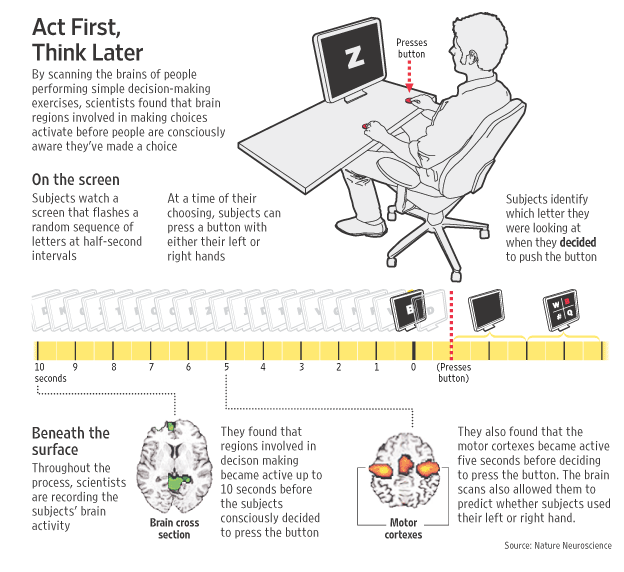
Source: Nature Neuroscience
This creates an awkward philosophical problem. You're made of atoms. Atoms follow physics. Physics is deterministic. So where exactly does the "free" part of free will squeeze in?
Your brain is essentially a very sophisticated meat computer running on electrical signals and chemicals. The decisions it makes follow from prior states, which follow from prior states, all the way back to causes you definitely didn't control - like your parents having unprotected intercourse, or the Big Bang, depending on how far back you want to get philosophical about it.
If I could choose whether to have free will, I'd probably choose to have it. But then again, I suppose I'd have to already have free will to make that choice. It's quite the pickle, really.
The good news: You were never in control anyway, so you can stop blaming yourself for eating that entire pizza. The bad news: You also can't take credit for anything good you've done. The weird news: You'll keep acting like you have free will regardless, because that decision was also made by atoms you don't control.
It makes you wonder - if we don't have free will, why do we have the illusion of it? Perhaps it's because atoms that think they're making choices are slightly less likely to wander into traffic. Evolution doesn't care if you're right, just if you survive long enough to be wrong reproductively.
Study by John-Dylan Haynes et al., Max Planck Institute for Human Cognitive and Brain Sciences, published in Nature Neuroscience (April 15, 2008). Original reporting courtesy World Science.
Comments