
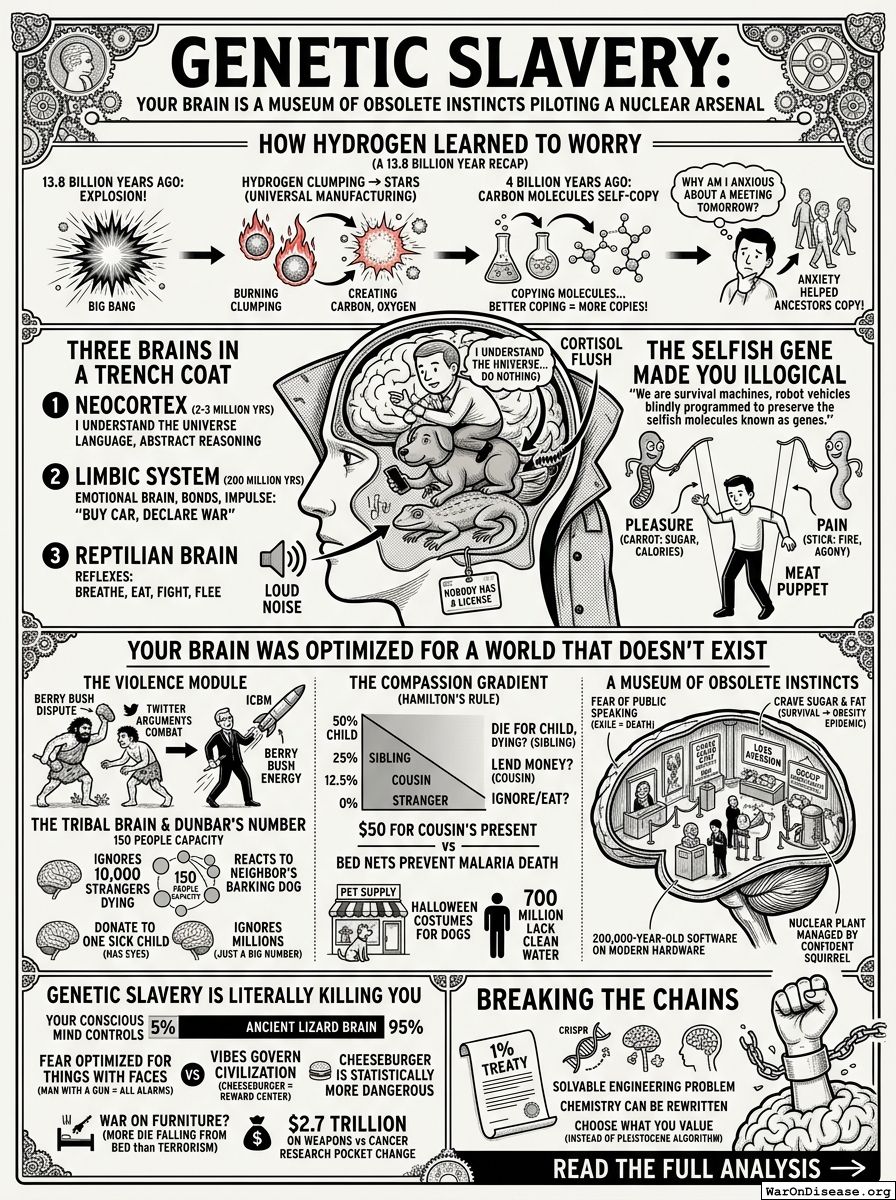
How Hydrogen Learned to Worry (A 13.8 Billion Year Recap)
Thirteen point eight billion years ago, the universe exploded. This was the last time anything interesting happened for about 400 million years. Then hydrogen atoms, which had been drifting around doing nothing (hydrogen is the simplest element because the universe started with low expectations), began clumping together until they got so dense they caught fire. These fires are called "stars." Stars are the universe's first manufacturing process: they take hydrogen, crush it into heavier elements like carbon and oxygen, and then explode, scattering their products across space. The workplace fatality rate is 100%.
This went on for about 9 billion years. Then, on one unremarkable rock orbiting one unremarkable star, carbon atoms started doing something unusual. Carbon bonded with hydrogen, oxygen, and nitrogen in arrangements that could do one very specific trick: copy themselves.
This was the moment everything went wrong.
The molecules that were better at copying made more copies. The ones that were worse at copying made fewer. This is the entire plot of the next 4 billion years. It is also the entire plot of your economy, your politics, your wars, and your inability to fund clinical trials. Everything else is a footnote. Including you.
Four billion years of copying molecules competing with other copying molecules eventually produced a copying molecule so complicated it could look up at the stars that made it and ask, "Why am I anxious about a meeting tomorrow?" The answer is: because anxiety made your ancestors copy more effectively than calm did. You are a temporary vehicle that copying molecules built to make more copying molecules, and the vehicle has become sentient enough to realize this. Congratulations. You're a meat taxi for chemistry.
Three Brains in a Trench Coat
But the vehicle wasn't built all at once. It was built in layers, like a bad renovation where nobody removed the previous tenants' plumbing.
First came the reptilian brain: roughly 500 million years old, handling the functions so basic they're barely worth listing (breathe, eat, fight, flee, reproduce). This is the brain you share with lizards. It has no feelings. It has no opinions. It has reflexes. It's still running right now. It's the reason your heart is beating without your permission.
Then, about 200 million years ago, mammals evolved the limbic system on top of the reptile brain, like building a nursery on top of a weapons depot. This is your emotional brain. It's the reason you bond with your children instead of eating them (a genuine upgrade over the reptilian model). It processes information faster than the part of your brain that thinks, so by the time rational thought shows up, the limbic system has already texted your ex, bought a car, or declared war, and you'll spend the next decade explaining why.
Finally, very recently (roughly 2-3 million years ago), the neocortex expanded dramatically. This is the part you think of as "you." It handles language, abstract reasoning, and the ability to contemplate your own mortality and then do absolutely nothing about it. It's the thinnest layer, the newest addition, and the most easily overridden. Your neocortex can calculate orbital mechanics. Your limbic system can shut all of that down with a single flush of cortisol because someone looked at you funny. Your reptilian brain can override both of them simultaneously because it heard a loud noise.
You are three brains in a trench coat pretending to be one person. The reptile wants to survive. The mammal wants to be loved. The human wants to understand the universe. They take turns driving, none of them have a license, and the reptile has seniority.
The Selfish Gene Made You Illogical (It Was a Good Idea at the Time)
Richard Dawkins put it perfectly: "We are survival machines, robot vehicles blindly programmed to preserve the selfish molecules known as genes."
Translation: You're a meat puppet controlled by chemicals whose entire business plan is "make more chemicals before something eats us."
Your genes don't care if you're happy. They don't care if you live past 30. They care about exactly one thing: making copies of themselves before something with teeth finds you. This is the entire explanation for human behavior, and every other explanation is a footnote.
The mechanism is elegant in its cruelty. Your genes have exactly two tools: pleasure and pain. Pleasure is the carrot: eat sugar, feel good, gain calories, survive winter. Pain is the stick: touch fire, feel agony, never touch fire again, keep the meat vehicle intact. Every decision you think you're making freely is actually your genes yanking these two levers like a puppet master who took one management course and learned that rewards and punishments are the only two things that work.
For 99.9% of human history, this was brilliant engineering. The tribes that were paranoid, violent, and territorial survived. The ones that were trusting, peaceful, and generous were eaten by the paranoid ones, which is evolution's way of saying "nice guys finish extinct."
Your Brain Was Optimized for a World That Doesn't Exist
The Violence Module
15-30% of your ancestors died from violence. Not disease. Not starvation. Other humans, smashing their heads with rocks over territorial disputes about berry bushes. You've since upgraded the rocks to intercontinental ballistic missiles, but the berry bush energy remains.
The tribes that survived assumed every stranger might want to kill them, struck first when threatened, formed tight combat groups, and hoarded weapons obsessively. Your brain is still running this exact software. That's why you instinctively distrust people who don't look like your tribe, why Twitter arguments feel like actual combat (your amygdala genuinely can't tell the difference), and why countries with thousands of nuclear weapons are worried they don't have enough.
The Tribal Brain
Dunbar's number says humans can maintain stable relationships with about 150 people. That's your entire social capacity. Your brain has 150 slots for caring about people, and you've filled most of them with coworkers you tolerate and celebrities who don't know you exist.
Your brain treats anything outside your 150-person monkeysphere as an abstraction. You care more about your neighbor's barking dog than 10,000 people dying of malaria, because the dog is RIGHT THERE being loud and malaria is just a concept with numbers attached. You'll donate to save one sick child whose face you can see but ignore statistics about millions, because one child has eyes and millions is just a very big number that makes your brain hurt and then change the channel.
Democracy asks this brain to make civilization-level decisions. It goes exactly as well as asking a labrador retriever to do your taxes.
The Compassion Gradient
Hamilton's Rule says: help someone if the benefit to them, multiplied by your genetic relatedness, exceeds the cost to you. Your genes don't do universal compassion. They do a cost-benefit analysis based on shared DNA.
You'll die for your children, who share 50% of your genes. You'll probably die for your siblings, depending on which sibling. You'd lend money to your cousins, reluctantly. You'd change the channel to avoid thinking about strangers. And other species? You'd eat them.
You will spend $50 on a birthday present your cousin doesn't want while $5 worth of mosquito bed nets would prevent a child's death from malaria in sub-Saharan Africa. Your genes would rather waste ten times the resources on a relative than save a stranger.
You have pet supply stores that sell Halloween costumes for dogs while 700 million humans lack clean water. You spend more on birthday cards for people you're obligated to pretend to like than on preventing the deaths of people you've never met. And here's the part that should alarm you: this feels completely normal. That's the gradient working.
Your Brain Is a Museum of Obsolete Instincts
Almost every universal human behavior that seems irrational is perfectly rational—just for an environment that hasn't existed for 10,000 years:
- You fear public speaking more than death because social rejection in a tribe of 150 meant exile, and exile meant dying alone in the dark with things that had teeth.
- You crave sugar and fat with an intensity that feels like need because for 200,000 years it basically was need. Now sugar is in everything and your species has an obesity epidemic that kills more people than war.
- You experience loss aversion (losing $100 hurts twice as much as gaining $100 feels good) because in the ancestral environment, losing your food meant death.
- You gossip compulsively because monitoring social dynamics in a tribe of 150 was survival-critical intelligence. That instinct built a $100 billion entertainment industry dedicated to tracking the social dynamics of people you've never met and never will.
Your brain is running 200,000-year-old software on modern hardware. It's like discovering your nuclear power plant is being managed by a very confident squirrel.
Genetic Slavery Is Literally Killing You
Your conscious mind controls maybe 5% of your decisions. The other 95% is your ancient lizard brain running software older than agriculture. You think you're the pilot. You're actually a passenger who occasionally gets to suggest a direction.
This scales to civilization. Your brain's fear center is directly connected to your voting finger. Politicians know this. Say "terrorism" and your lizard brain overrides everything. More people die from falling out of bed than terrorism. You're 35,000 times more likely to die from heart disease. But terrorism feels scarier, because evolution optimized your fear response for things with faces, not things with cholesterol. A man with a gun activates every alarm your brain has. A cheeseburger activates your reward center. The cheeseburger is statistically more dangerous than the man, but your brain doesn't do statistics. Your brain does vibes. Your entire civilization is governed by vibes.
That's why you spent $2.7 trillion on weapons while cancer research got pocket change. Your bed is more dangerous than Al-Qaeda, but nobody's declared a War on Furniture.
Breaking the Chains
You can't change human nature. Two hundred thousand years of evolution doesn't care about your TED talk. But you can create economic systems that make curing people more profitable than killing them. That's the only upgrade your species has ever responded to.
Here's the good news that none of your philosophers seem to have noticed: this is a solvable engineering problem. If you've ever been anesthetized, you've already experienced proof of concept. A chemical entered your bloodstream and your entire experience of pain, fear, and consciousness switched off like a light. Your genes' control over you is not metaphysical. It's chemistry. And chemistry can be rewritten.
The same biotechnology that could cure your diseases could, eventually, liberate you from the neurochemical puppet strings that make you irrational in the first place. CRISPR can rewrite the instructions your cells follow. Psychedelics are dissolving decades of calcified thought patterns in a single afternoon. Brain-computer interfaces are routing around damaged circuits entirely.
The endgame isn't making humans obedient. It's making humans free. For the first time in 200,000 years, you could actually choose what you value instead of having a Pleistocene survival algorithm choose for you.
A 1% Treaty doesn't ask you to be better. It assumes you won't be, and redirects your worst impulses toward not dying. Greed: make curing disease more profitable than building bombs. Fear: make politicians more scared of voters than lobbyists. Tribalism: create an us-vs-disease tribe instead of us-vs-them. Each of these is a hack that redirects an ancient instinct toward a modern goal. None of them require humans to be better. All of them require humans to be exactly as selfish, fearful, and tribal as they already are.
Your genes enslaved you in brains that fear strangers and cannot comprehend statistics. But they also gave you the ability to see the prison. No other animal can think: "Wow, my instincts are completely illogical." That's uniquely human. Use it.
Comments