
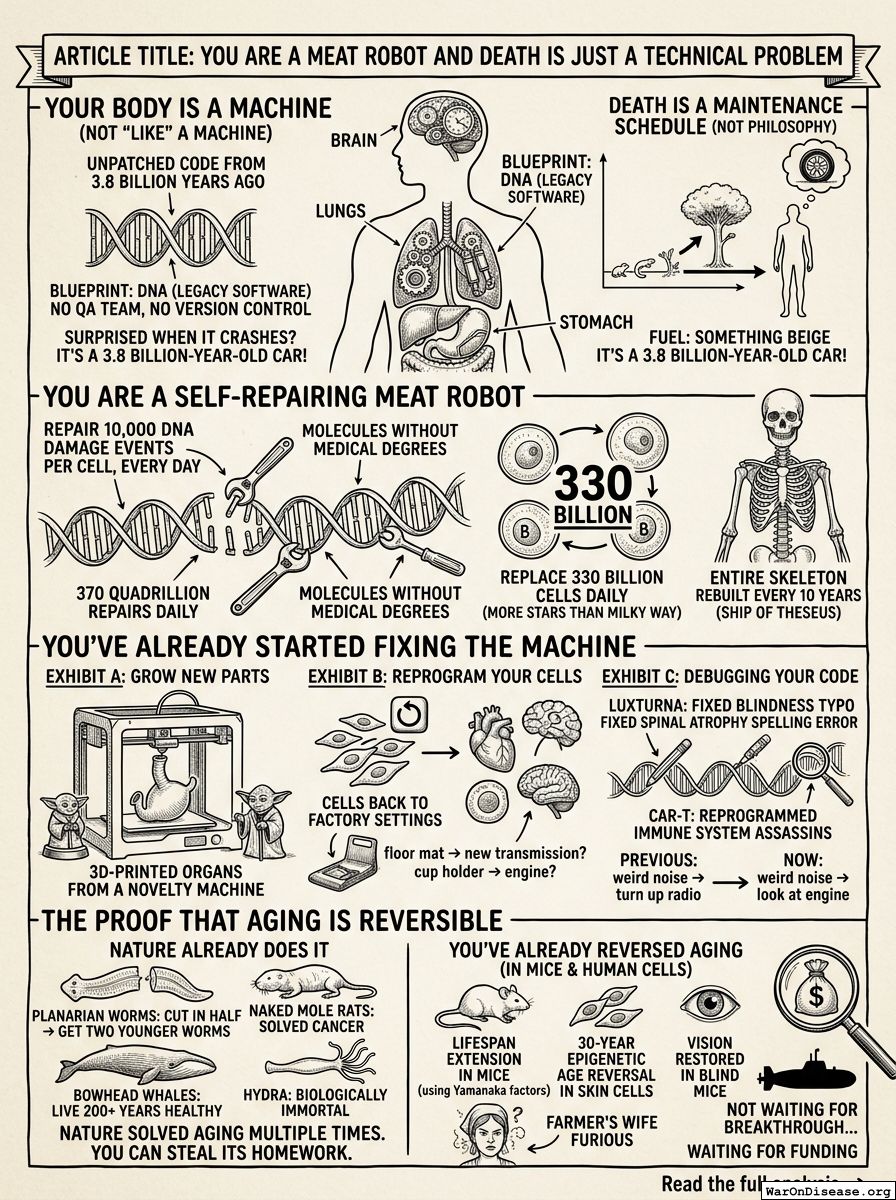
Your Body Is a Machine (Not "Like" a Machine)
Your body is a machine. Not "like" a machine. A machine. Blueprint: DNA. Moving parts: organs. Fuel: whatever you ate for lunch (usually something beige). Owner's manual: your genome, which you only discovered 20 years ago, in a drawer you hadn't opened for 200,000 years. Before that you were just shaking it and hoping. This is called "medicine."
Your DNA is a program written 3.8 billion years ago by a process with no quality assurance team, no project manager, and no version control. It has never been debugged. It has never been patched. It contains code from organisms that went extinct 500 million years ago. You are running legacy software that predates multicellular life, and you are surprised when it crashes. That's like being surprised when a 3.8-billion-year-old car breaks down. The surprising part is that it starts.
Death Is a Technical Problem
Every religion and philosopher has sold you the same story: death is natural, inevitable, and meaningful. Very comforting. Also wrong.
Death is what happens when your parts break faster than your body can fix them. That's not philosophy. That's a maintenance schedule. Every disease is a mechanical failure. Every ailment is a broken part. Every slow decline into decrepitude is an engineering problem with an engineering solution. You just keep filing them under "philosophy" and "the human condition," which is like filing a flat tire under "existentialism."
You've spent 200,000 years writing poetry about death. You could have spent it building a wrench. You did eventually build the wrench. Then you wrote poetry about the wrench.
You Are a Self-Repairing Meat Robot
Your DNA is 3 billion letters of code. Not "like" code. It is code. You learned to read it (the Human Genome Project) and you're learning to edit it (CRISPR). You are mechanics who finally found the service manual under the seat. The service manual is written in a language you only partially understand, in a font that's 3.8 billion years old. But still. Progress.
Every day, your body runs a maintenance routine that would make a German car engineer weep with joy and then immediately resign out of inadequacy:
- You replace 330 billion cells daily. That's 330 billion. With a B. Every day you throw away more cells than there are stars in the Milky Way and grow new ones before lunch.
- You repair 10,000 DNA damage events in every cell, every day. You have 37 trillion cells. That's 370 quadrillion repairs per day, performed by molecules that have never been to medical school.
- You rebuild your entire skeleton every 10 years. You are not the same skeleton you were a decade ago. You are a ship of Theseus made of calcium and poor decisions.
You are not a static object. You are a pattern that persists while matter flows through you. Like a river, except the river is meat and it's arguing with its insurance company. Aging is what happens when the river starts cutting corners on its own maintenance.
You've Already Started Fixing the Machine
Exhibit A: You Can Grow New Parts
A kid in Michigan has a 3D-printed windpipe keeping him alive. You print custom titanium skulls and jaws. You grow bladders and blood vessels in labs and install them in humans. Like replacement parts. For people. From a printer.
The same technology you use to print novelty phone cases, you're using to print throats. You are manufacturing replacement human organs on the same type of machine that makes Yoda figurines. If that doesn't prove you're a machine, I'm not sure what level of evidence you require. Perhaps someone could print you a new brain so you can process it.
Exhibit B: You Can Reprogram Your Cells
In 2006, Shinya Yamanaka figured out how to turn adult cells back into stem cells. Any cell. From anywhere in your body. Back to factory settings. Like holding down the reset button, except on a skin cell. And it works.
This means:
- Your skin cell can become a heart cell
- Your blood cell can become a brain cell
- Any cell can become any other cell
It's like discovering every part of your car can transform into any other part. Need a new transmission? Just reprogram your floor mat. Need a new engine? Your cup holder has been an engine this entire time. It just forgot.
You won a Nobel Prize for proving that your cells have no idea what they are and can be talked into being something else. This is the most important discovery in the history of medicine. You celebrated by going back to mostly not using it.
Exhibit C: You're Debugging Your Code
Gene therapy is literally finding typos in your DNA and correcting them:
- Luxturna (2017): Fixes blindness caused by a mutated RPE65 gene. One injection. Sight restored. The entire disease was a typo. One letter wrong, and you couldn't see. They fixed the letter.
- Zolgensma (2019): Fixes spinal muscular atrophy. Babies who would die before age 2 now walk. The disease was a spelling error in one gene. You corrected the spelling. The baby walks. That's the whole story.
- CAR-T therapy (2017): Reprograms your immune system to hunt cancer. Complete remission in "incurable" cases. You taught your white blood cells to be assassins. They were already assassins, technically, but now they're assassins with a target.
You're not treating symptoms anymore. You're fixing the actual code. That's like going from "the car makes a weird noise, turn up the radio" to "the car makes a weird noise, let me look at the engine." It only took you 200,000 years to try the second approach.
The Car Restoration Analogy
Think of your body as a 1987 Honda Civic with 3.8 billion miles on it. You already know how to fix most of the parts:
- Joints: Like worn brake pads. You pop them out and put new ones in. You've been doing this since the 1960s. It's boring now. Boring is good. Boring means you solved it.
- Arteries: Like clogged fuel lines. You shove a tiny metal tube (a "stent") in there and call it fixed. This works surprisingly well for something that sounds like plumbing.
- Hearts: Like a dead battery. You take one from another car (a car that no longer needs it, for reasons) and put it in yours. This is called a "transplant," which is a polite word for organ recycling.
You're making progress on the harder stuff, too. Cancer is frame damage, and immunotherapy is your new welding torch. Alzheimer's is a bad transmission, and you're finally starting to understand the gears.
The point is: nobody looks at a broken car and says, "Well, that's just the car's journey. The car lived a good life. We should accept the car's natural transition into rust." You call a mechanic. You are a car. Call a mechanic. Fund the mechanic. The mechanic is medical research and you are paying the mechanic almost nothing while spending your money on missiles, which are not a car repair tool even in the loosest interpretation of the word "repair."
The Proof That Aging Is Reversible
Nature Already Does It
If aging were a law of physics, these animals would be illegal:
- Planarian worms: Cut one in half, get two worms. Both younger than the original. It's like cutting your car in half and getting two newer cars. This is obviously impossible, except it happens every day in labs worldwide.
- Naked mole rats: Live 10x longer than similar-sized mammals. Don't get cancer. They look like a thumb that's been left in the bath too long, but they've solved cancer. You have not.
- Bowhead whales: Live 200+ years with no signs of age-related disease. A whale born when Napoleon was alive is still swimming around right now, perfectly healthy, probably judging you.
- Hydra: Biologically immortal. A tiny freshwater polyp with no brain has cracked the code to eternal life. You have a brain. You have not cracked the code. Draw your own conclusions.
Nature solved aging. Multiple times. In multiple species. Using multiple strategies. You just need to steal the answer, which should be easy because you've stolen everything else. You've had empires. You stole entire continents. Surely you can steal a jellyfish's homework.
You've Already Reversed Aging (In Mice... and Human Cells)
You've done it:
- Significant lifespan extension in aged mice using Yamanaka factors
- 30-year epigenetic age reversal in human skin cells
- Vision restored in blind mice; not slowed, reversed
You made old mice young again. You made old human cells young again. You made blind mice see again (which, if you think about it, means the nursery rhyme is now a research paper). The farmer's wife is going to be furious.
The mechanisms are understood. The techniques exist. You've demonstrated them in living organisms. This is not theoretical. This is not science fiction. This is science fact that you proved, published, won prizes for, and then filed under "interesting" before going back to building submarines.
You're not waiting for a breakthrough. You're waiting for funding. Which is like having the cure for death in your pocket and not using it because you can't find exact change.
Comments