
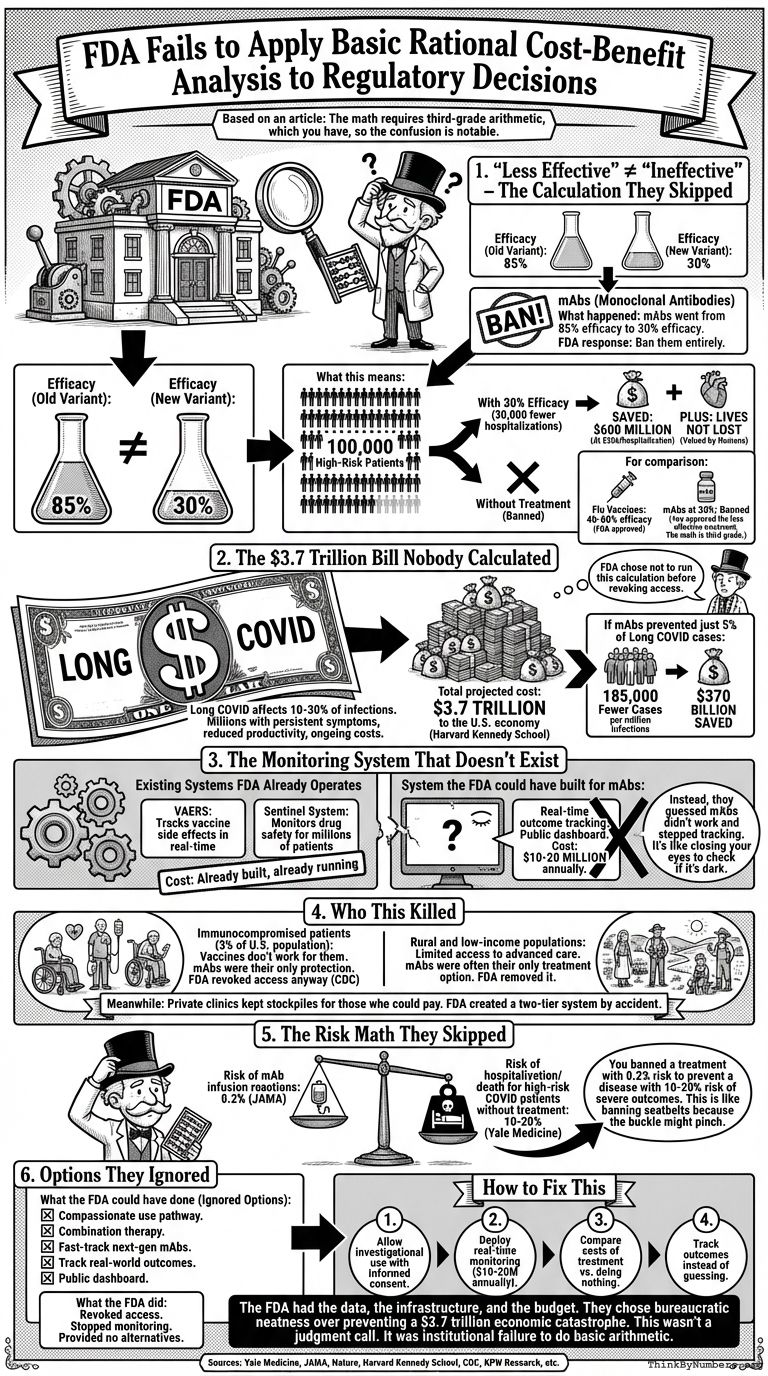
The FDA revoked monoclonal antibodies because they became "less effective" against new variants. Not ineffective. Less effective.
Your regulatory agency can't distinguish between 30% efficacy and 0% efficacy. The math requires third-grade arithmetic, which you have, so the confusion is notable.
Here's the calculation they skipped:
1. "Less Effective" ≠ "Ineffective"
What happened:
- mAbs went from 85% efficacy to 30% efficacy against new variants
- FDA response: Ban them entirely
What this means:
- 100,000 high-risk patients
- 30% reduction = 30,000 fewer hospitalizations
- At $20,000 per hospitalization = $600 million saved
- Plus the lives not lost, which humans claim to value
For comparison:
- Flu vaccines: 40-60% efficacy (FDA approved)
- mAbs at 30%: Banned
You approved the less effective treatment. The math is third grade.
2. The $3.7 Trillion Bill Nobody Calculated
Long COVID affects 10-30% of infections. That's millions of people with persistent symptoms, reduced productivity, and ongoing medical costs.
Total projected cost: $3.7 trillion to the U.S. economy (Harvard Kennedy School)
If mAbs prevented just 5% of Long COVID cases:
- 185,000 fewer cases per million infections
- $370 billion saved
The FDA chose not to run this calculation before revoking access.
3. The Monitoring System That Doesn't Exist
Systems the FDA already operates:
- VAERS: Tracks vaccine side effects in real-time
- Sentinel System: Monitors drug safety for millions of patients
- Cost: Already built, already running
System the FDA could have built for mAbs:
- Real-time outcome tracking
- Public dashboard showing efficacy by variant
- Cost: $10-20 million annually
Instead, they guessed mAbs didn't work and stopped tracking outcomes. It's like closing your eyes to check if it's dark.
4. Who This Killed
Immunocompromised patients (3% of U.S. population):
- Vaccines don't work for them
- mAbs were their only protection
- FDA revoked access anyway (CDC)
Rural and low-income populations:
- Limited access to advanced care
- mAbs were often their only treatment option
- FDA removed it
Meanwhile: Private clinics kept stockpiles for those who could pay. The FDA created a two-tier system by accident.
5. The Risk Math They Skipped
Risk of mAb infusion reactions: 0.2% (JAMA)
Risk of hospitalization/death for high-risk COVID patients without treatment: 10-20% (Yale Medicine)
You banned a treatment with 0.2% risk to prevent a disease with 10-20% risk of severe outcomes. This is like banning seatbelts because the buckle might pinch.
6. Options They Ignored
What the FDA could have done:
- Compassionate use pathway for high-risk patients
- Combination therapy (mAbs + antivirals)
- Fast-track next-generation mAbs
- Track real-world outcomes with existing systems
- Public dashboard for transparency
What the FDA did:
- Revoked access
- Stopped monitoring
- Provided no alternatives
How to Fix This
- Allow investigational use with informed consent for treatments showing partial efficacy
- Deploy real-time monitoring using systems that already exist ($10-20M annually)
- Compare costs of treatment vs. doing nothing before making decisions
- Track outcomes instead of guessing
The FDA had the data, the infrastructure, and the budget. They chose bureaucratic neatness over preventing a $3.7 trillion economic catastrophe.
This wasn't a judgment call. It was institutional failure to do basic arithmetic.
Sources
- 30%: If mAbs reduced hospitalization risk by 30% in a high-risk group (down from 85% in earlier variants), that’s still substantial. https://www.yalemedicine.org/news/5-things-to-know-omicron
- $600 million: At an average hospitalization cost of $20,000, this saves $600 million and countless lives. https://www.healthcare.gov/why-coverage-is-important/protection-from-high-medical-costs/
- 40-60%: FDA-approved flu vaccines often hover around 40-60% efficacy—why the double standard here? https://www.ama-assn.org/delivering-care/public-health/8-things-doctors-wish-patients-knew-about-flu-vaccines
- 10-30%: Long COVID affects an estimated 10-30% of COVID-19 cases, translating to millions of individuals with persistent symptoms, reduced productivity, and increased healthcare costs. https://www.nature.com/articles/s41579-022-00846-2
- $3.7 trillion: Long COVID is projected to cost the U.S. economy $3.7 trillion, per update by David Cutler at Harvard Kennedy School
- $10-20 million annually: Developing and maintaining a monitoring system could cost $10-20 million annually, a negligible amount compared to the potential healthcare savings from even modest improvements in treatment outcomes. https://kpwashingtonresearch.org/index.php/news-and-events/recent-news/news-2019/fda-commits-220-million-next-phase-drug-safety-monitoring-system
- ~3%: Immunocompromised patients (~3% of U.S. population): These individuals rely on mAbs for passive immunity because vaccines are often ineffective for them. https://www.cdc.gov/coronavirus/2019-ncov/hcp/clinical-considerations/covid-19-immunocompromised-patients.html
- ~0.2%: Risk of severe infusion reactions from mAbs is ~0.2%. https://jamanetwork.com/journals/jama/fullarticle/2777081
- 10-20%: Risk of hospitalization or death for high-risk COVID patients is 10-20% without treatment. https://www.yalemedicine.org/news/paxlovid-is-beneficial-for-high-risk-acute-covid-19-patients-study-suggests
Comments