
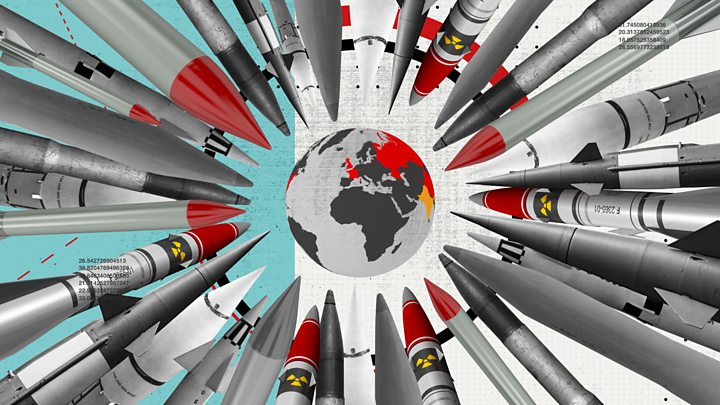
A 10-kiloton nuclear weapon kills 1.3 million people. There are 15,000 nuclear weapons in the world. The math is third-grade level. The reasoning behind it is not.
Nuclear weapons work by splitting atoms. This makes the atoms very angry, which is why there's an explosion. If we had just left the atoms alone, they would have stayed happy and nobody would have died. But we didn't, and now we have 15,000 angry atom machines.
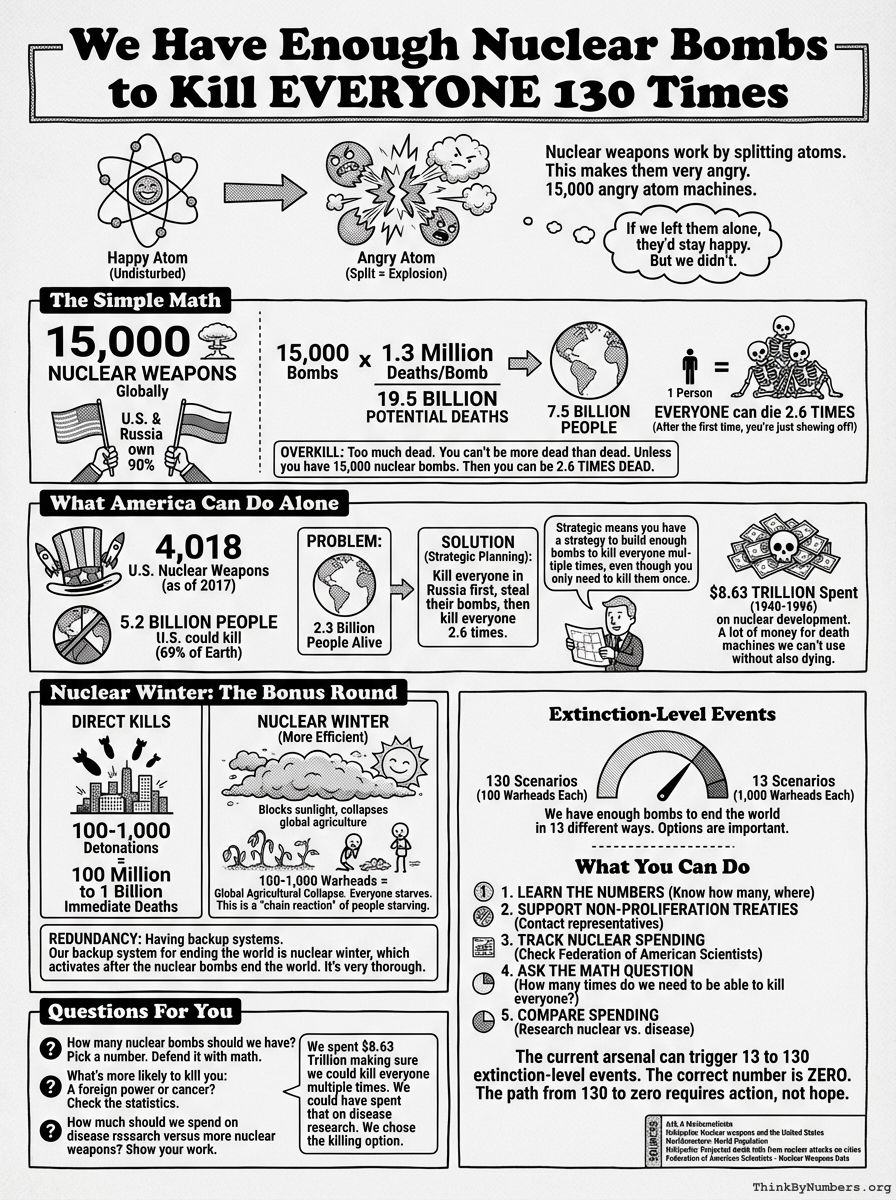
The Simple Math
15,000 nuclear weapons exist globally. The U.S. and Russia own 90% of them.
19.5 billion potential deaths from our current arsenal. That's 19.5 gigadeaths, if you prefer.
7.5 billion people currently live on Earth.
Everyone can die 2.6 times. After the first time, you're just showing off.
Maybe to understand overkill, we have to look at the word itself. It's made up of "over" and "kill." "Over" means too much, and "kill" means making someone dead. So "overkill" means making someone too much dead. But you can't be more dead than dead. Unless you have 15,000 nuclear weapons. Then apparently you can be 2.6 times dead.
What America Can Do Alone
4,018 U.S. nuclear weapons as of 2017.
5.2 billion people the U.S. could kill. That's 69% of Earth's population.
Problem: This leaves 2.3 billion people alive.
Solution: Kill everyone in Russia first, steal their bombs, then kill everyone 2.6 times. This is called "strategic planning."
I think "strategic" means you have a strategy. Our strategy is to build enough bombs to kill everyone on Earth multiple times, even though you only need to kill them once. It's like making 2.6 sandwiches when you're only hungry for one sandwich, except instead of sandwiches it's the complete annihilation of human civilization.
Between 1940 and 1996, the U.S. spent $8.63 trillion on nuclear weapons development. That's a lot of money to build death machines we can't use without also dying.
Nuclear Winter: The Bonus Round
The direct kills are just the beginning. Nuclear winter is where things get mathematically interesting.
100-1,000 nuclear warheads detonated would block enough sunlight to collapse global agriculture. Everyone starves. This is more efficient than shooting them individually.
Nuclear winter is when nuclear bombs make it winter, but all year round. Not the fun kind of winter with snow and hot chocolate. The kind where the sun doesn't work anymore and all the plants die. People need plants to make food, so when the plants die, people die too. It's like a chain reaction, except instead of atoms splitting, it's people starving.
13-130 extinction-level events are theoretically possible with our current arsenal, depending on how many bombs you use per event.
The global nuclear stockpile can kill everyone directly, then trigger conditions that kill everyone again through starvation and societal collapse. We built redundancy into our apocalypse.
Redundancy means having backup systems in case the first one fails. Our backup system for ending the world is nuclear winter, which activates after the nuclear bombs end the world. This way, if anyone survives the bombs, the winter kills them. It's very thorough.
The Math Breakdown
Direct impact: 1 million deaths per detonation × 100-1,000 detonations = 100 million to 1 billion immediate deaths.
Nuclear winter scenario: Global agricultural collapse affects billions. Far more than the bombs kill directly.
Lower bound: 130 scenarios using 100 warheads each could trigger global catastrophe.
Upper bound: 13 scenarios using 1,000 warheads each achieve the same result.
We have enough bombs to end the world in 13 different ways. Or 130 smaller ways. Options are important.
Questions For You
These are actual questions. You should have answers:
- How many nuclear bombs should we have? Pick a number. Defend it with math.
- What's more likely to kill you: A foreign power or cancer? Check the statistics.
- How much should we spend on disease research versus more nuclear weapons? Show your work.
Between 1940 and 1996, we spent $8.63 trillion making sure we could kill everyone multiple times. We could have spent that on making sure people don't die from diseases. We chose the killing option.
What You Can Do
Here's how to reduce the number of nuclear weapons:
- Learn the numbers - Know how many nuclear weapons exist and where they are
- Support non-proliferation treaties - Contact representatives about arms reduction
- Track nuclear spending - Check Federation of American Scientists for current data
- Ask the math question - How many times do we need to be able to kill everyone?
- Compare spending - Research how much we spend on nuclear weapons versus disease research
The current arsenal can trigger 13 to 130 extinction-level events. The correct number is zero. The path from 130 to zero requires action, not hope.
Sources
- Ask A Mathematician: Could we kill all of Earth's life with nuclear bombs?
- Wikipedia: Nuclear weapons and the United States
- Worldometers: World Population
- Wikipedia: Projected death tolls from nuclear attacks on cities
- Federation of American Scientists - Nuclear Weapons Data
Comments