
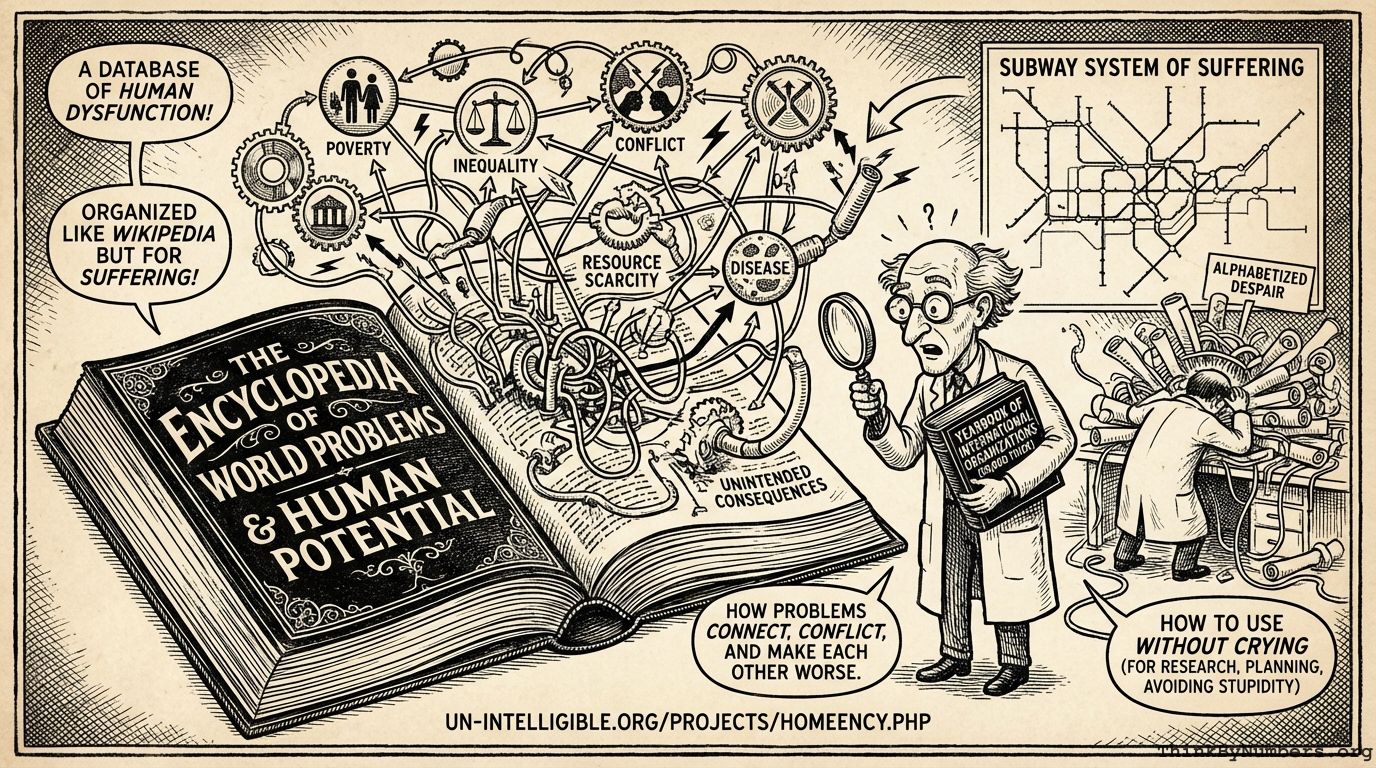
Someone made a list of every problem humanity has. ALL of them. Every single thing that's wrong with the world. Then they cross-referenced how the problems connect, conflict, and make each other worse.
You now have a database of human dysfunction, organized like Wikipedia but for suffering. It's alphabetized despair.
What This Is
The Encyclopedia of World Problems and Human Potential is exactly what it sounds like: an encyclopedia of everything that's wrong. It catalogs problems humanity faces, how they interact, and what might fix them.
It maps the connections between issues like a subway system, except instead of trains it's suffering, and instead of getting you somewhere it shows you how everything is connected to everything else in terrible ways.
The online archive contains hyperlinked datasets showing:
- How problems relate to each other
- The 50,000 international organizations trying to solve them
- Which solutions conflict with other solutions
- Why fixing one problem often creates three new problems
There's also a Yearbook of International Organizations, which is like a phone book for people trying to save the world. It's very thick. Fifty thousand organizations thick. This tells you something about either human compassion or human inefficiency, but scholars disagree on which.
Why This Exists
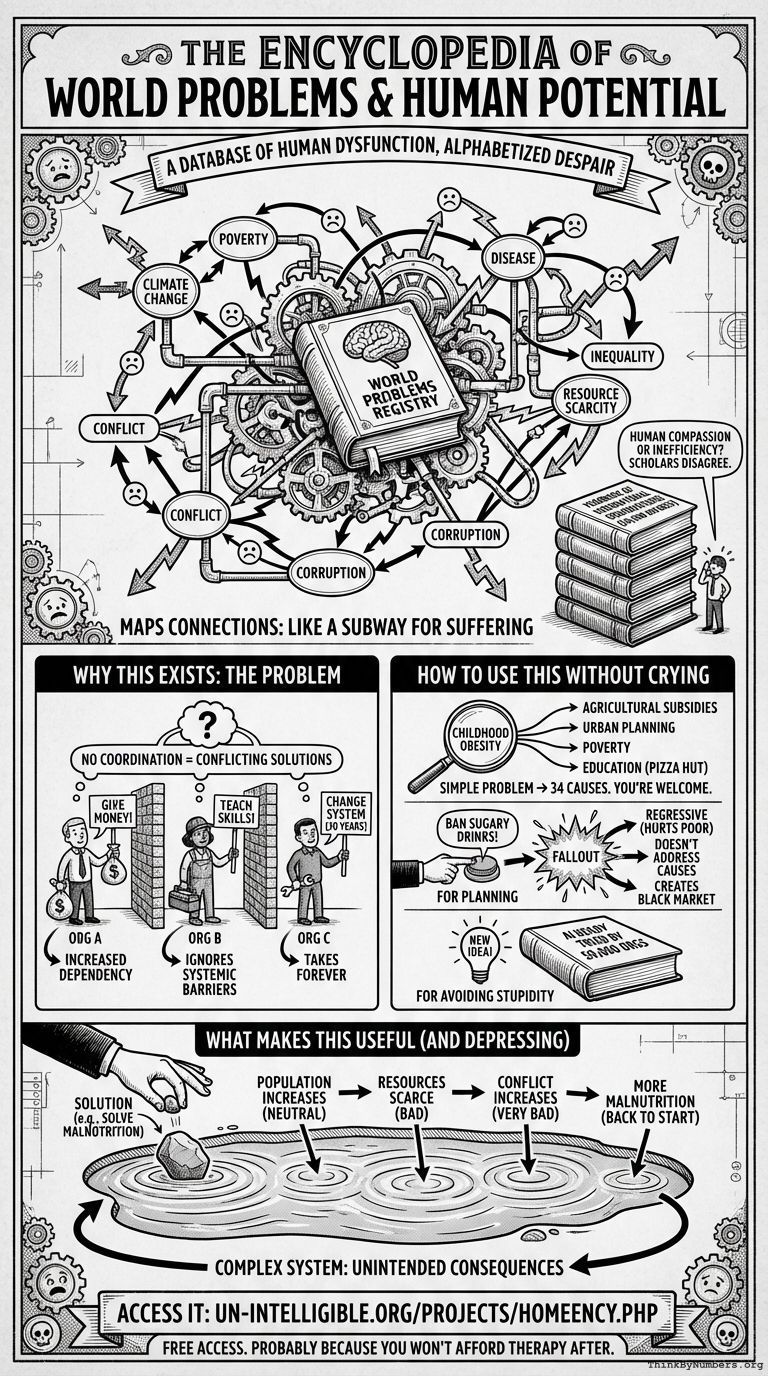
The problem: There are approximately 47 different organizations working on poverty. Each one uses a different definition of poverty. Different methods. Different success metrics. They don't coordinate because they compete for funding.
Some solutions to poverty increase inequality. Some solutions to inequality increase poverty. Nobody maintains a map of which interventions conflict with each other. So you get:
- Organization A: "Give people money!" (increases dependency)
- Organization B: "Teach people skills!" (ignores systemic barriers)
- Organization C: "Change the system!" (takes 30 years)
- Organizations A, B, and C: Do not talk to each other
The solution: Make a comprehensive reference showing how problems interconnect. It's like a map, except instead of roads it's suffering, and instead of destinations it's "things that make other things worse."
When fixing Problem A worsens Problem B, you want to know BEFORE implementing the fix. This seems obvious, but humans rarely do obvious things, which is why this encyclopedia had to be created in the first place.
How to Use This Without Crying
For research: Look up a problem to see what it connects to.
Example: You search "childhood obesity." It links to:
- Agricultural subsidies (corn syrup is cheap)
- Urban planning (no sidewalks = no walking)
- Poverty (healthy food costs more)
- Education (schools serve Pizza Hut)
- About 30 other things you weren't considering
Now your simple problem has 34 causes. You're welcome.
For planning: Check if your brilliant solution creates three new problems.
Example: "Let's ban sugary drinks!" sounds good until you realize:
- It's regressive (hurts poor people more)
- It doesn't address underlying causes (stress, poverty, food deserts)
- It creates a black market (humans are creative)
The database shows you these connections before you become the person who accidentally created a soda black market.
For avoiding stupidity: Before you announce you've solved a complex problem, check if 50,000 organizations already tried your idea.
Spoiler: They did. It didn't work. Or it worked but created different problems. Or it worked in Norway but failed everywhere else. The encyclopedia knows.
What Makes This Useful (And Depressing)
Most problems aren't isolated. They form networks where changes ripple outward like throwing a rock in a pond, except the pond is society and the rock is your solution and the ripples are unintended consequences.
Example:
- You solve malnutrition (good!)
- Population increases (neutral)
- Resources become scarce (bad)
- Conflict increases (very bad)
- More malnutrition (you're back where you started)
This is called a "complex system" and humans are very bad at understanding them, which is why we keep being surprised when our solutions explode.
The encyclopedia maps these systems. You can't solve interconnected problems by pretending they're not connected. This tool shows you the connections so you can feel appropriately overwhelmed.
Access it: un-intelligible.org/projects/homeency.php
It's free. Probably because after reading it, you won't have any money left for therapy.
Comments