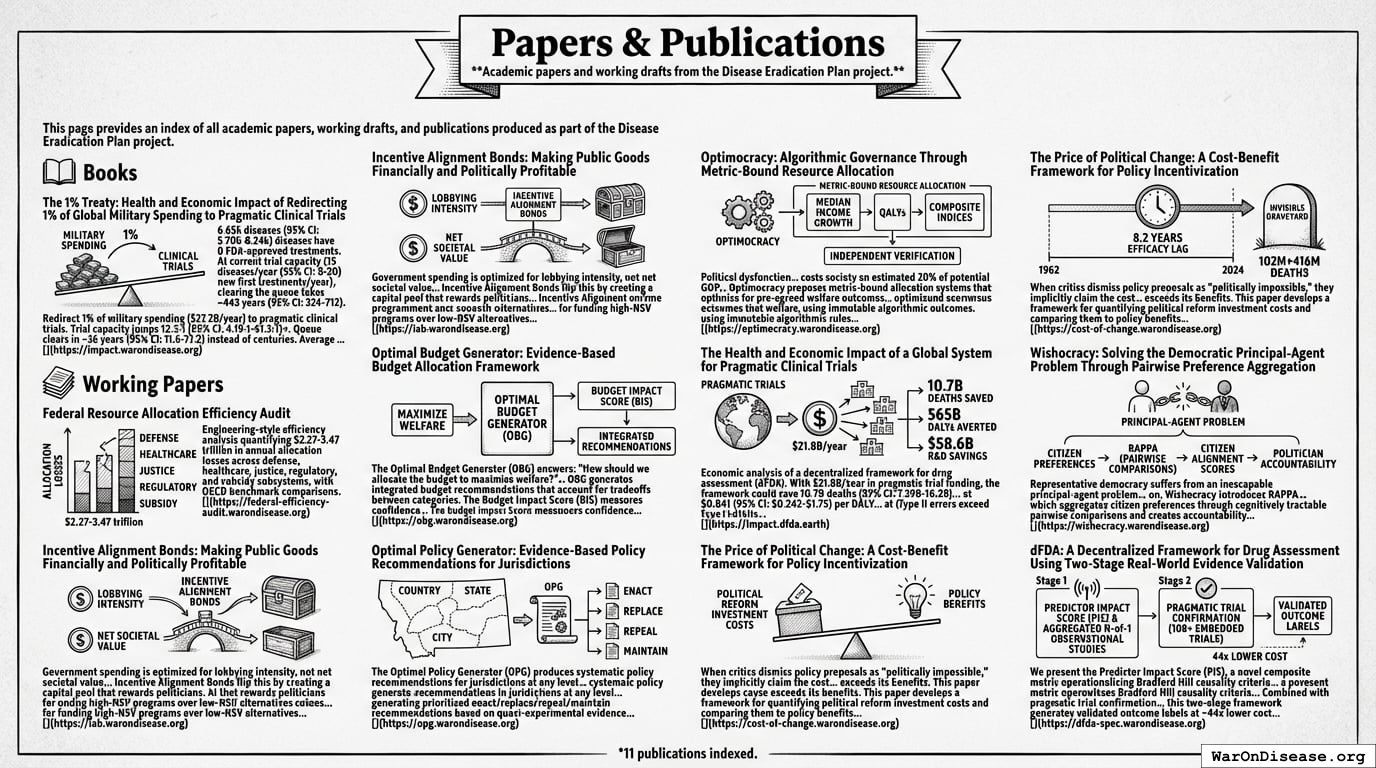
Academic papers and working drafts from the Disease Eradication Plan project.
Academic papers and working drafts from the Disease Eradication Plan project.
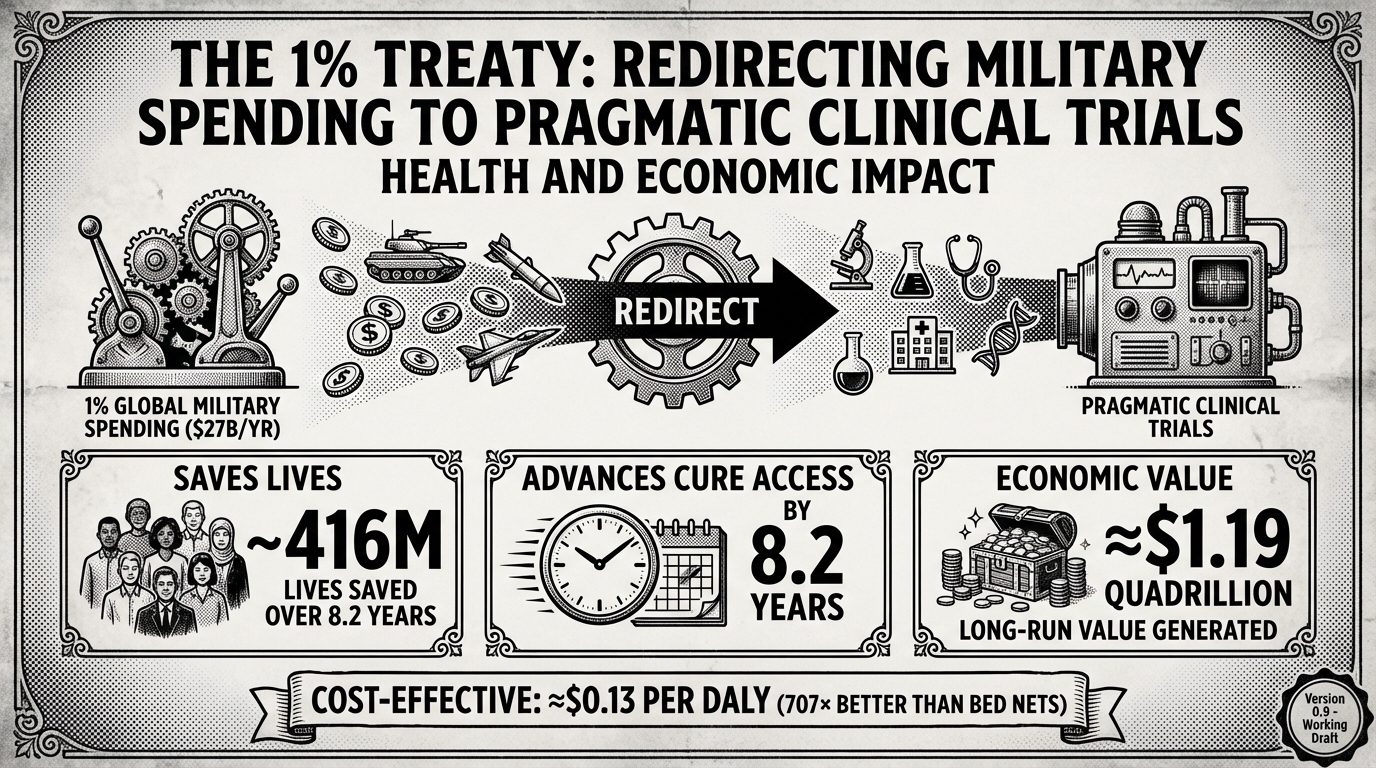
6,650 diseases (90% CI: 5,700 diseases-8,232 diseases) have zero FDA-approved treatments; at current trial capacity, exploring them takes ~443 years (90% CI: 255 years-841 years). Redirecting 1% of military spending scales capacity 12.3x (90% CI: 4.92x-50.8x), cutting the timeline to ~36 years (90% CI: 8.15 years-106 years) and preventing 10.7 billion deaths (90% CI: 6.24 billion deaths-20.3 billion deaths). At $0.00177 (90% CI: $0.000809-$0.00354)/DALY, 50.3kx (90% CI: 25.0kx-111.1kx) more cost-effective than the best existing interventions. The result holds across every specified adoption pathway.
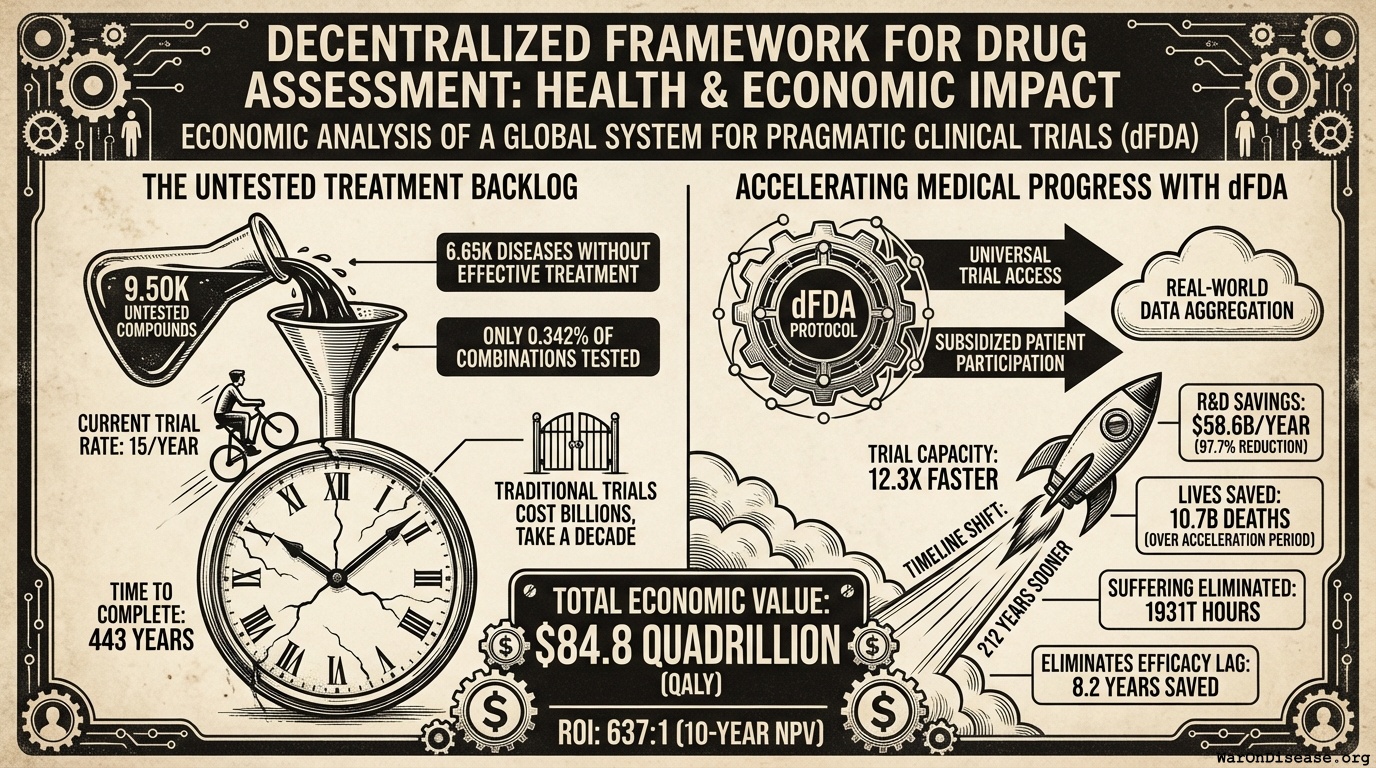
Only 15 diseases/year get their first treatment each year. With 6,650 diseases (90% CI: 5,700 diseases-8,232 diseases) lacking effective treatments, the backlog would take 443 years (90% CI: 255 years-841 years) to clear. Integrating pragmatic trials into standard healthcare increases trial capacity 12.3x (90% CI: 4.92x-50.8x), cutting that timeline from 443 years (90% CI: 255 years-841 years) to 36 years (90% CI: 8.15 years-106 years). The average untreated disease gets a treatment 212 years (90% CI: 124 years-398 years) earlier, saving 10.7 billion deaths (90% CI: 6.24 billion deaths-20.3 billion deaths) at $0.842 (90% CI: $0.264-$1.49) per year of healthy life saved.
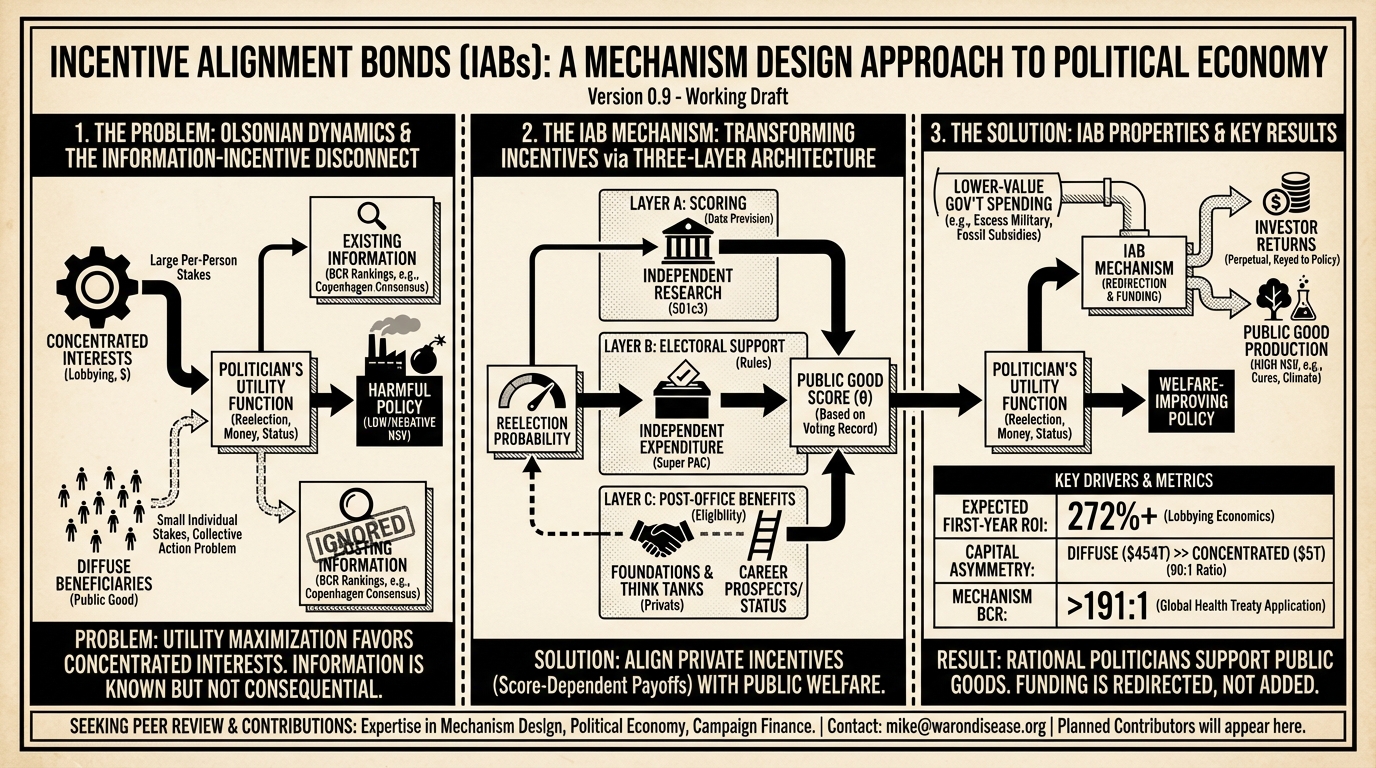
Government spending is optimized for lobbying intensity, not net societal value. Programs with 100:1 benefit-cost ratios get billions while programs with negative returns get hundreds of billions. Incentive Alignment Bonds flip this by creating a capital pool that rewards politicians (via campaign support and post-office opportunities) for funding high-NSV programs over low-NSV alternatives. The result: public good becomes private profit for both investors and elected officials.
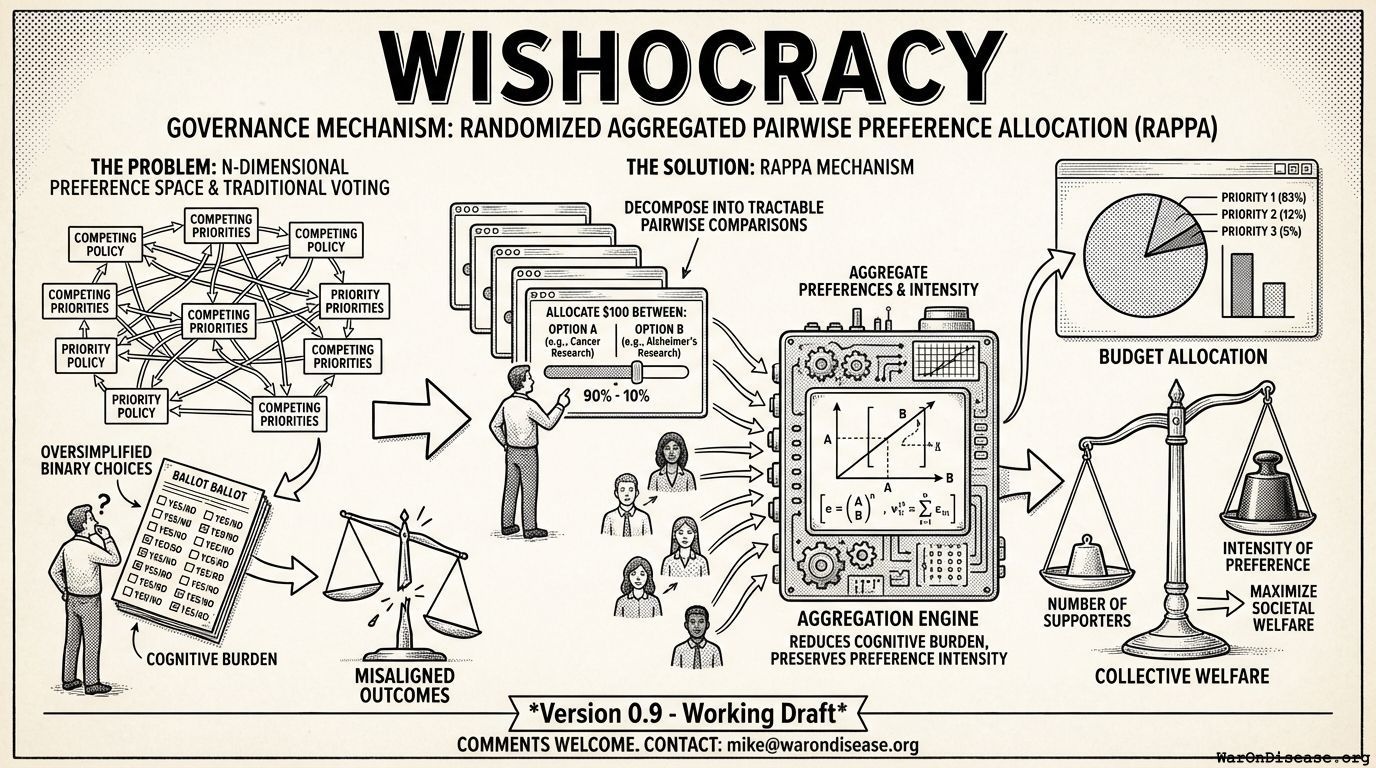
Representative democracy suffers from an inescapable principal-agent problem where elected officials' incentives diverge from citizen welfare. Wishocracy introduces RAPPA (Randomized Aggregated Pairwise Preference Allocation), which aggregates citizen preferences through cognitively tractable pairwise comparisons and creates accountability via Citizen Alignment Scores that channel electoral resources toward politicians who actually represent what citizens want.
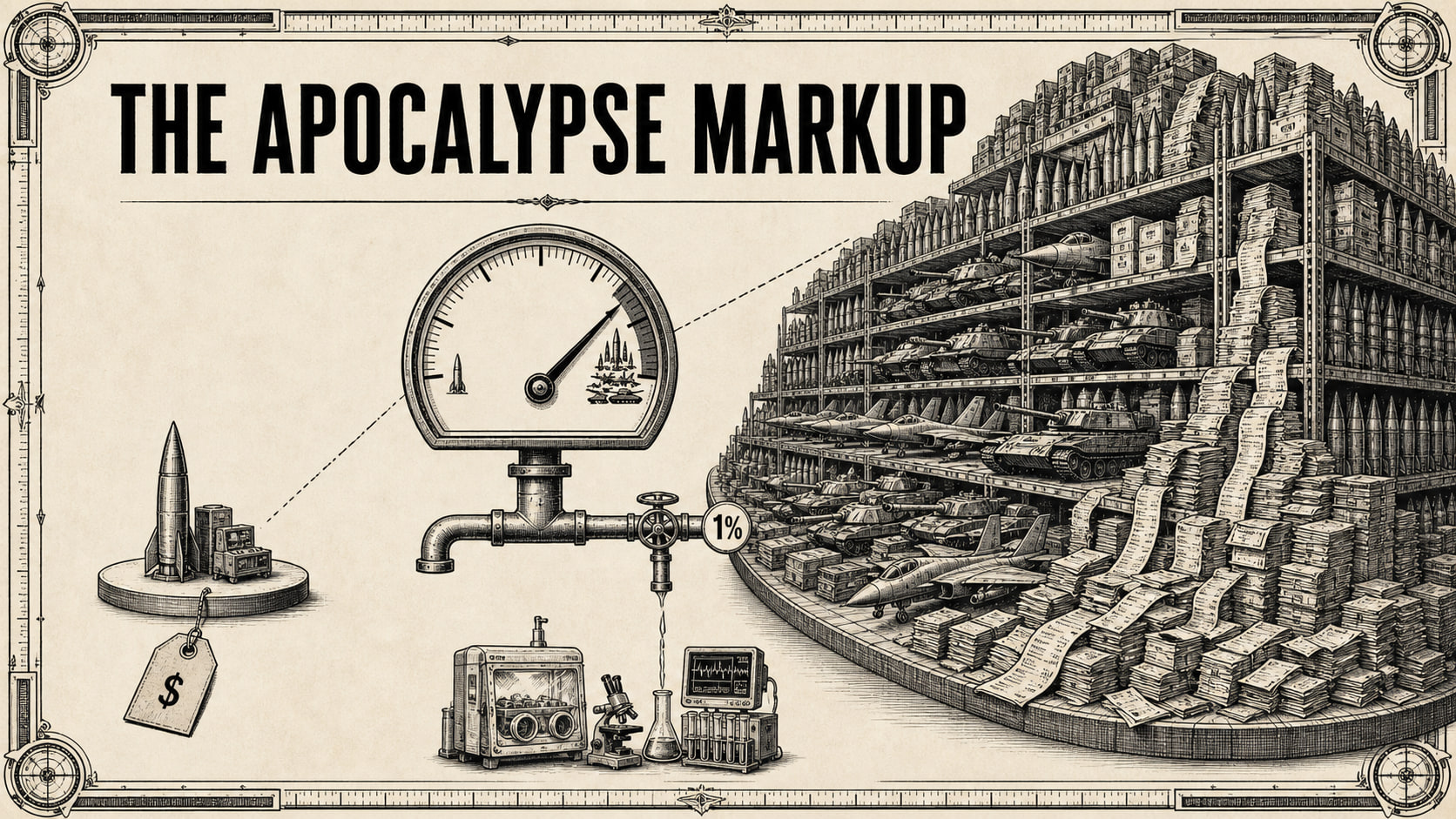
The Price of Apocalypse is $752 million (90% CI: $464 million-$2.16 billion) per year. Your governments spend $2.72 trillion. That is an 3.6kx (90% CI: 1.3kx-5.9kx) markup on the end of civilization.

The US spends $886 billion per year on military hegemony. The only quantifiable benefit is $20-200 billion in dollar privilege. The net is negative $674 billion to $1.38 trillion per year. Switzerland spends $7 billion and has better outcomes by every measure.
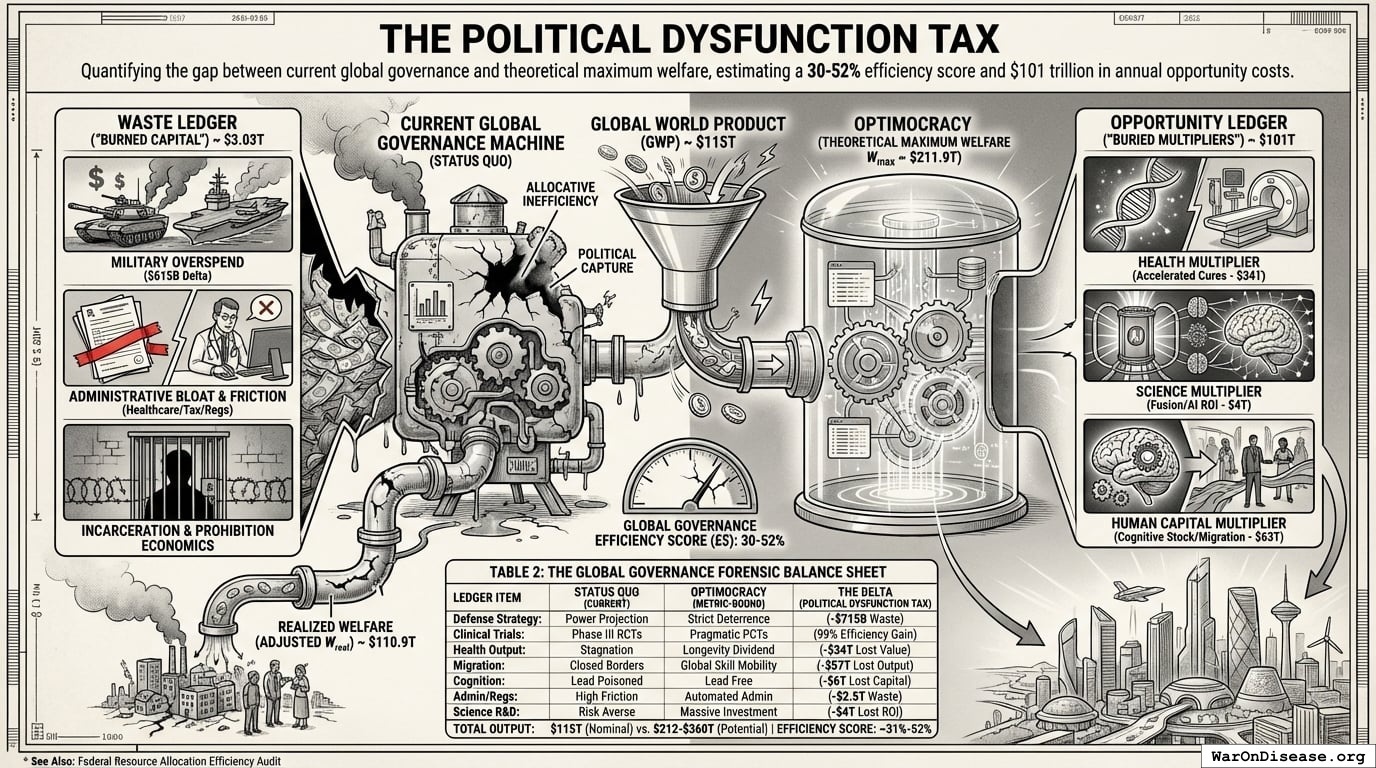
Governance dysfunction imposes large per-person annual costs and suppresses long-run compounding. This paper quantifies the opportunity ledger and efficiency gap with model-linked parameters.
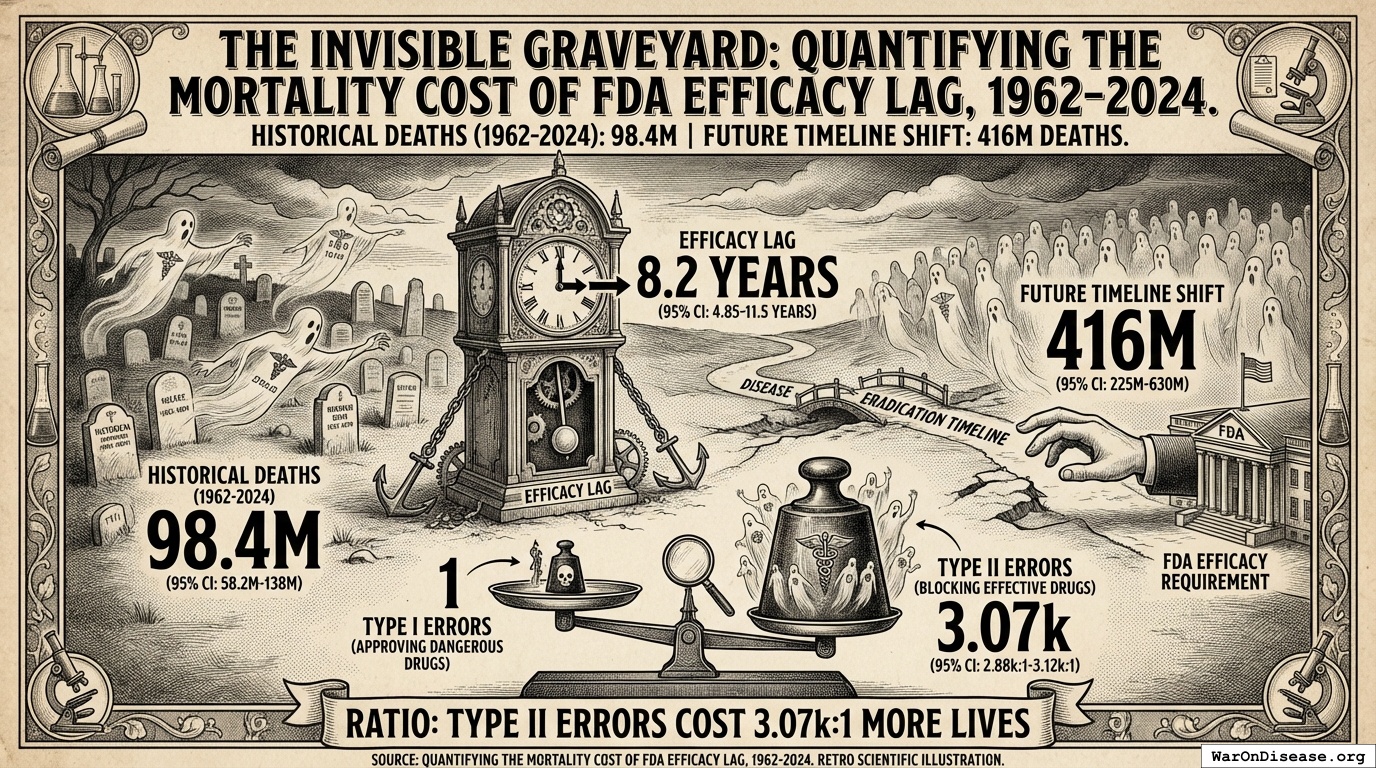
After proving a drug is safe, the FDA requires 8.2 years (90% CI: 4.84 years-11.5 years) to prove it works before patients can access it. We estimate this delay cost 102 million deaths (90% CI: 50.8 million deaths-169 million deaths) among people waiting for approved drugs (1962-2024). The human cost in death and disability of blocking good drugs is 3,389 (90% CI: 1,811-5,734) higher than the cost of approving bad ones.

Three counts of negligent mass homicide against the governments of Earth. The body count, the bill, and the only remedy that works on actual humans.