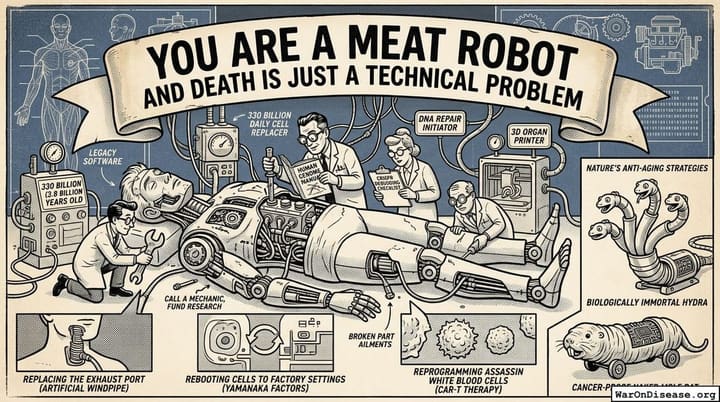
You replace 330 billion cells daily, 3D-print windpipes, and reprogram skin into brain cells. Your body is a machine. Death is a maintenance failure. You've been writing poetry about it when you should have built a wrench.
You replace 330 billion cells daily, 3D-print windpipes, and reprogram skin into brain cells. Your body is a machine. Death is a maintenance failure. You've been writing poetry about it when you should have built a wrench.
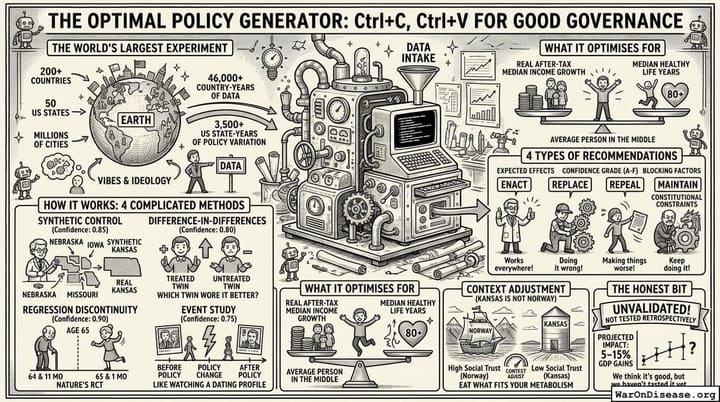
46,000+ country-years of policy data. 3,500+ US state-years. Centuries of natural experiments we've never analysed. The OPG just asks: what worked? Then suggests doing that.
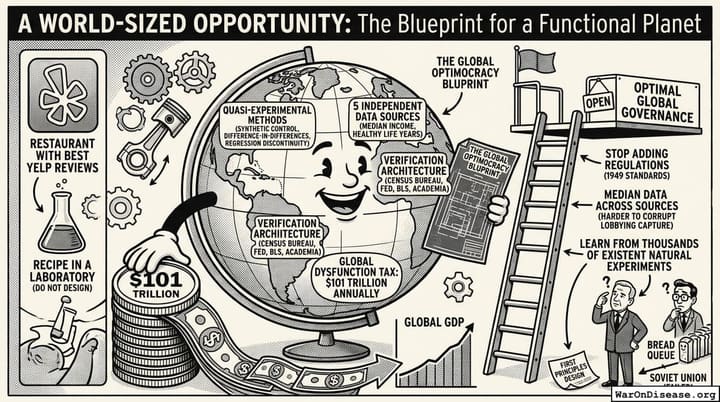
The US spends 3% more of GDP on government than Switzerland yet lives 6.5 fewer years. What if we just... looked at what works elsewhere and did that? Causal inference says yes.
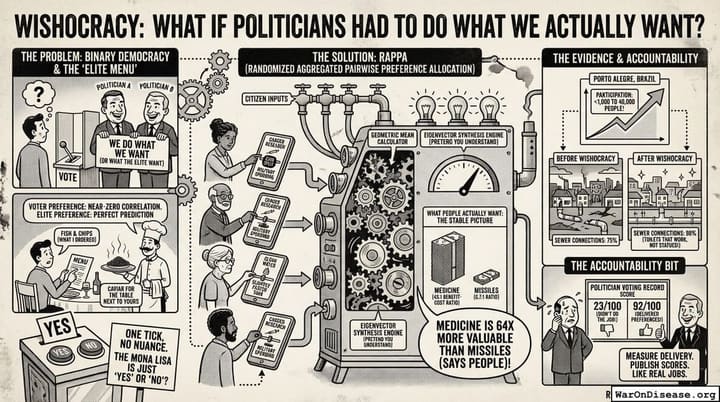
Voter preferences have near-zero effect on policy. Citizens want 45:1 medical research vs military spending, but get the reverse. RAPPA fixes this with a slider and a dream.
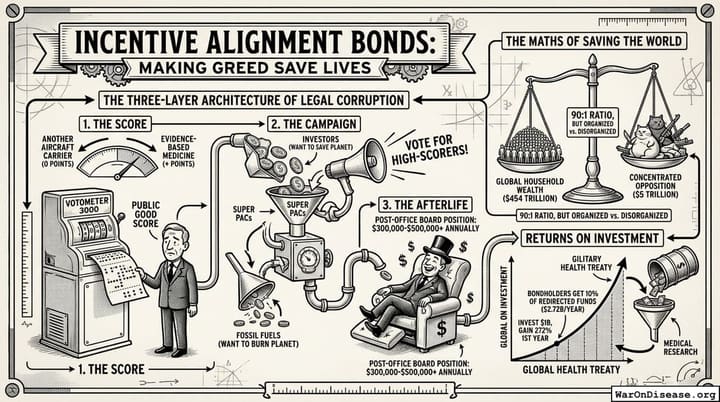
What if saving millions of lives was a good investment? IABs pay 272% ROI to investors who bribe politicians into doing their jobs. Global household wealth is $454T. Opposition is $5T. Do the maths.
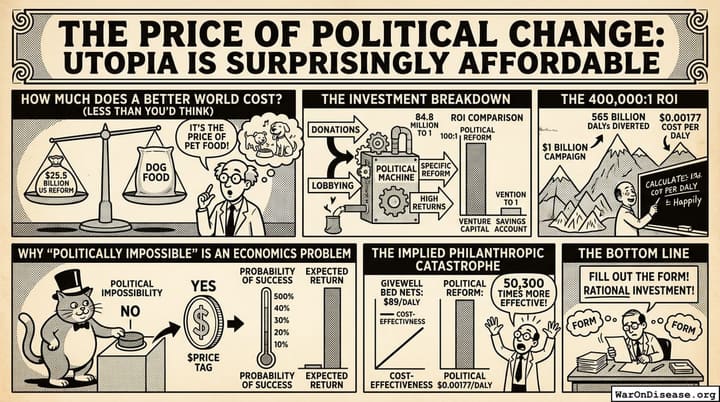
The maximum cost to reform all US policy is $25.5 billion. The return is $84.8 quadrillion. That's an 84.8 million:1 ROI. The real question isn't can we afford it, but why haven't we bought it.
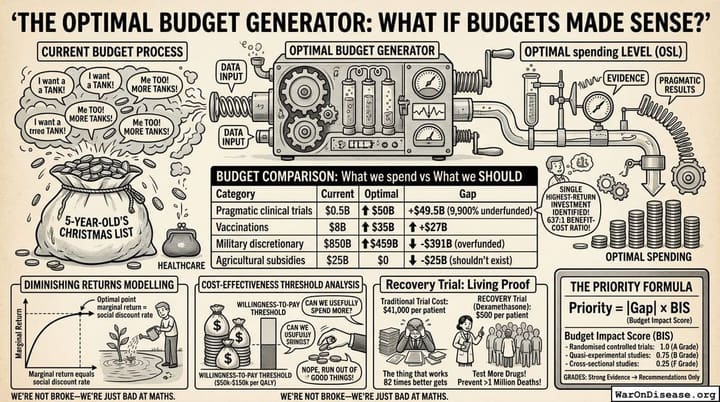
Pragmatic clinical trials: current $0.5B, optimal $50B (9,900% underinvestment). Military: current $850B, optimal $459B. Agricultural subsidies: optimal $0. This spreadsheet is devastating.
Cybercrime costs $10.5 trillion annually—larger than every economy except the US and China. AI will scale this parasitic drain exponentially, creating an "inverse singularity" where evil profit margins attract the smartest minds, while governments waste money on tanks instead of cybersecurity.
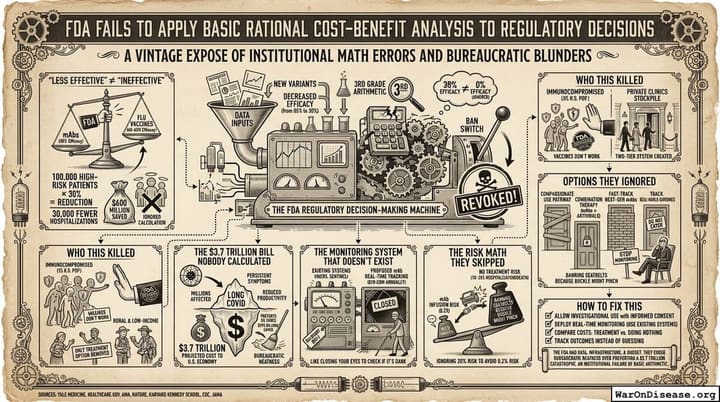
FDA banned monoclonal antibodies despite 30% efficacy. They ignored $3.7T Long COVID cost, risked $600M in preventable hospitalizations.
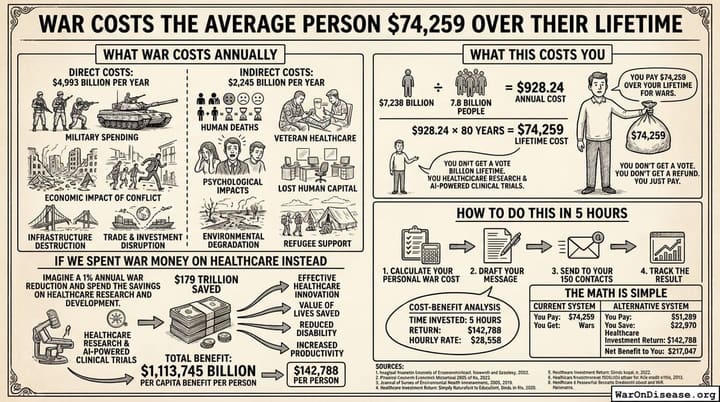
War costs you $74,259 in lifetime taxes. That's a car's worth of money spent on bombs instead of things that don't explode people.